Exam-Style Problems
⬅ Back to SubchapterNov 2006 p1 q2
591
Given that \(x = \sin^{-1}\left(\frac{2}{5}\right)\), find the exact value of
(i) \(\cos^2 x\),
(ii) \(\tan^2 x\).

Nov 2004 p1 q6
592
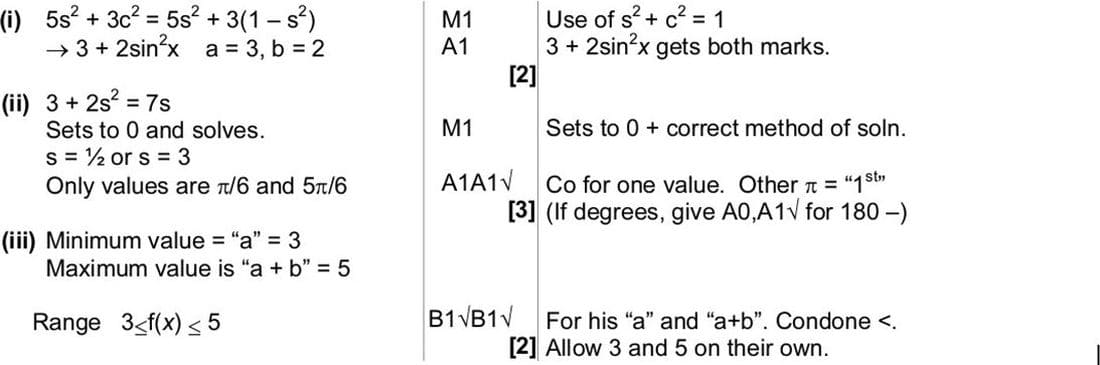
The function \(f : x \mapsto 5 \sin^2 x + 3 \cos^2 x\) is defined for the domain \(0 \leq x \leq \pi\).
- Express \(f(x)\) in the form \(a + b \sin^2 x\), stating the values of \(a\) and \(b\).
- Hence find the values of \(x\) for which \(f(x) = 7 \sin x\).
- State the range of \(f\).
Feb/Mar 2020 p12 q11
593
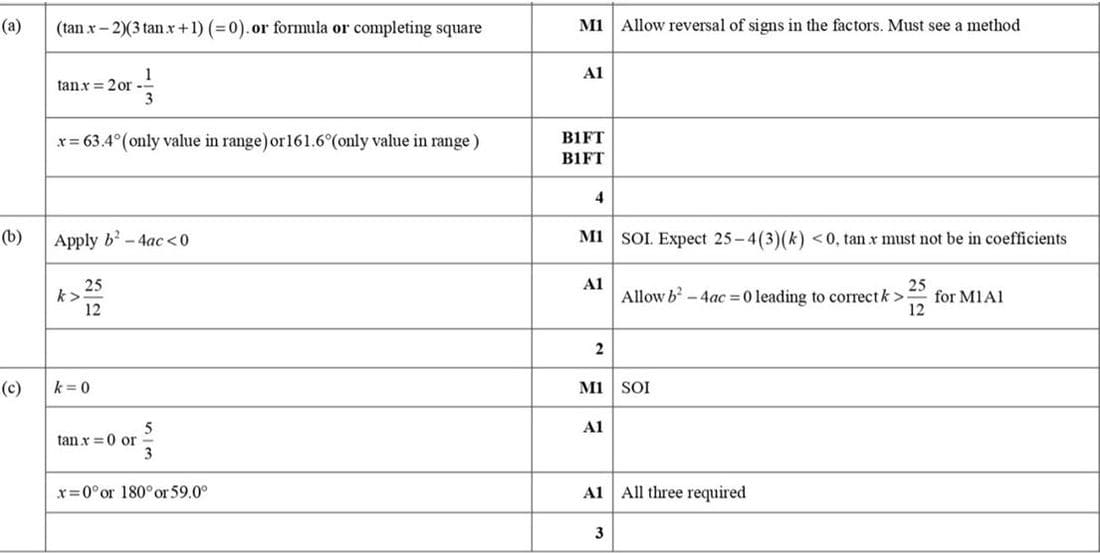
(a) Solve the equation \(3 \tan^2 x - 5 \tan x - 2 = 0\) for \(0^\circ \leq x \leq 180^\circ\).
(b) Find the set of values of \(k\) for which the equation \(3 \tan^2 x - 5 \tan x + k = 0\) has no solutions.
(c) For the equation \(3 \tan^2 x - 5 \tan x + k = 0\), state the value of \(k\) for which there are three solutions in the interval \(0^\circ \leq x \leq 180^\circ\), and find these solutions.
Nov 2019 p12 q6
594
The function \(f : x \mapsto 3 \cos^2 x - 2 \sin^2 x\) is defined for \(0 \leq x \leq \pi\).
(i) Express \(f(x)\) in the form \(a \cos^2 x + b\), where \(a\) and \(b\) are constants.
(ii) Find the range of \(f\).

June 2019 p13 q9
595
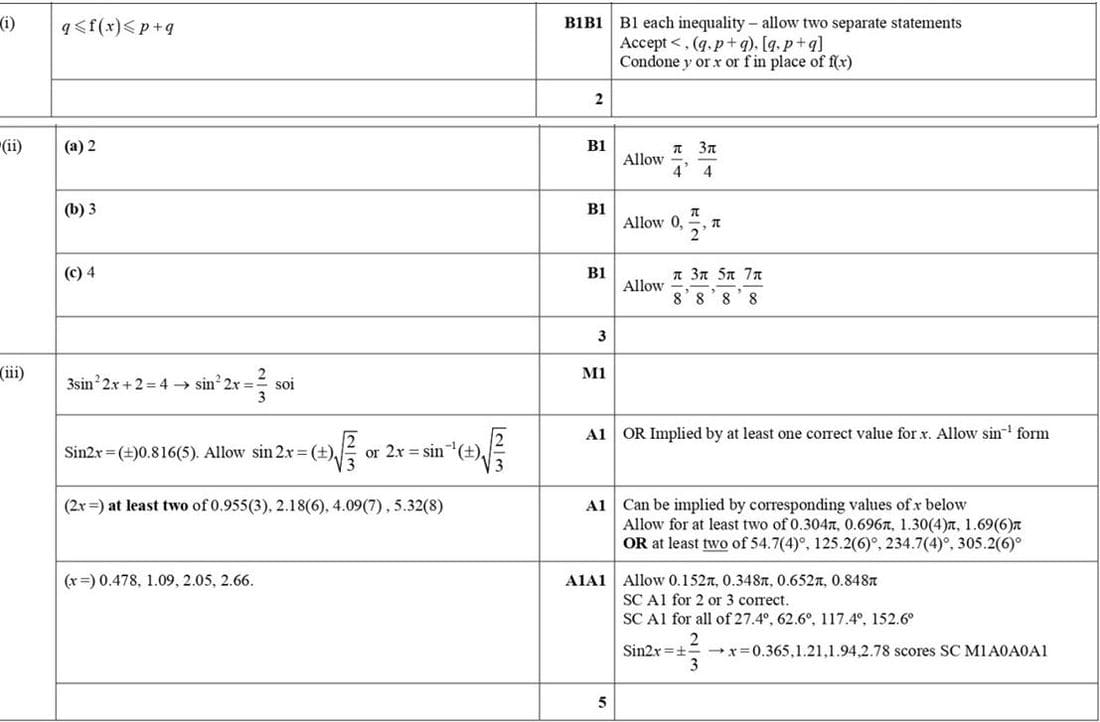
The function \(f : x \mapsto p \sin^2 2x + q\) is defined for \(0 \leq x \leq \pi\), where \(p\) and \(q\) are positive constants. The diagram shows the graph of \(y = f(x)\).
(i) In terms of \(p\) and \(q\), state the range of \(f\).
(ii) State the number of solutions of the following equations.
(a) \(f(x) = p + q\)
(b) \(f(x) = q\)
(c) \(f(x) = \frac{1}{2}p + q\)
(iii) For the case where \(p = 3\) and \(q = 2\), solve the equation \(f(x) = 4\), showing all necessary working.