Exam-Style Problems
⬅ Back to SubchapterNov 2015 p12 q1
Functions f and g are defined by
\(f : x \mapsto 3x + 2, \quad x \in \mathbb{R}\)
\(g : x \mapsto 4x - 12, \quad x \in \mathbb{R}\)
Solve the equation \(f^{-1}(x) = gf(x)\).

June 2014 p12 q10
Functions f and g are defined by
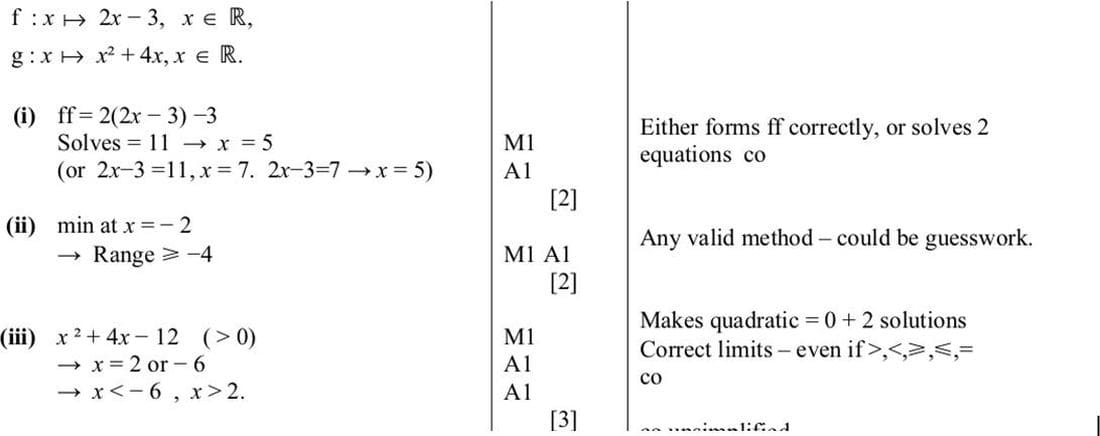
\(f: x \mapsto 2x - 3, \; x \in \mathbb{R},\)
\(g: x \mapsto x^2 + 4x, \; x \in \mathbb{R}.\)
- Solve the equation \(ff(x) = 11.\)
- Find the range of \(g.\)
- Find the set of values of \(x\) for which \(g(x) > 12.\)
Nov 2013 p11 q5
The function f is defined by
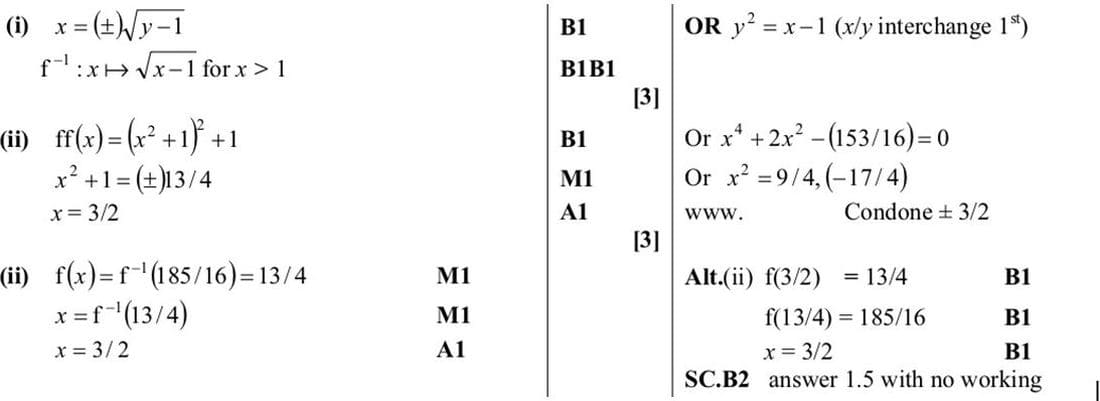
\(f : x \mapsto x^2 + 1\) for \(x \geq 0\).
(i) Define in a similar way the inverse function \(f^{-1}\).
(ii) Solve the equation \(ff(x) = \frac{185}{16}\).
Nov 2011 p13 q9
Functions f and g are defined by
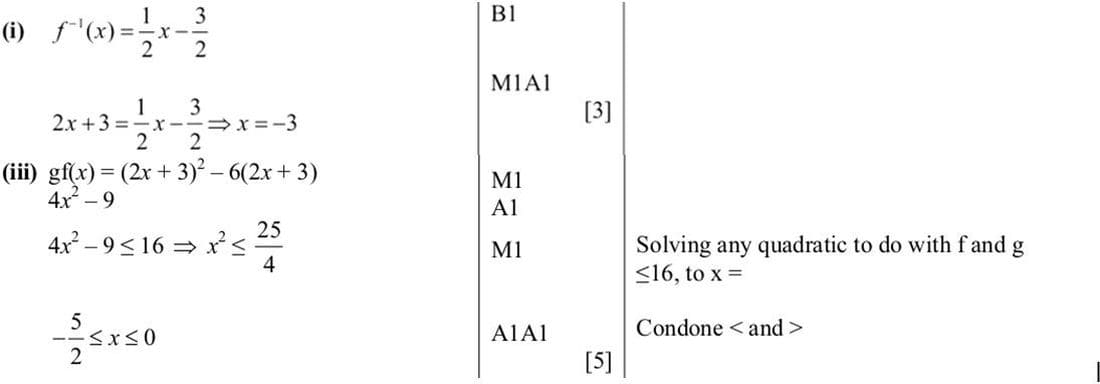
\(f : x \mapsto 2x + 3\) for \(x \leq 0\),
\(g : x \mapsto x^2 - 6x\) for \(x \leq 3\).
(i) Express \(f^{-1}(x)\) in terms of \(x\) and solve the equation \(f(x) = f^{-1}(x)\).
(iii) Find the set of values of \(x\) which satisfy \(gf(x) \leq 16\).
Nov 2011 p12 q2
The functions f and g are defined for \(x \in \mathbb{R}\) by
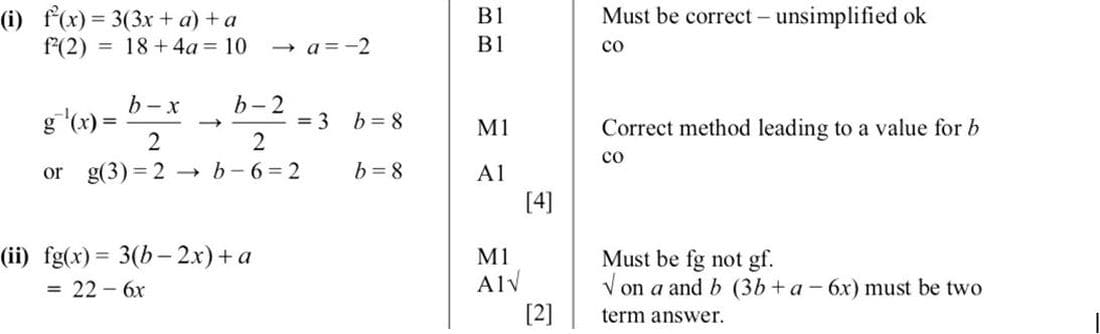
\(f : x \mapsto 3x + a,\)
\(g : x \mapsto b - 2x,\)
where \(a\) and \(b\) are constants. Given that \(ff(2) = 10\) and \(g^{-1}(2) = 3\), find
- the values of \(a\) and \(b\),
- an expression for \(fg(x)\).