Exam-Style Problems
⬅ Back to SubchapterNov 2017 p43 q2
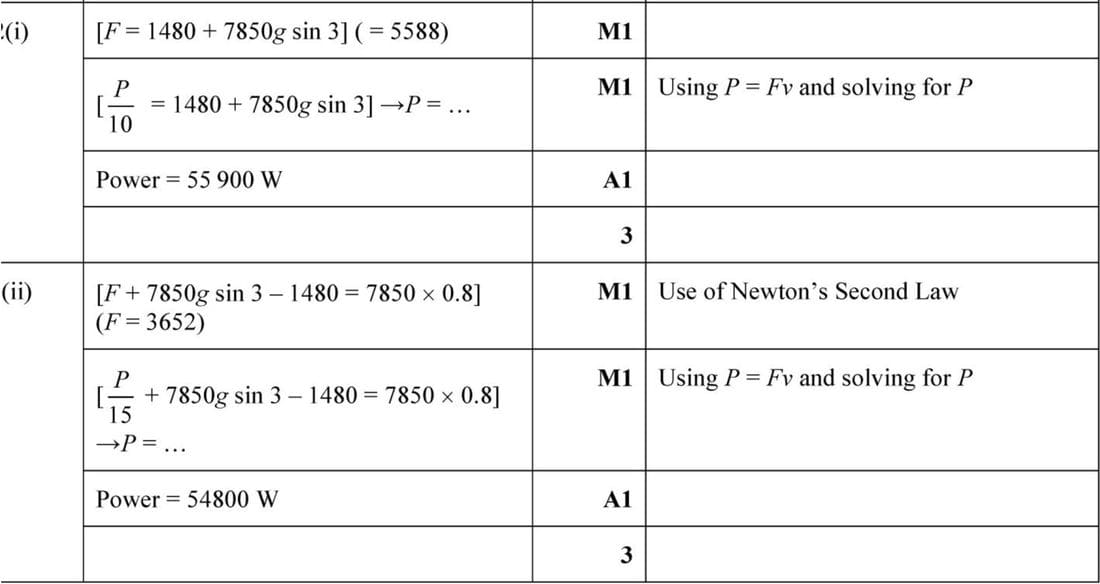
A lorry of mass 7850 kg travels on a straight hill which is inclined at an angle of 3° to the horizontal. There is a constant resistance to motion of 1480 N.
(i) Find the power of the lorry’s engine when the lorry is going up the hill at a constant speed of 10 m s-1.
(ii) Find the power of the lorry’s engine at an instant when the lorry is going down the hill at a speed of 15 m s-1 with an acceleration of 0.8 m s-2.
Nov 2017 p42 q5
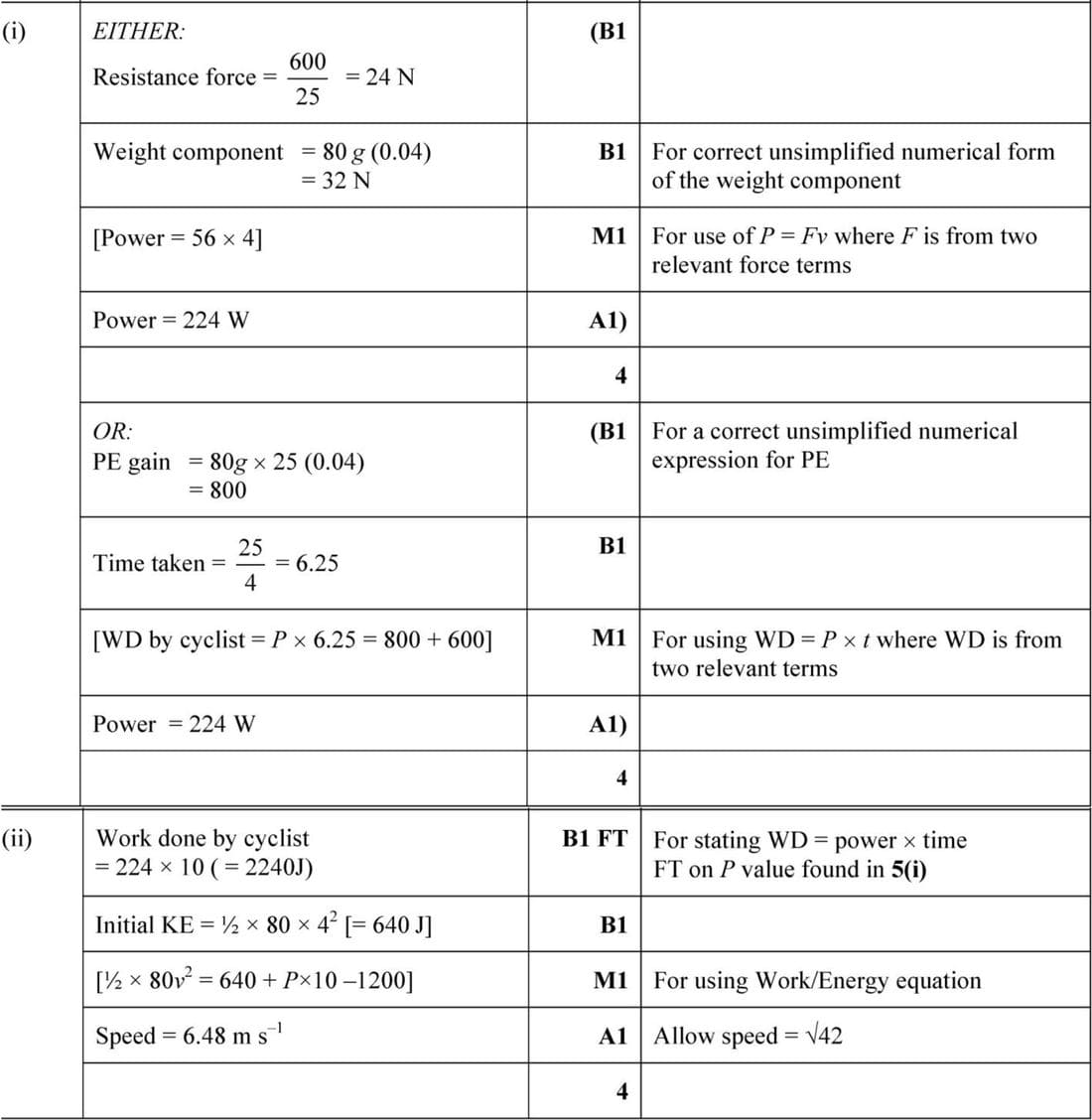
A cyclist is riding up a straight hill inclined at an angle \(\alpha\) to the horizontal, where \(\sin \alpha = 0.04\). The total mass of the bicycle and rider is 80 kg. The cyclist is riding at a constant speed of 4 m s\(^{-1}\). There is a force resisting the motion. The work done by the cyclist against this resistance force over a distance of 25 m is 600 J.
(i) Find the power output of the cyclist.
The cyclist reaches the top of the hill, where the road becomes horizontal, with speed 4 m s\(^{-1}\). The cyclist continues to work at the same rate on the horizontal part of the road.
(ii) Find the speed of the cyclist 10 seconds after reaching the top of the hill, given that the work done by the cyclist during this period against the resistance force is 1200 J.
Nov 2017 p41 q2
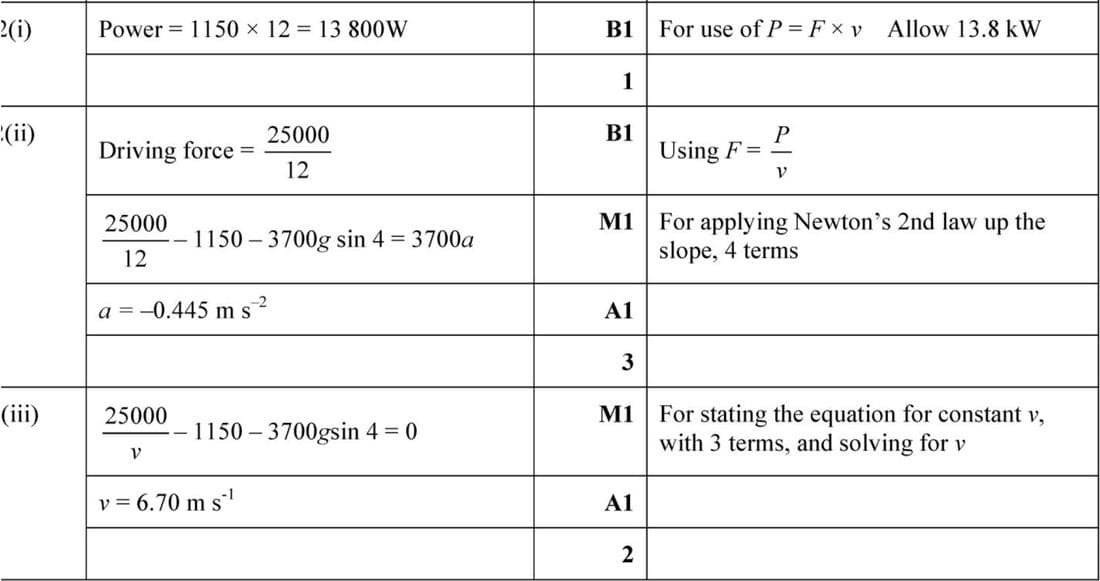
A tractor of mass 3700 kg is travelling along a straight horizontal road at a constant speed of 12 m s-1. The total resistance to motion is 1150 N.
- Find the power output of the tractor’s engine.
The tractor comes to a hill inclined at 4° above the horizontal. The power output is increased to 25 kW and the resistance to motion is unchanged.
- Find the deceleration of the tractor at the instant it begins to climb the hill.
- Find the constant speed that the tractor could maintain on the hill when working at this power.
June 2017 p43 q6
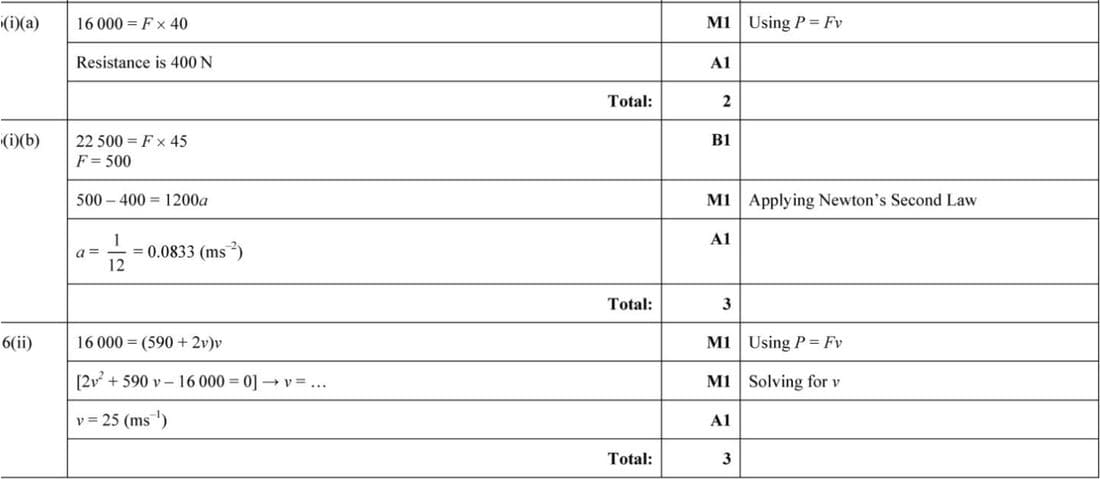
A car of mass 1200 kg is travelling along a horizontal road.
(i) It is given that there is a constant resistance to motion.
(a) The engine of the car is working at 16 kW while the car is travelling at a constant speed of 40 m s-1. Find the resistance to motion.
(b) The power is now increased to 22.5 kW. Find the acceleration of the car at the instant it is travelling at a speed of 45 m s-1.
(ii) It is given instead that the resistance to motion of the car is (590 + 2v) N when the speed of the car is v m s-1. The car travels at a constant speed with the engine working at 16 kW. Find this speed.
June 2017 p42 q4
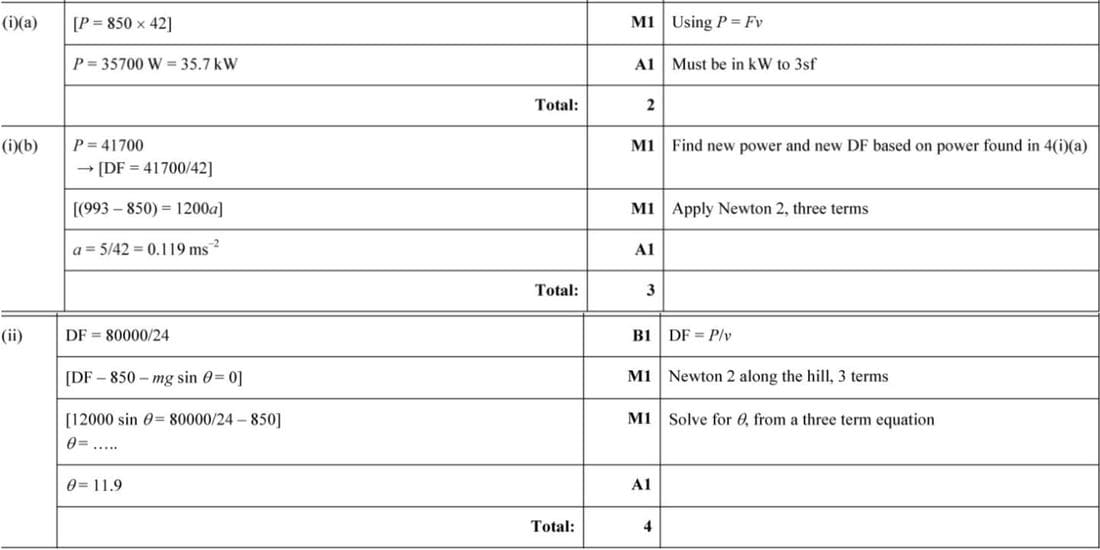
A car of mass 1200 kg is moving on a straight road against a constant force of 850 N resisting the motion.
(i) On a part of the road that is horizontal, the car moves with a constant speed of 42 m s-1.
(a) Calculate, in kW, the power developed by the engine of the car. [2]
(b) Given that this power is suddenly increased by 6 kW, find the instantaneous acceleration of the car. [3]
(ii) On a part of the road that is inclined at θ° to the horizontal, the car moves up the hill at a constant speed of 24 m s-1, with the engine working at 80 kW. Find θ. [4]