Exam-Style Problems
⬅ Back to SubchapterJune 2019 p43 q5
3518
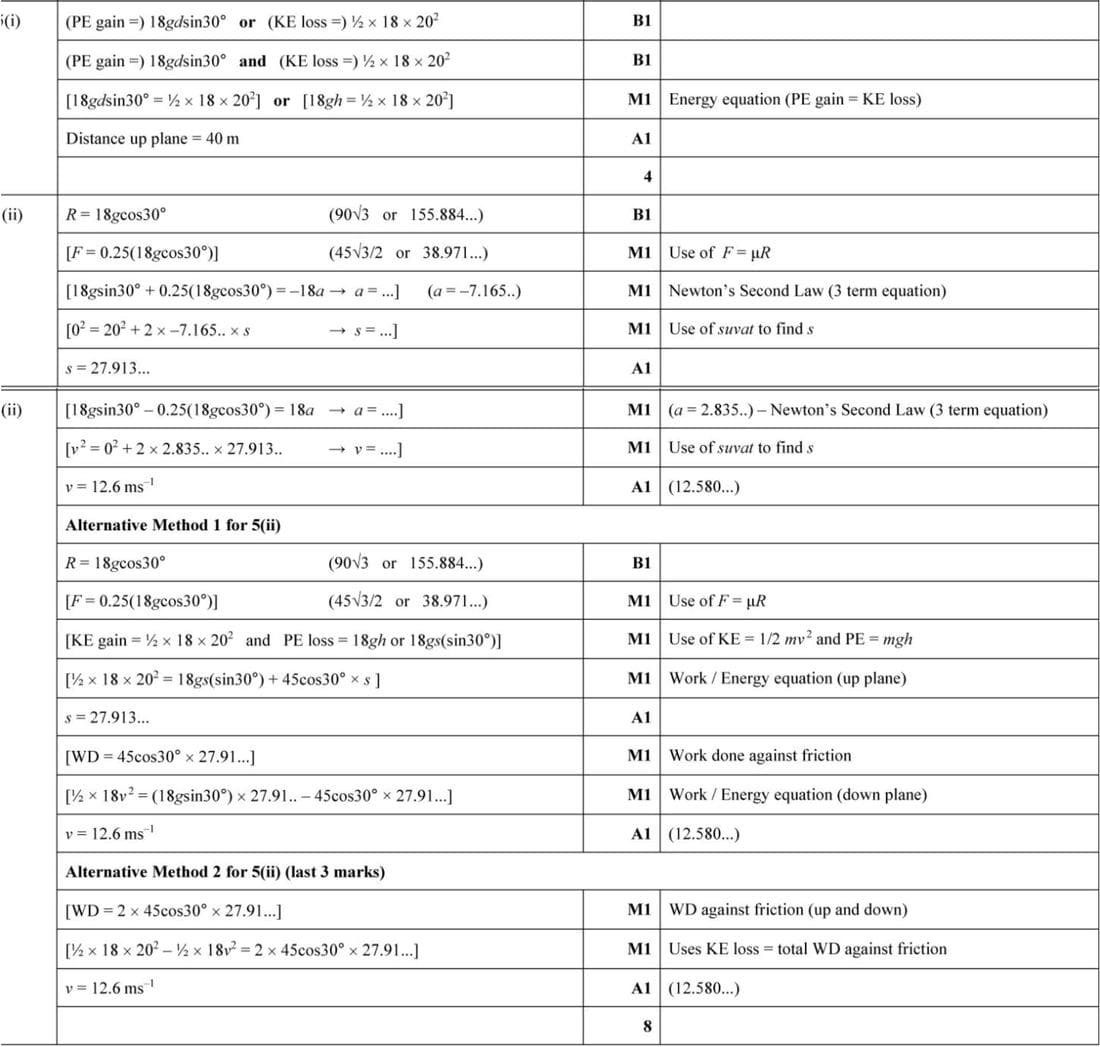
A particle of mass 18 kg is on a plane inclined at an angle of 30° to the horizontal. The particle is projected up a line of greatest slope of the plane with a speed of 20 m/s-1.
- Given that the plane is smooth, use an energy method to find the distance the particle moves up the plane before coming to instantaneous rest.
- Given instead that the plane is rough and the coefficient of friction between the particle and the plane is 0.25, find the speed of the particle as it returns to its starting point.
June 2019 p41 q6
3519
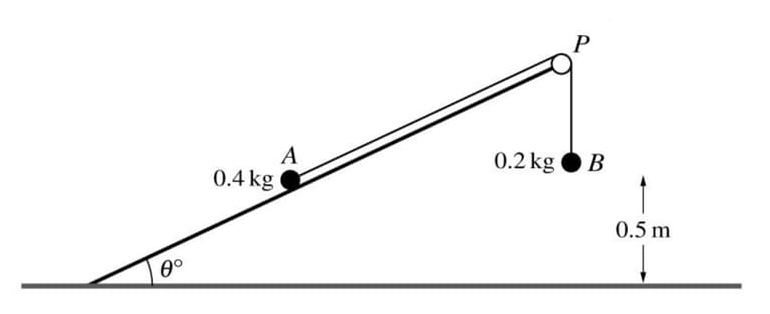
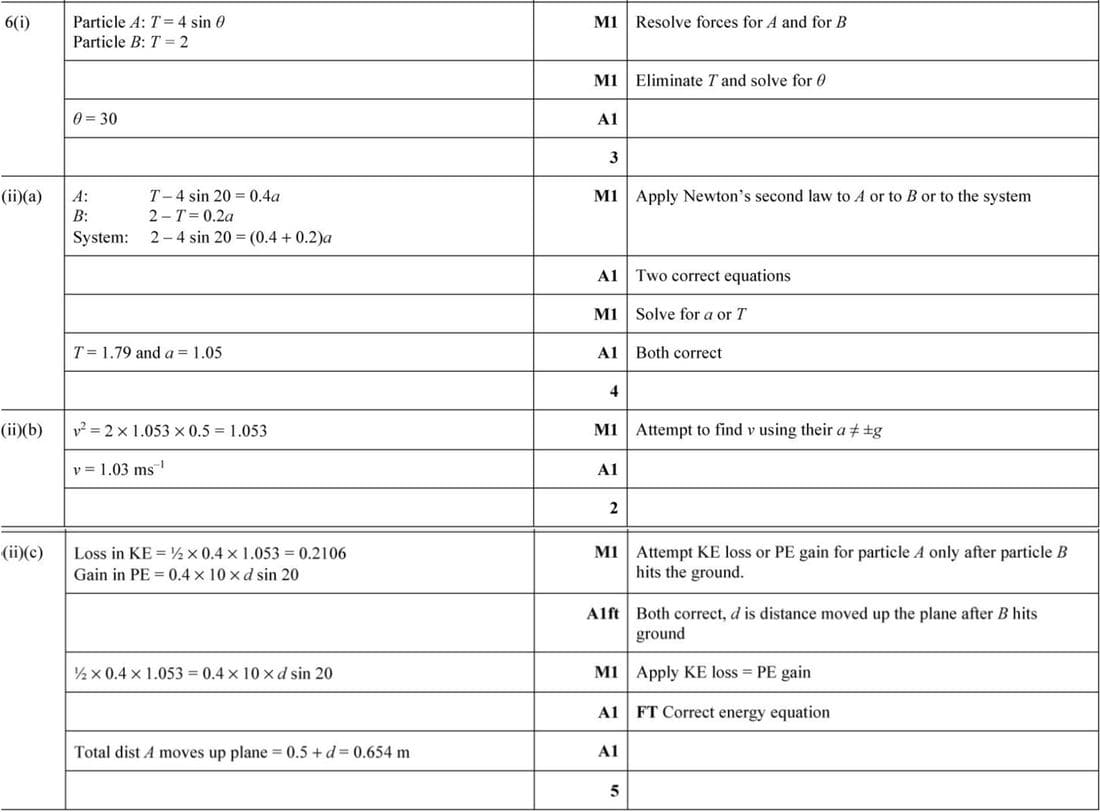
Two particles A and B, of masses 0.4 kg and 0.2 kg respectively, are connected by a light inextensible string. Particle A is held on a smooth plane inclined at an angle of \(\theta^\circ\) to the horizontal. The string passes over a small smooth pulley P fixed at the top of the plane, and B hangs freely 0.5 m above horizontal ground (see diagram). The particles are released from rest with both sections of the string taut.
- Given that the system is in equilibrium, find \(\theta\).
- It is given instead that \(\theta = 20\). In the subsequent motion particle A does not reach P and B remains at rest after reaching the ground.
- Find the tension in the string and the acceleration of the system.
- Find the speed of A at the instant B reaches the ground.
- Use an energy method to find the total distance A moves up the plane before coming to instantaneous rest.
Feb/Mar 2019 p42 q7
3520
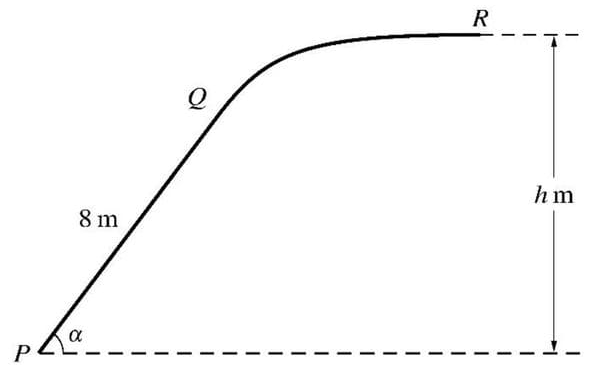
The diagram shows the vertical cross-section PQR of a slide. The part PQ is a straight line of length 8 m inclined at angle \(\alpha\) to the horizontal, where \(\sin \alpha = 0.8\). The straight part PQ is tangential to the curved part QR, and R is h m above the level of P. The straight part PQ of the slide is rough and the curved part QR is smooth. A particle of mass 0.25 kg is projected with speed 15 m s-1 from P towards Q and comes to rest at R. The coefficient of friction between the particle and PQ is 0.5.
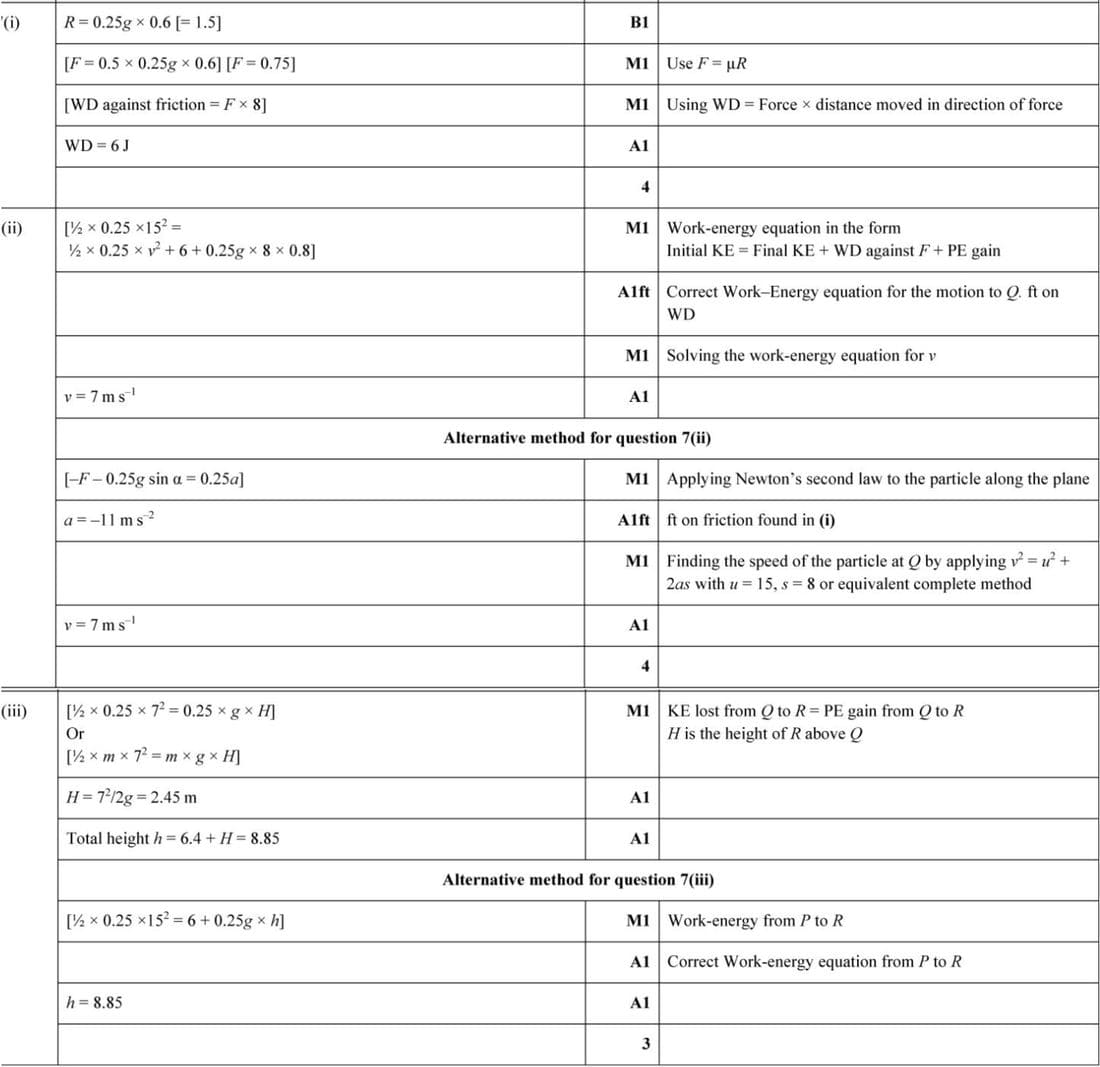
- Find the work done by the friction force during the motion of the particle from P to Q. [4]
- Hence find the speed of the particle at Q. [4]
- Find the value of h. [3]
Nov 2018 p42 q7
3521
A particle of mass 0.3 kg is released from rest above a tank containing water. The particle falls vertically, taking 0.8 s to reach the water surface. There is no instantaneous change of speed when the particle enters the water. The depth of water in the tank is 1.25 m. The water exerts a force on the particle resisting its motion. The work done against this resistance force from the instant that the particle enters the water until it reaches the bottom of the tank is 1.2 J.
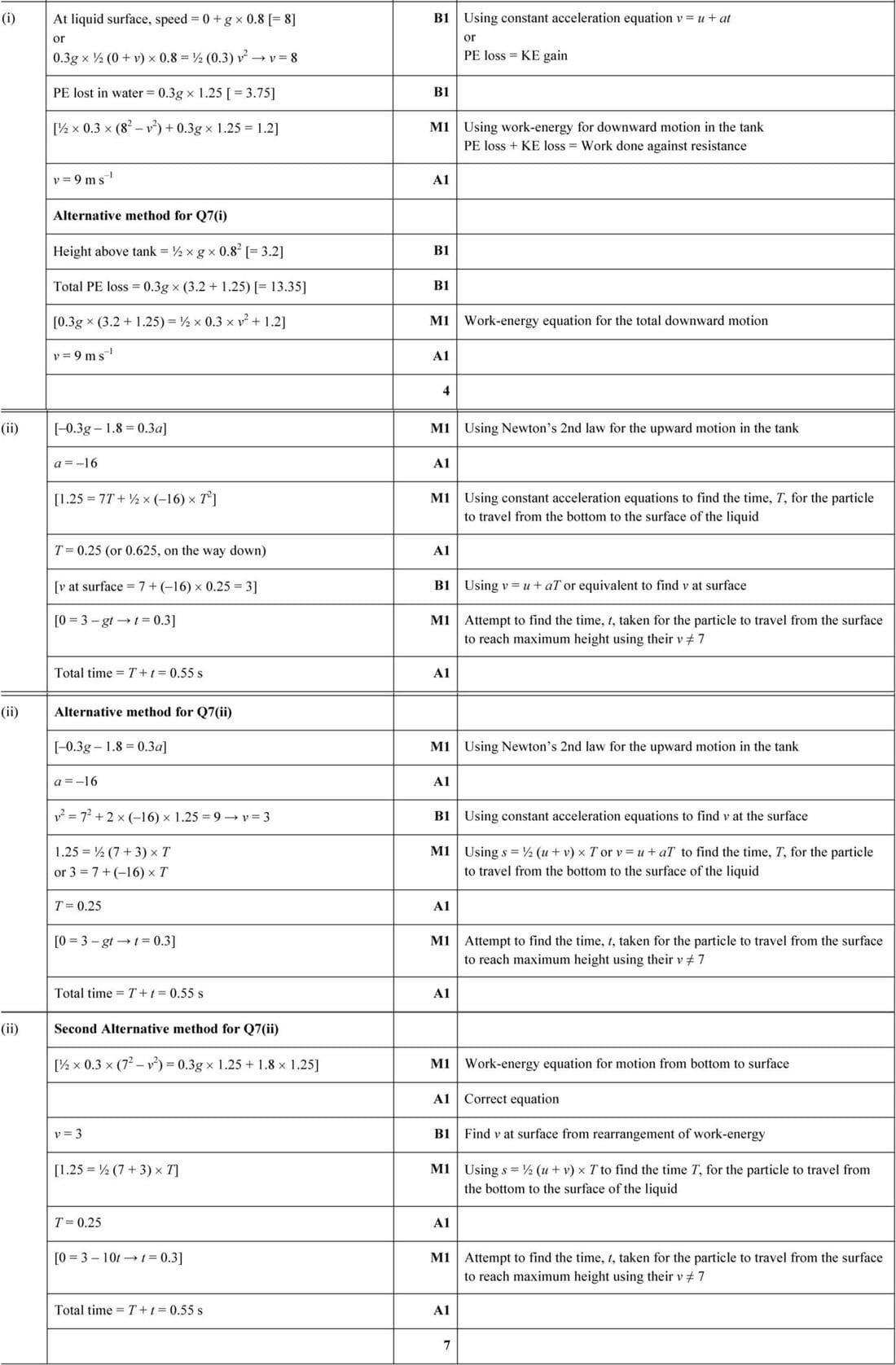
(i) Use an energy method to find the speed of the particle when it reaches the bottom of the tank. [4]
When the particle reaches the bottom of the tank, it bounces back vertically upwards with initial speed 7 m s−1. As the particle rises through the water, it experiences a constant resistance force of 1.8 N. The particle comes to instantaneous rest t seconds after it bounces on the bottom of the tank.
(ii) Find the value of t. [7]
June 2018 p43 q4
3522
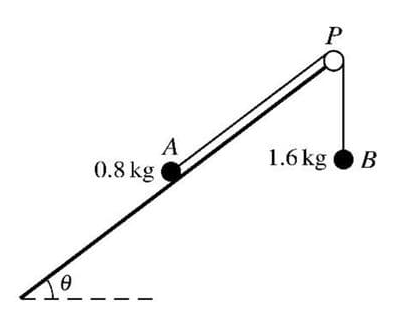
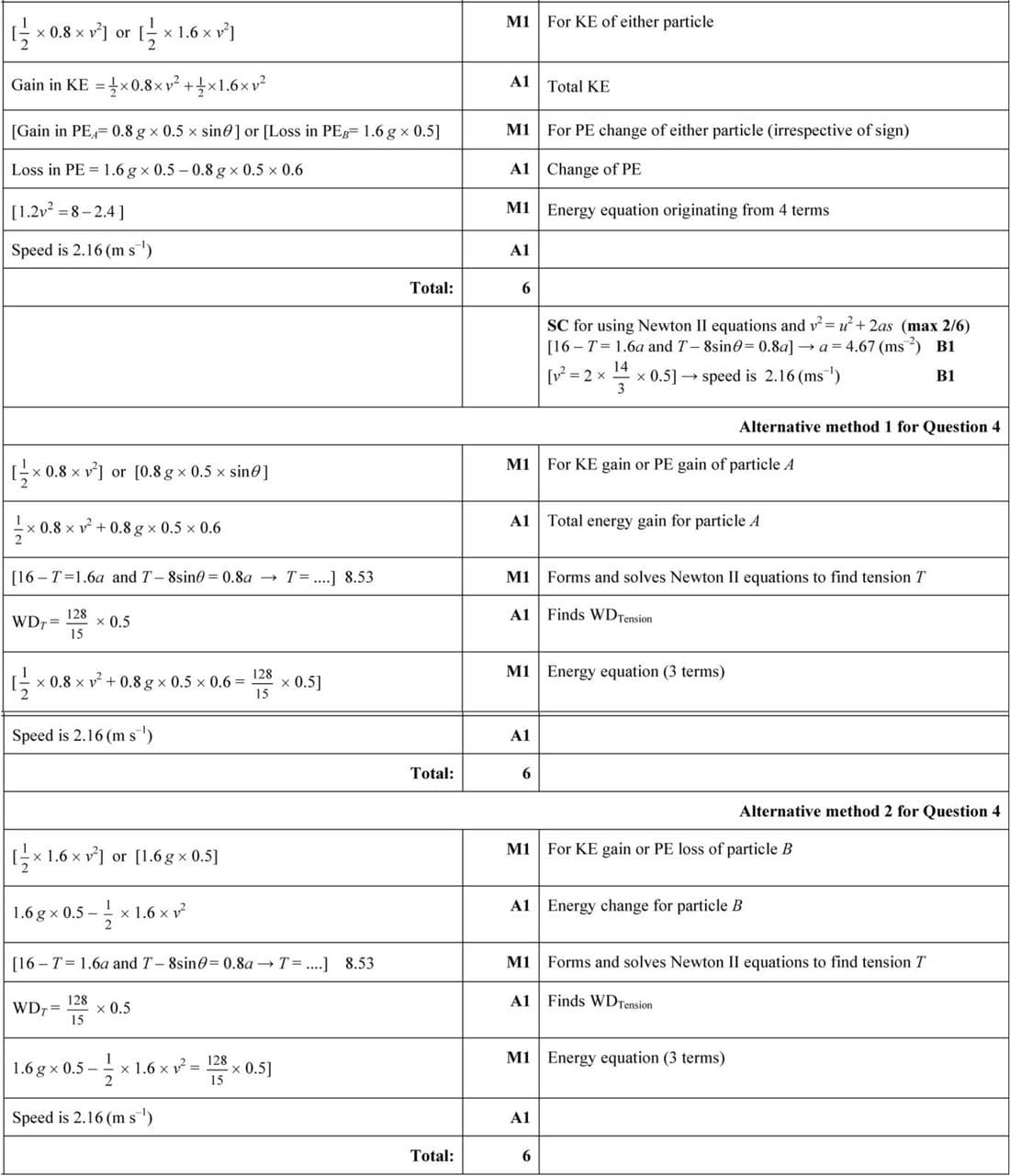
Two particles A and B, of masses 0.8 kg and 1.6 kg respectively, are connected by a light inextensible string. Particle A is placed on a smooth plane inclined at an angle \(\theta\) to the horizontal, where \(\sin \theta = \frac{3}{5}\). The string passes over a small smooth pulley P fixed at the top of the plane, and B hangs freely (see diagram). The section AP of the string is parallel to a line of greatest slope of the plane. The particles are released from rest with both sections of the string taut. Use an energy method to find the speed of the particles after each particle has moved a distance of 0.5 m, assuming that A has not yet reached the pulley.