Exam-Style Problems
⬅ Back to SubchapterNov 2017 p42 q7
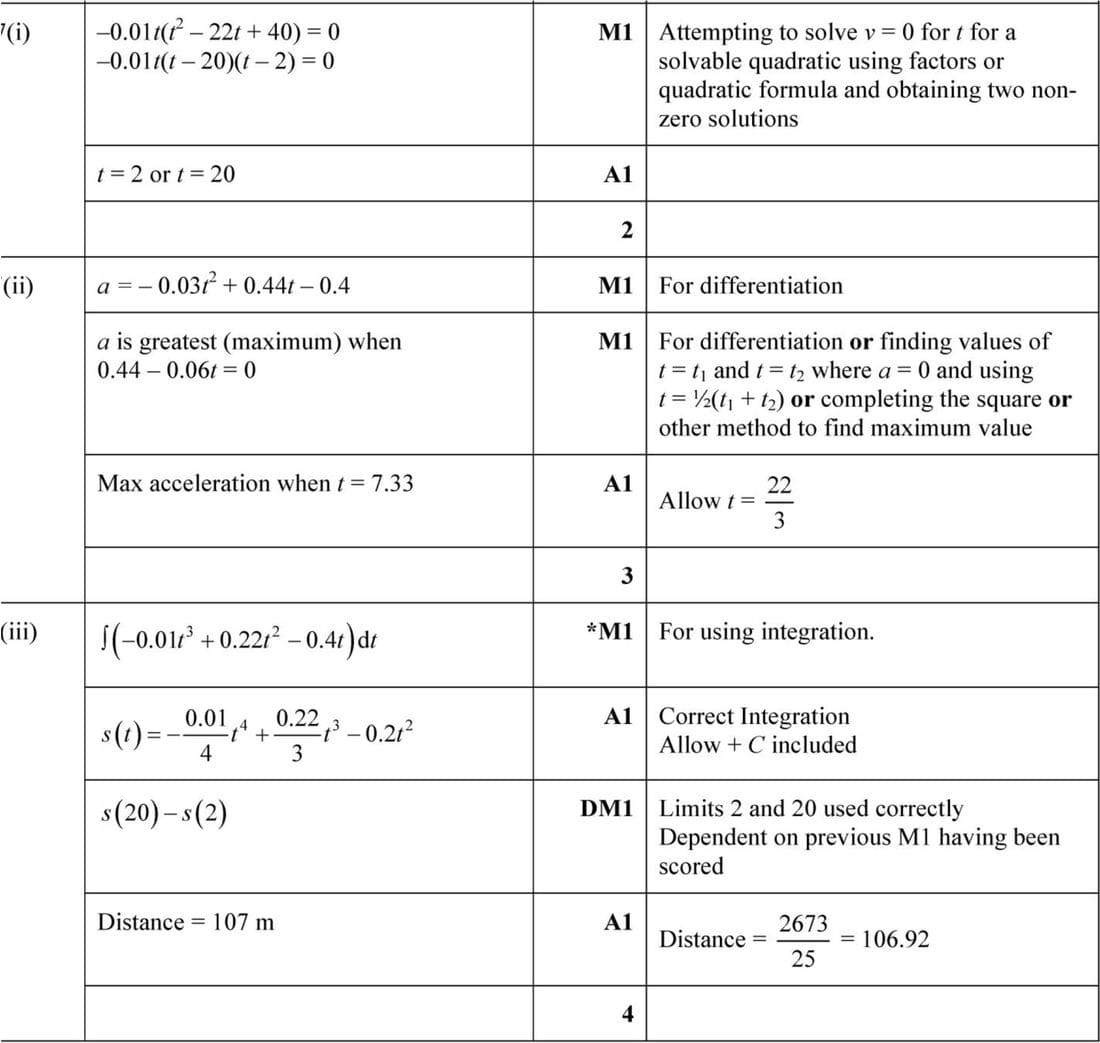
A particle starts from rest and moves in a straight line. The velocity of the particle at time t s after the start is v m s-1, where
\(v = -0.01t^3 + 0.22t^2 - 0.4t\).
- Find the two positive values of t for which the particle is instantaneously at rest.
- Find the time at which the acceleration of the particle is greatest.
- Find the distance travelled by the particle while its velocity is positive.
Nov 2017 p41 q5
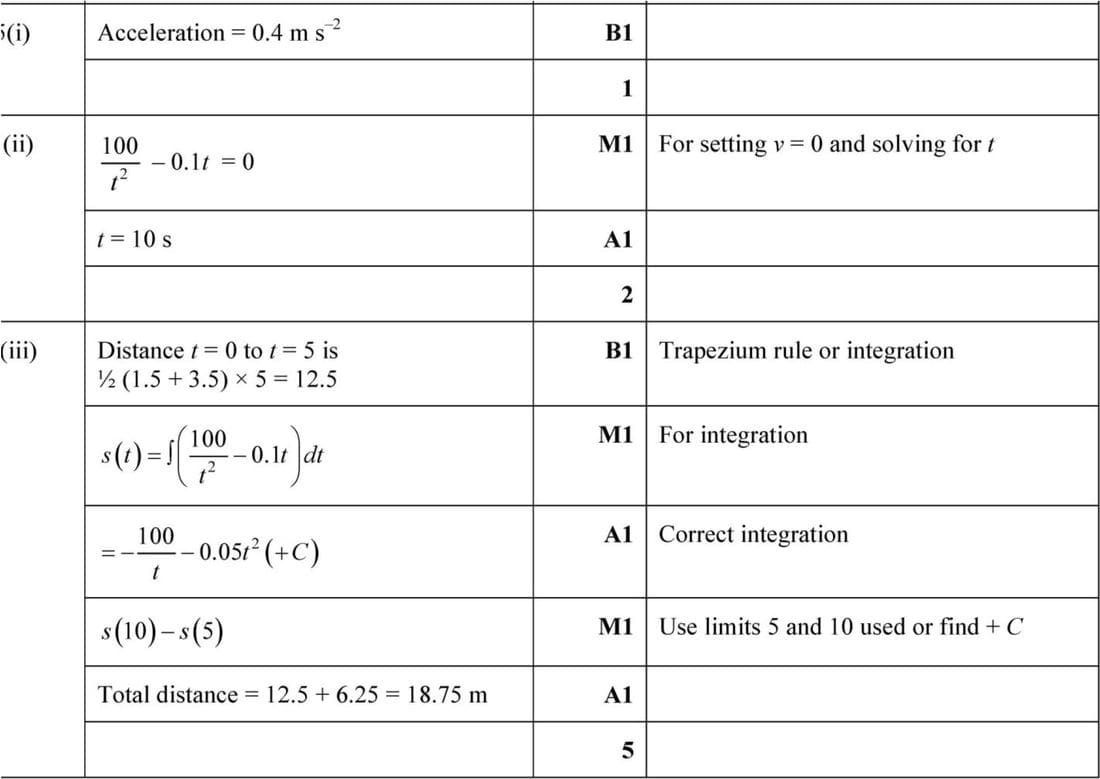
A particle starts from a point O and moves in a straight line. The velocity of the particle at time t s after leaving O is v m s-1, where
\(v = 1.5 + 0.4t \quad \text{for} \quad 0 \leq t \leq 5,\)
\(v = \frac{100}{t^2} - 0.1t \quad \text{for} \quad t \geq 5.\)
- Find the acceleration of the particle during the first 5 seconds of motion.
- Find the value of t when the particle is instantaneously at rest.
- Find the total distance travelled by the particle in the first 10 seconds of motion.
June 2017 p43 q4
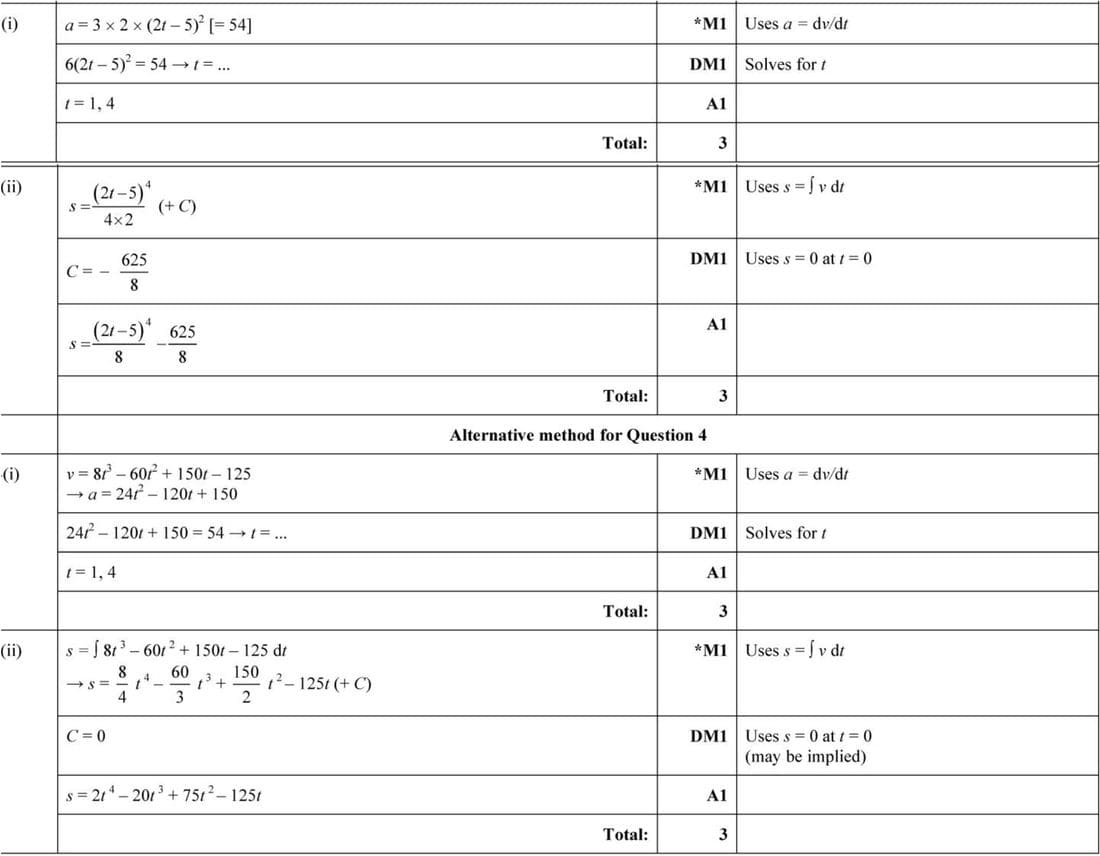
A particle P moves in a straight line starting from a point O. At time t s after leaving O, the velocity, v m s-1, of P is given by v = (2t - 5)^3.
- Find the values of t when the acceleration of P is 54 m s-2.
- Find an expression for the displacement of P from O at time t s.
June 2017 p41 q6
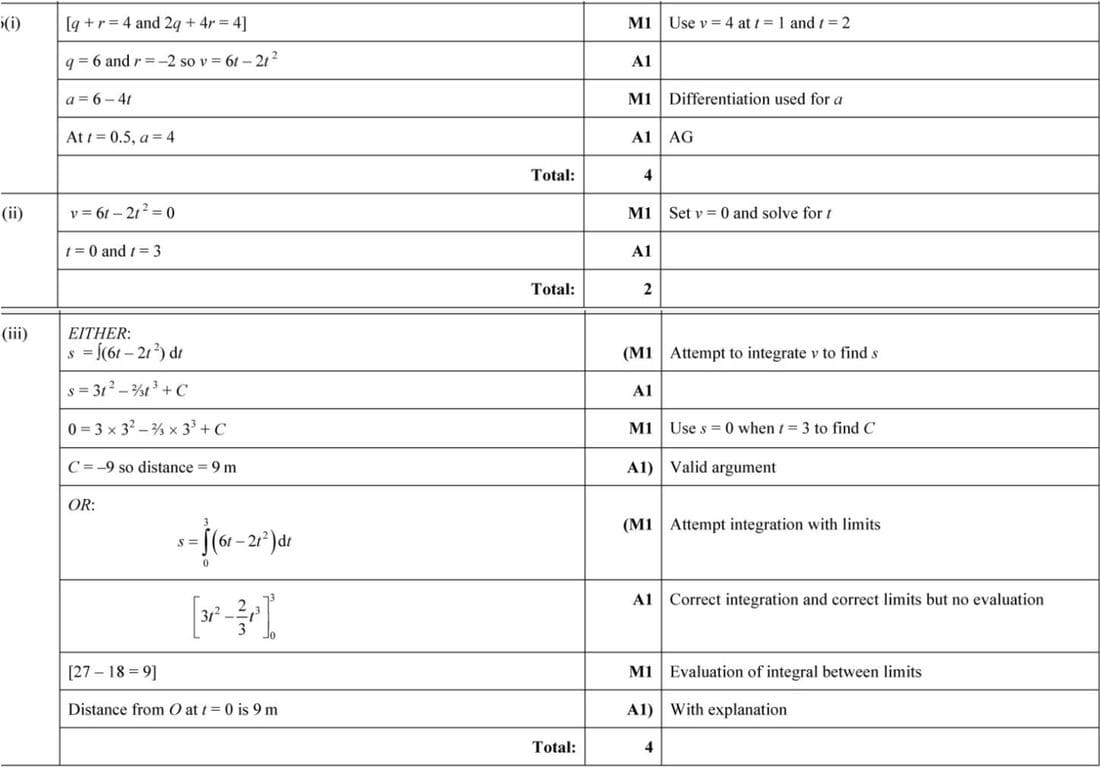
A particle P moves in a straight line passing through a point O. At time t s, the velocity of P, v m s-1, is given by v = qt + rt2, where q and r are constants. The particle has velocity 4 m s-1 when t = 1 and when t = 2.
- Show that, when t = 0.5, the acceleration of P is 4 m s-2.
- Find the values of t when P is at instantaneous rest.
- The particle is at O when t = 3. Find the distance of P from O when t = 0.
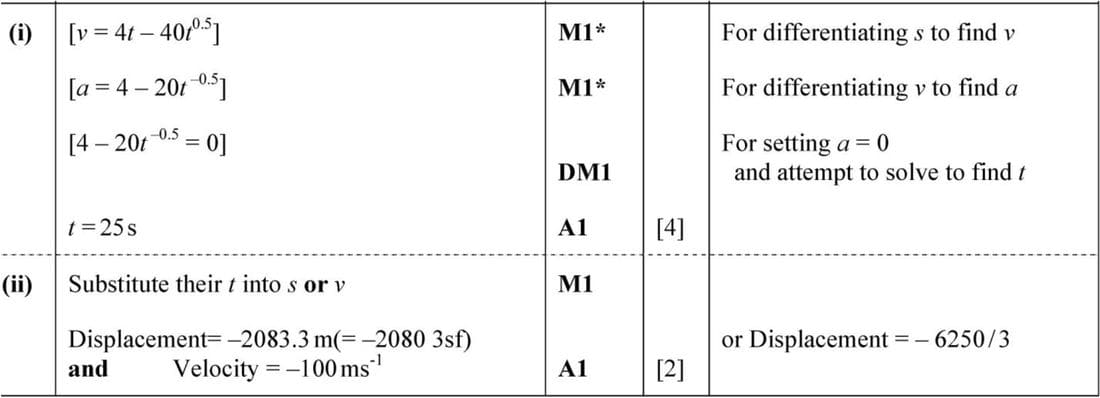
Nov 2016 p42 q2
A particle moves in a straight line. Its displacement t s after leaving a fixed point O on the line is s m, where \(s = 2t^2 - \frac{80}{3}t^{3/2}\).
- Find the time at which the acceleration of the particle is zero.
- Find the displacement and velocity of the particle at this instant.