Exam-Style Problems
⬅ Back to SubchapterNov 2018 p41 q1
A particle of mass 0.2 kg moving in a straight line experiences a constant resistance force of 1.5 N. When the particle is moving at speed 2.5 m s-1, a constant force of magnitude F N is applied to it in the direction in which it is moving. Given that the speed of the particle 5 seconds later is 4.5 m s-1, find the value of F.

Nov 2011 p41 q5
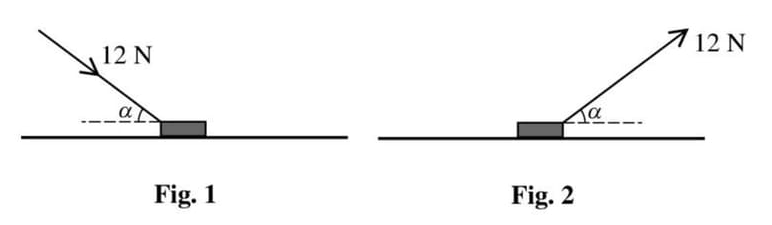
A block of mass 2 kg is at rest on a horizontal floor. The coefficient of friction between the block and the floor is \(\mu\). A force of magnitude 12 N acts on the block at an angle \(\alpha\) to the horizontal, where \(\tan \alpha = \frac{3}{4}\). When the applied force acts downwards as in Fig. 1 the block remains at rest.
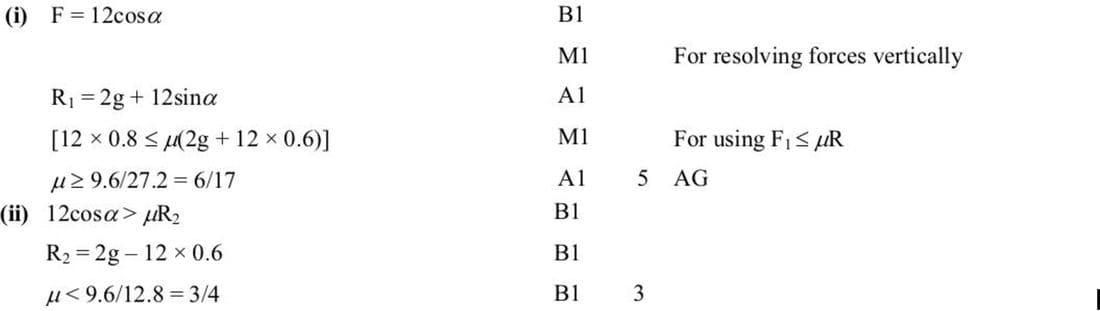
- Show that \(\mu \geq \frac{6}{17}\).
When the applied force acts upwards as in Fig. 2 the block slides along the floor.
- Find another inequality for \(\mu\).
June 2010 p43 q7
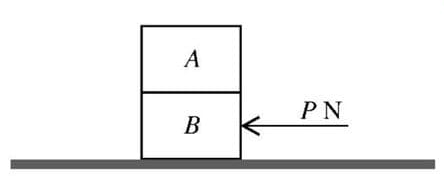
Two rectangular boxes A and B are of identical size. The boxes are at rest on a rough horizontal floor with A on top of B. Box A has mass 200 kg and box B has mass 250 kg. A horizontal force of magnitude P N is applied to B (see diagram). The boxes remain at rest if P \leq 3150 and start to move if P > 3150.
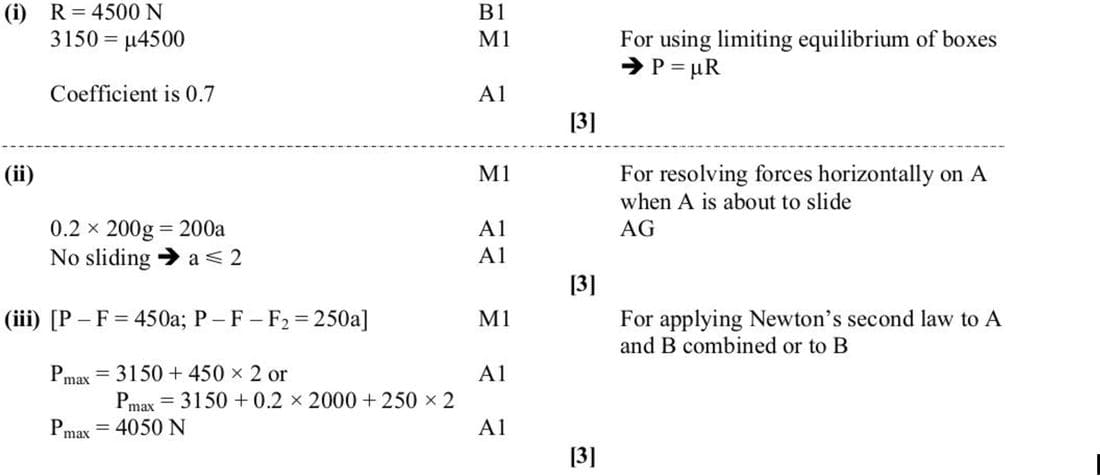
- Find the coefficient of friction between B and the floor.
- Given that P > 3150 and that no sliding takes place between the boxes, show that the acceleration of the boxes is not greater than 2 \text{ m s}^{-2}.
- Find the maximum possible value of P.
Nov 2004 p4 q6
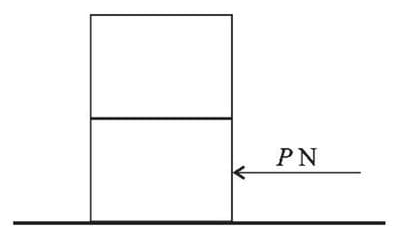
Two identical boxes, each of mass 400 kg, are at rest, with one on top of the other, on horizontal ground. A horizontal force of magnitude P newtons is applied to the lower box (see diagram). The coefficient of friction between the lower box and the ground is 0.75 and the coefficient of friction between the two boxes is 0.4.
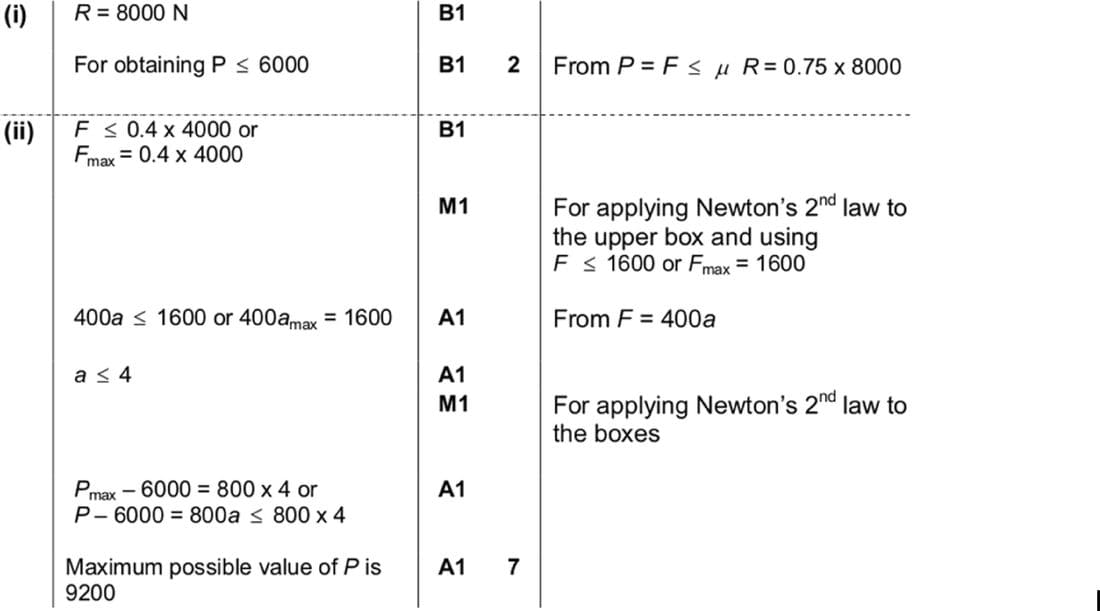
(i) Show that the boxes will remain at rest if P ≤ 6000.
The boxes start to move with acceleration a m/s².
(ii) Given that no sliding takes place between the boxes, show that a ≤ 4 and deduce the maximum possible value of P.
Nov 2019 p41 q5
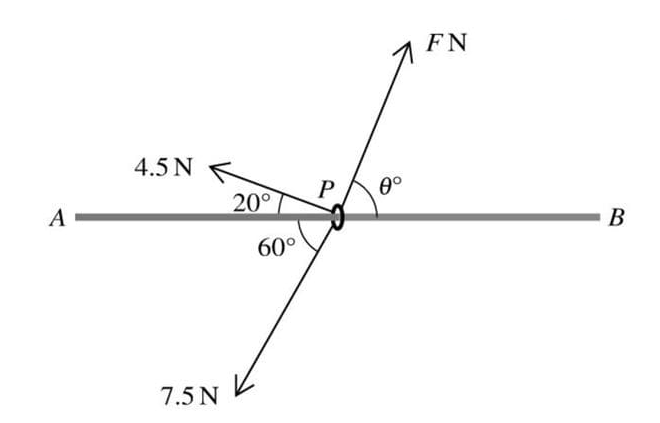
A small ring P is threaded on a fixed smooth horizontal rod AB. Three horizontal forces of magnitudes 4.5 N, 7.5 N and F N act on P (see diagram).
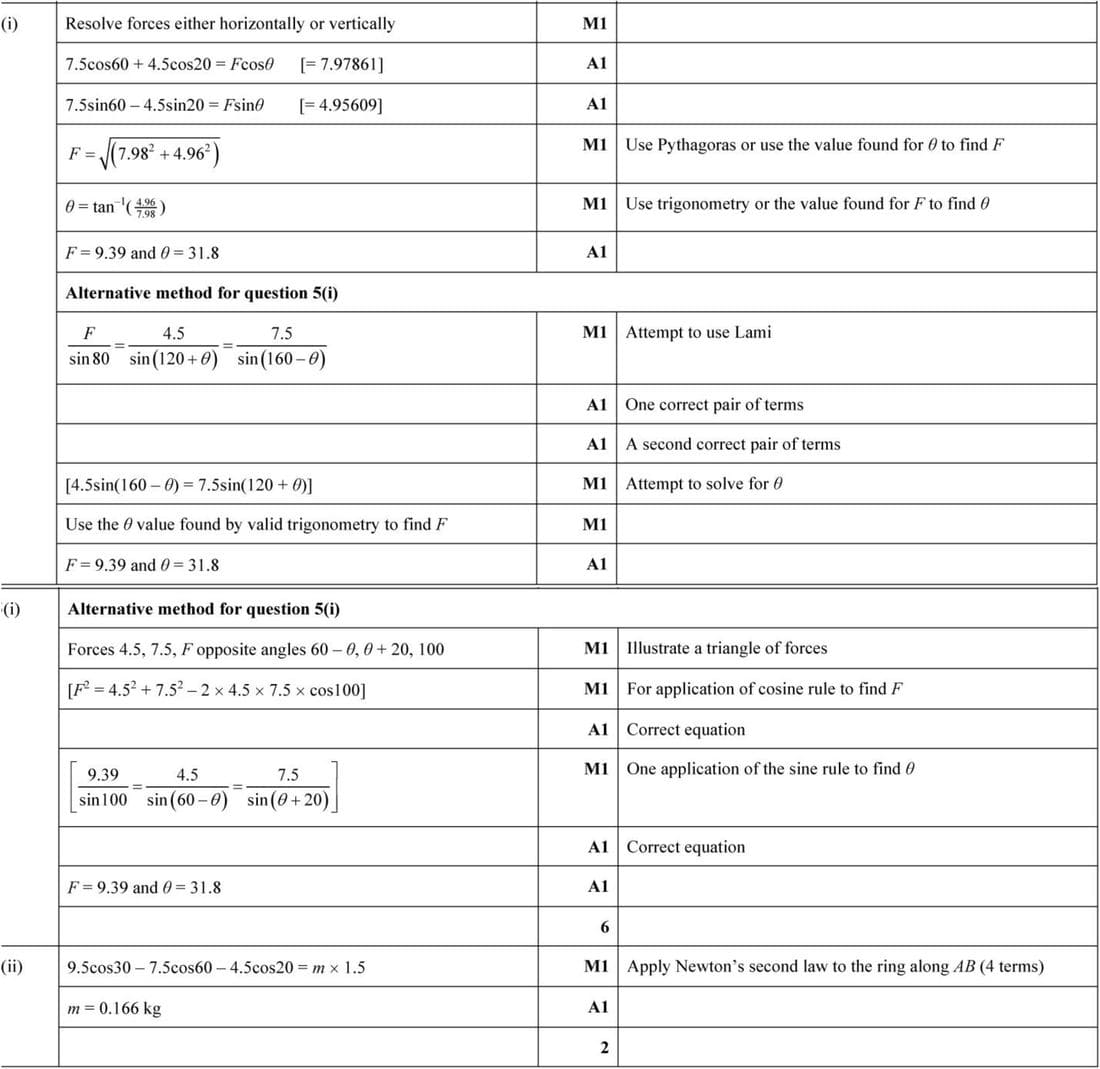
(i) Given that these three forces are in equilibrium, find the values of F and \(\theta\).
(ii) It is given instead that the values of F and \(\theta\) are 9.5 and 30 respectively, and the acceleration of the ring is 1.5 m s-2. Find the mass of the ring.