Exam-Style Problems
⬅ Back to SubchapterNov 2007 p4 q3
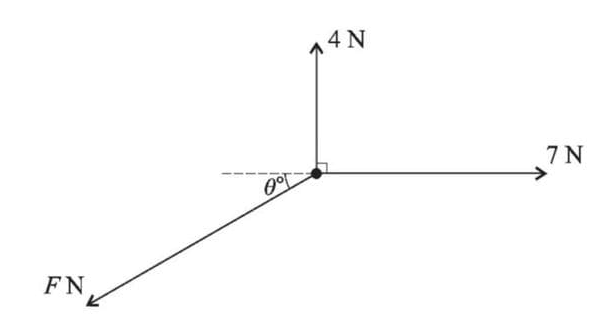
A particle is in equilibrium on a smooth horizontal table when acted on by the three horizontal forces shown in the diagram.
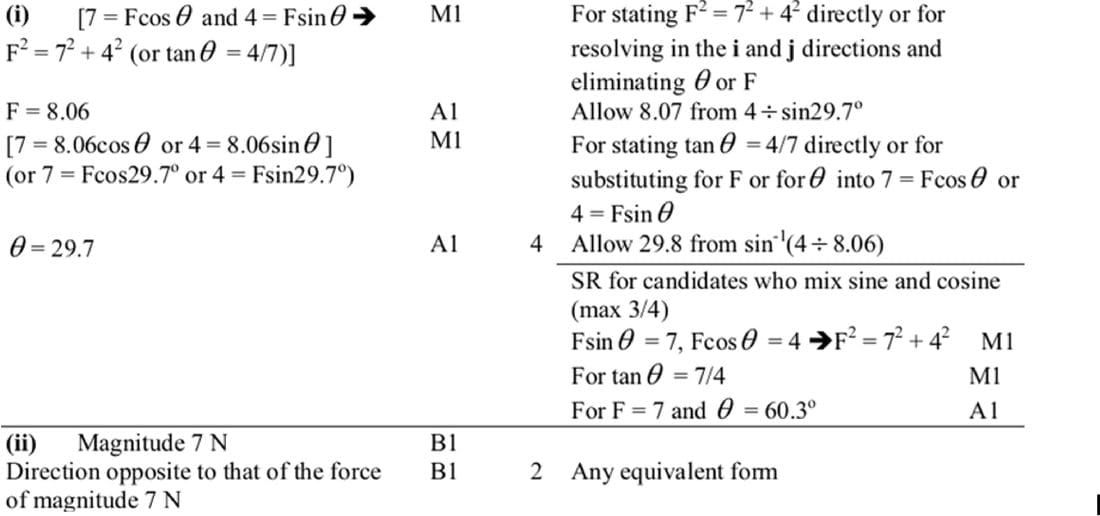
(i) Find the values of \(F\) and \(\theta\).
(ii) The force of magnitude 7 N is now removed. State the magnitude and direction of the resultant of the remaining two forces.
June 2007 p4 q2
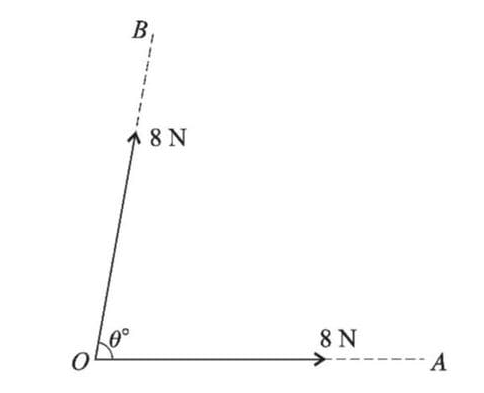
Two forces, each of magnitude 8 N, act at a point in the directions OA and OB. The angle between the forces is \(\theta^\circ\) (see diagram). The resultant of the two forces has component 9 N in the direction OA. Find
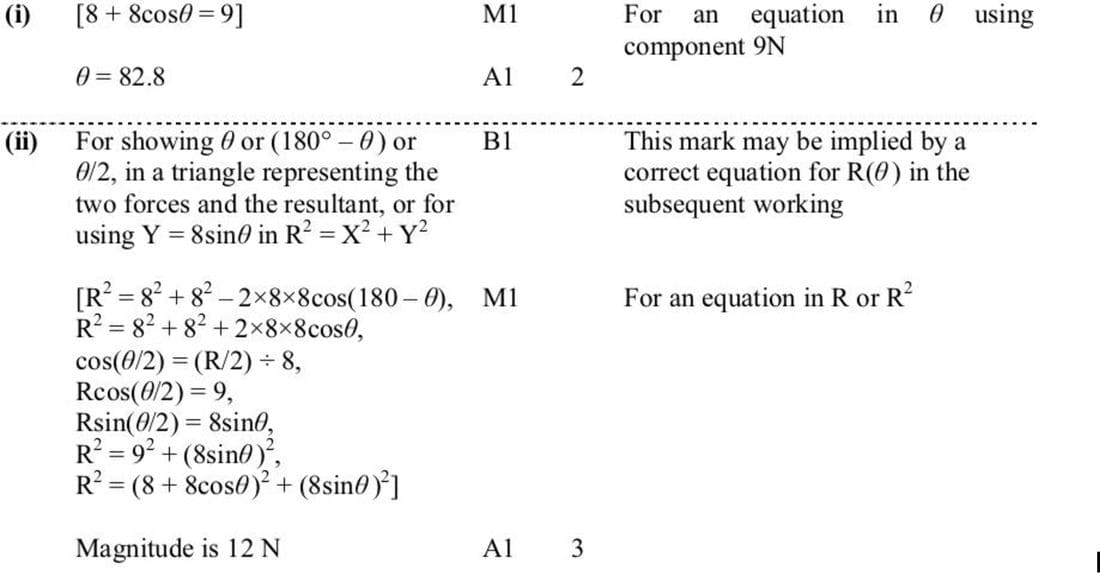
- the value of \(\theta\),
- the magnitude of the resultant of the two forces.
Nov 2006 p4 q6
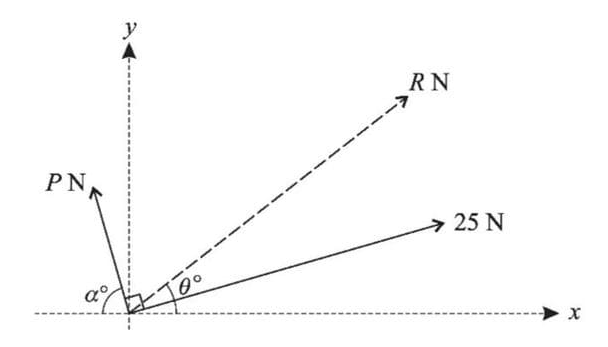
Forces of magnitudes PN and 25N act at right angles to each other. The resultant of the two forces has magnitude RN and makes an angle of θ° with the x-axis (see diagram). The force of magnitude PN has components -2.8N in the x-direction and 9.6N in the y-direction respectively, and makes an angle of α° with the negative x-axis.
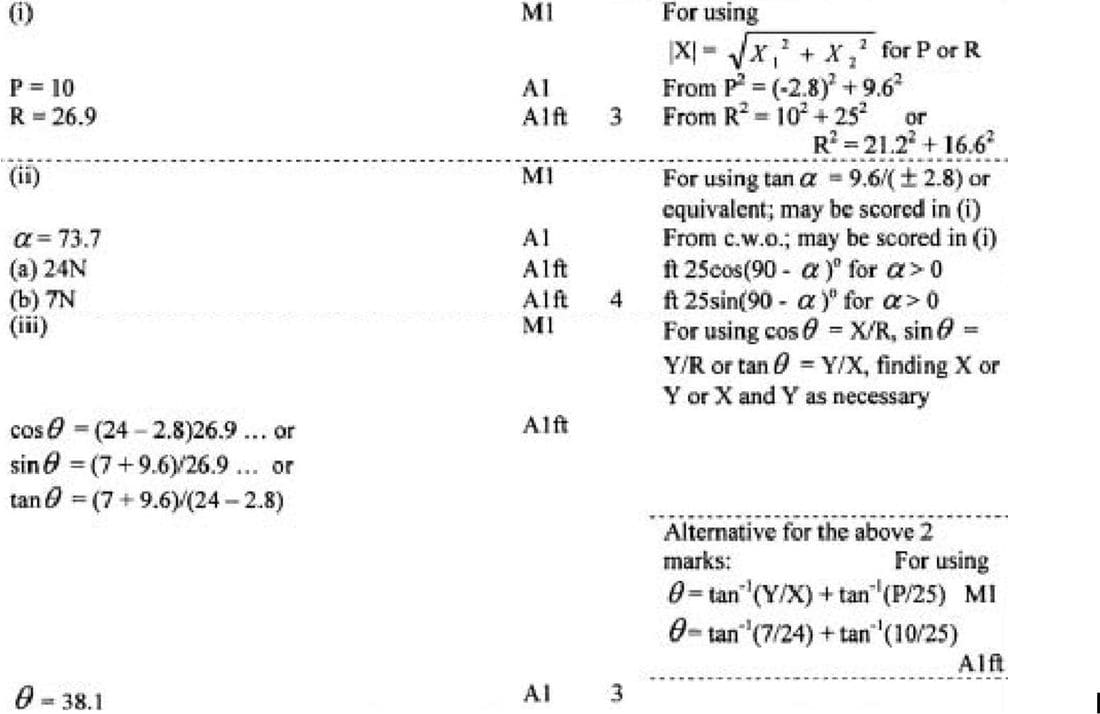
- Find the values of P and R.
- Find the value of α, and hence find the components of the force of magnitude 25N in
- the x-direction,
- the y-direction.
- Find the value of θ.
June 2005 p4 q2
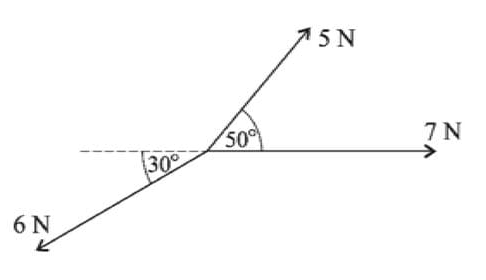
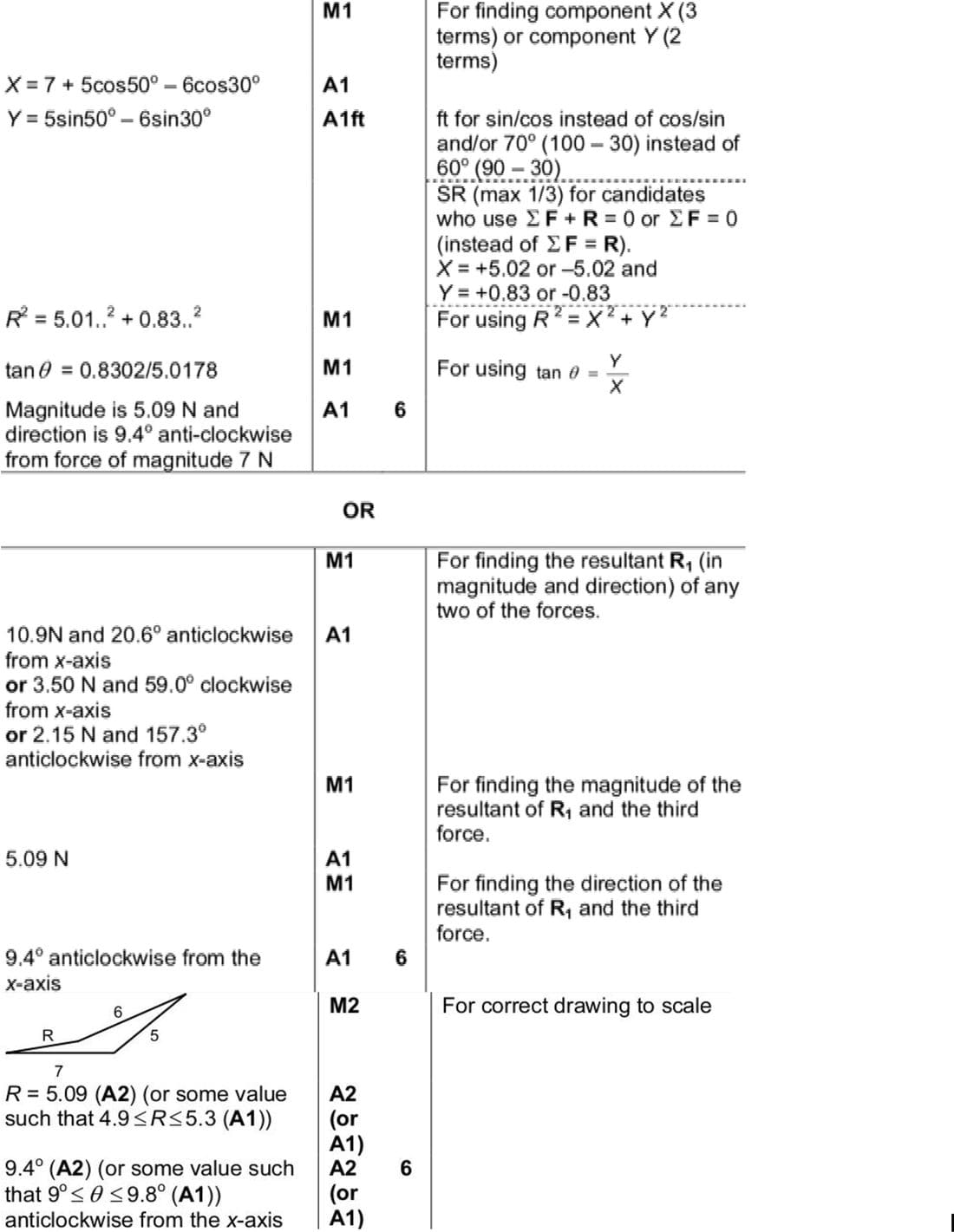
Three coplanar forces act at a point. The magnitudes of the forces are 5 N, 6 N, and 7 N, and the directions in which the forces act are shown in the diagram. Find the magnitude and direction of the resultant of the three forces.
June 2004 p4 q2
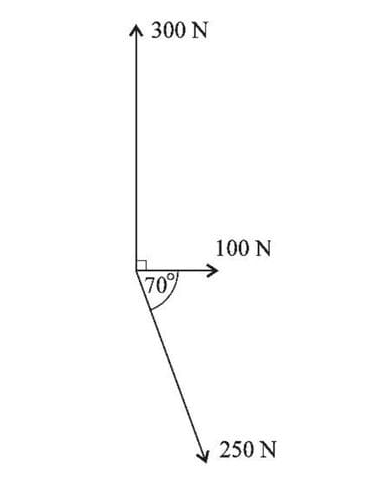
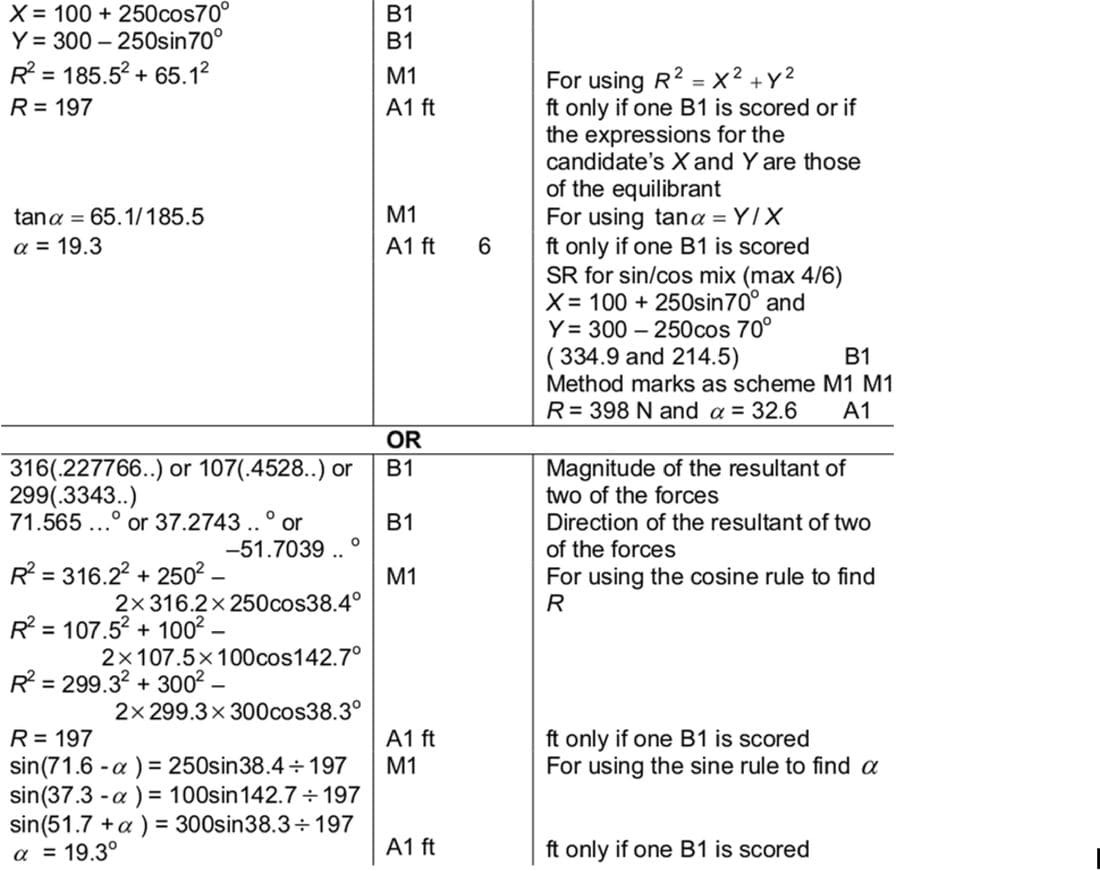
Coplanar forces of magnitudes 250 N, 100 N, and 300 N act at a point in the directions shown in the diagram. The resultant of the three forces has magnitude \(R\) N, and acts at an angle \(\alpha^\circ\) anticlockwise from the force of magnitude 100 N. Find \(R\) and \(\alpha\).