Exam-Style Problems
⬅ Back to SubchapterJune 2010 p43 q5
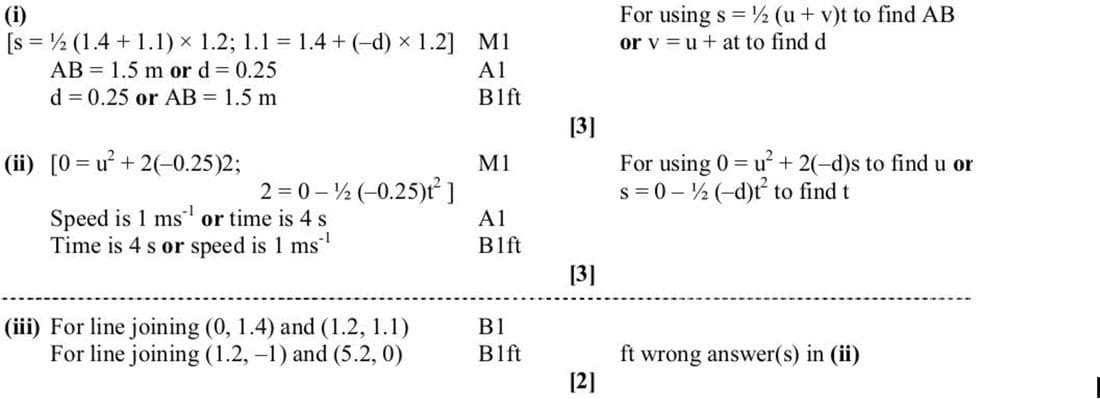
A ball moves on the horizontal surface of a billiards table with deceleration of constant magnitude \(d \, \text{m/s}^2\). The ball starts at \(A\) with speed \(1.4 \, \text{m/s}\) and reaches the edge of the table at \(B\), \(1.2\) s later, with speed \(1.1 \, \text{m/s}\).
- Find the distance \(AB\) and the value of \(d\).
- Find the speed with which the ball starts to move towards \(A\) and the time taken for the ball to travel from \(B\) to \(C\).
- Sketch a velocity-time graph for the motion of the ball, from the time the ball leaves \(A\) until it comes to rest at \(C\), showing on the axes the values of the velocity and the time when the ball is at \(A\), at \(B\) and at \(C\).
\(AB\) is at right angles to the edge of the table containing \(B\). The table has a low wall along each of its edges and the ball rebounds from the wall at \(B\) and moves directly towards \(A\). The ball comes to rest at \(C\) where the distance \(BC\) is \(2\) m.
Nov 2008 p4 q6
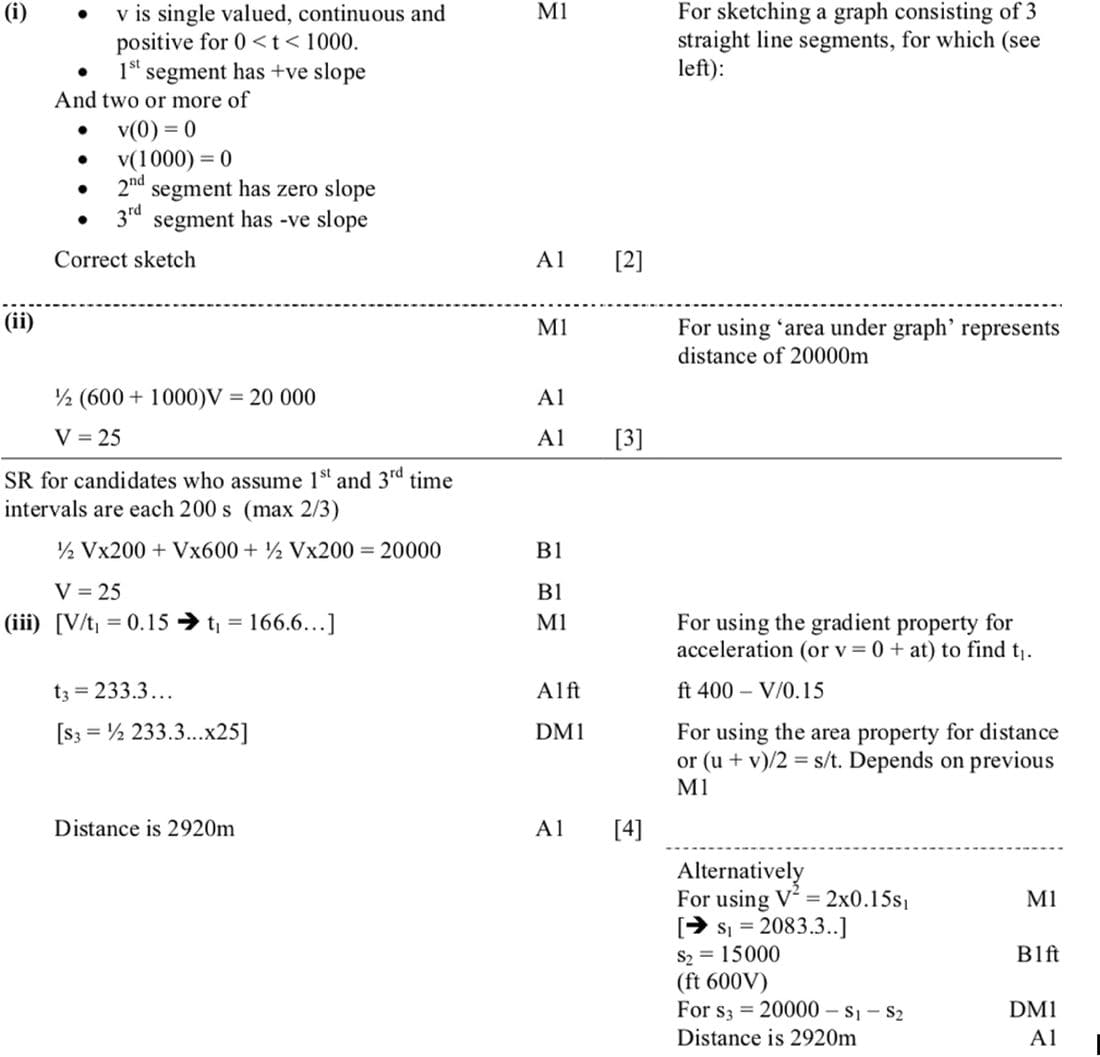
A train travels from A to B, a distance of 20,000 m, taking 1,000 s. The journey has three stages. In the first stage the train starts from rest at A and accelerates uniformly until its speed is V m/s. In the second stage the train travels at constant speed V m/s for 600 s. During the third stage of the journey the train decelerates uniformly, coming to rest at B.
- Sketch the velocity-time graph for the train’s journey.
- Find the value of V.
- Given that the acceleration of the train during the first stage of the journey is 0.15 m/s², find the distance travelled by the train during the third stage of the journey.

June 2022 p41 q1
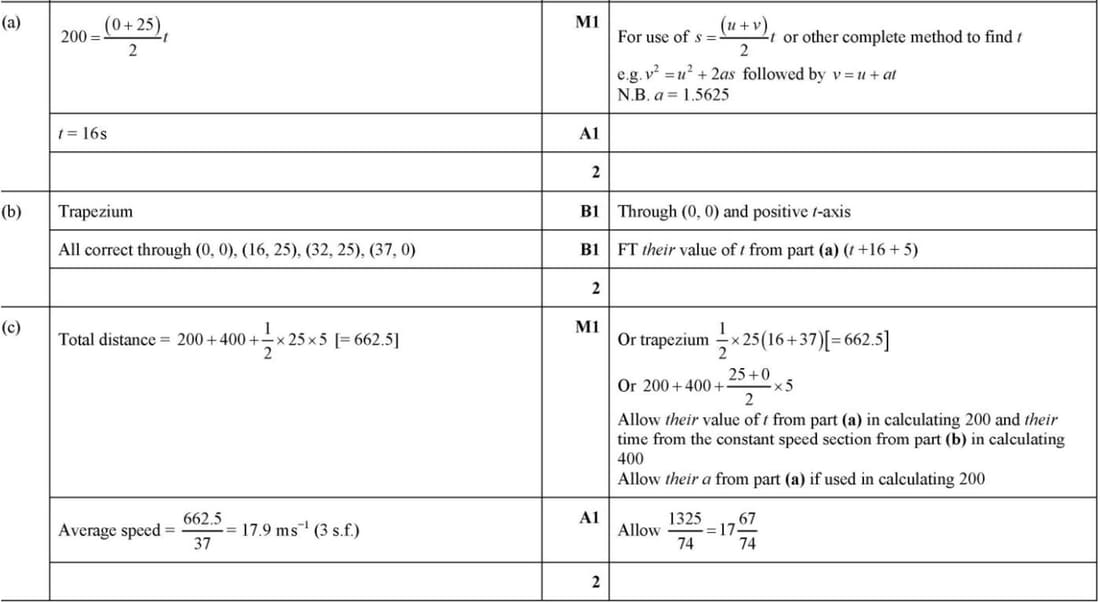
A car starts from rest and moves in a straight line with constant acceleration for a distance of 200 m, reaching a speed of 25 m s-1. The car then travels at this speed for 400 m, before decelerating uniformly to rest over a period of 5 s.
(a) Find the time for which the car is accelerating.
(b) Sketch the velocity–time graph for the motion of the car, showing the key points.
(c) Find the average speed of the car during its motion.
June 2020 p43 q4
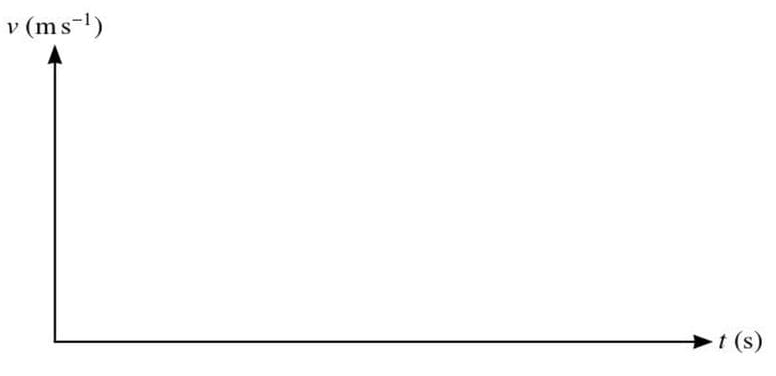
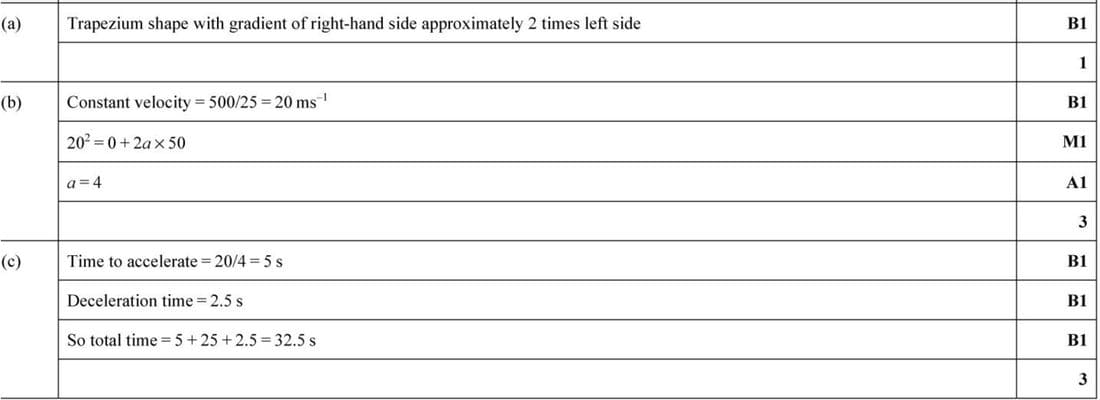
A car starts from rest and moves in a straight line with constant acceleration \(a \text{ m s}^{-2}\) for a distance of 50 m. The car then travels with constant velocity for 500 m for a period of 25 s, before decelerating to rest. The magnitude of this deceleration is \(2a \text{ m s}^{-2}\).
(a) Sketch the velocity-time graph for the motion of the car.
(b) Find the value of \(a\).
(c) Find the total time for which the car is in motion.
June 2020 p42 q1
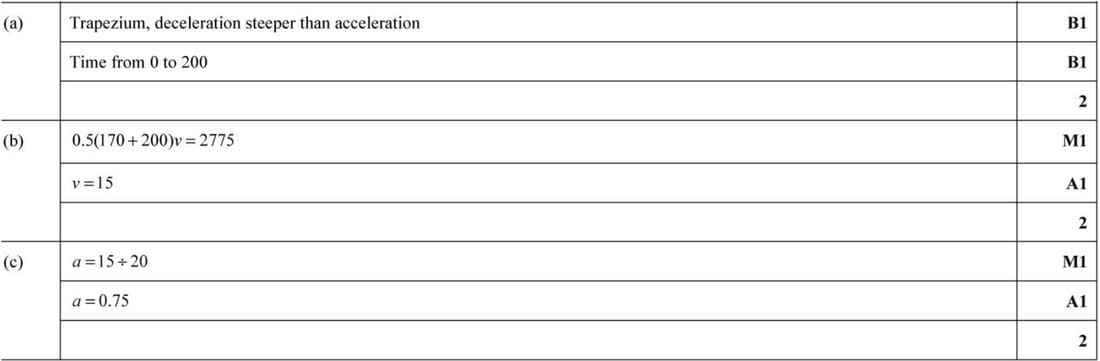
A tram starts from rest and moves with uniform acceleration for 20 s. The tram then travels at a constant speed, \(V \text{ m s}^{-1}\), for 170 s before being brought to rest with a uniform deceleration of magnitude twice that of the acceleration. The total distance travelled by the tram is 2.775 km.
(a) Sketch a velocity-time graph for the motion, stating the total time for which the tram is moving. [2]
(b) Find \(V\). [2]
(c) Find the magnitude of the acceleration. [2]