Exam-Style Problems
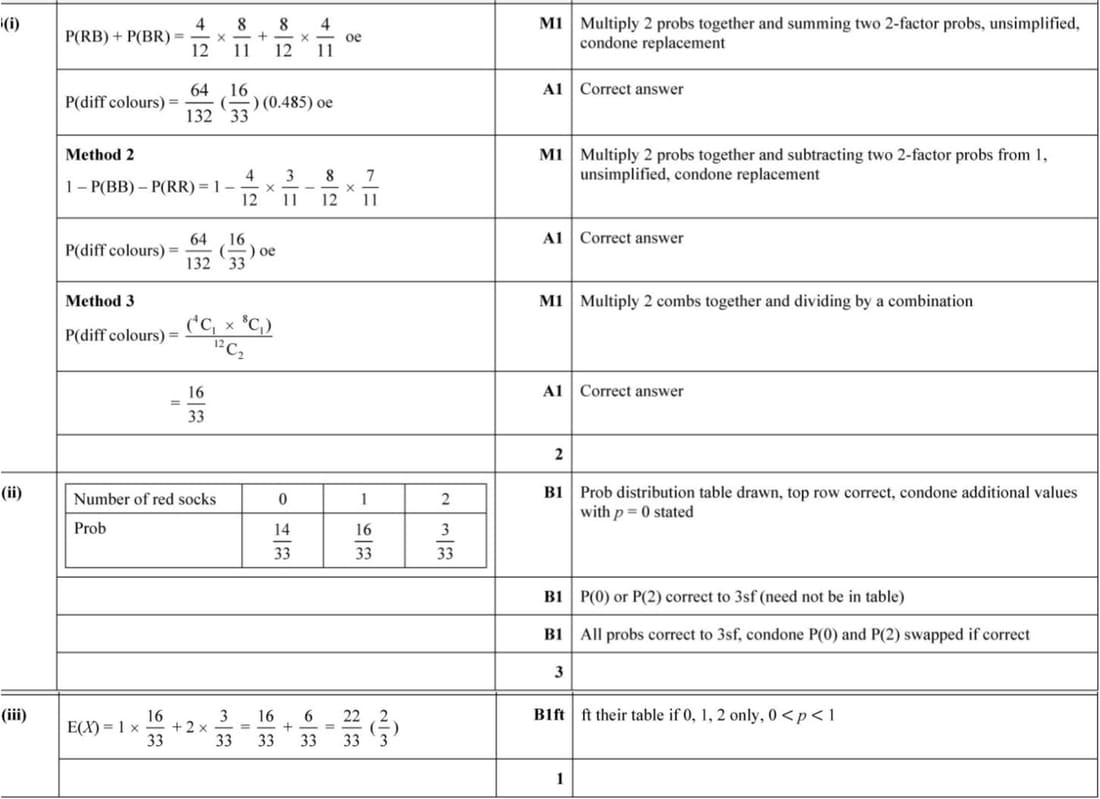
⬅ Back to SubchapterJune 2018 p61 q3
Andy has 4 red socks and 8 black socks in his drawer. He takes 2 socks at random from his drawer.
- Find the probability that the socks taken are of different colours.
- Draw up the probability distribution table for X.
- Find E(X).
The random variable X is the number of red socks taken.
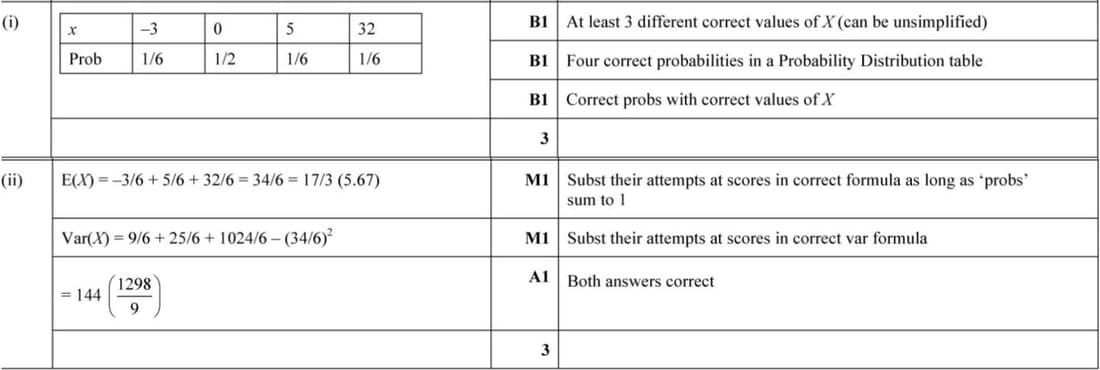
Nov 2017 p63 q4
A fair die with faces numbered 1, 2, 2, 2, 3, 6 is thrown. The score, X, is found by squaring the number on the face the die shows and then subtracting 4.
- Draw up a table to show the probability distribution of X.
- Find E(X) and Var(X).
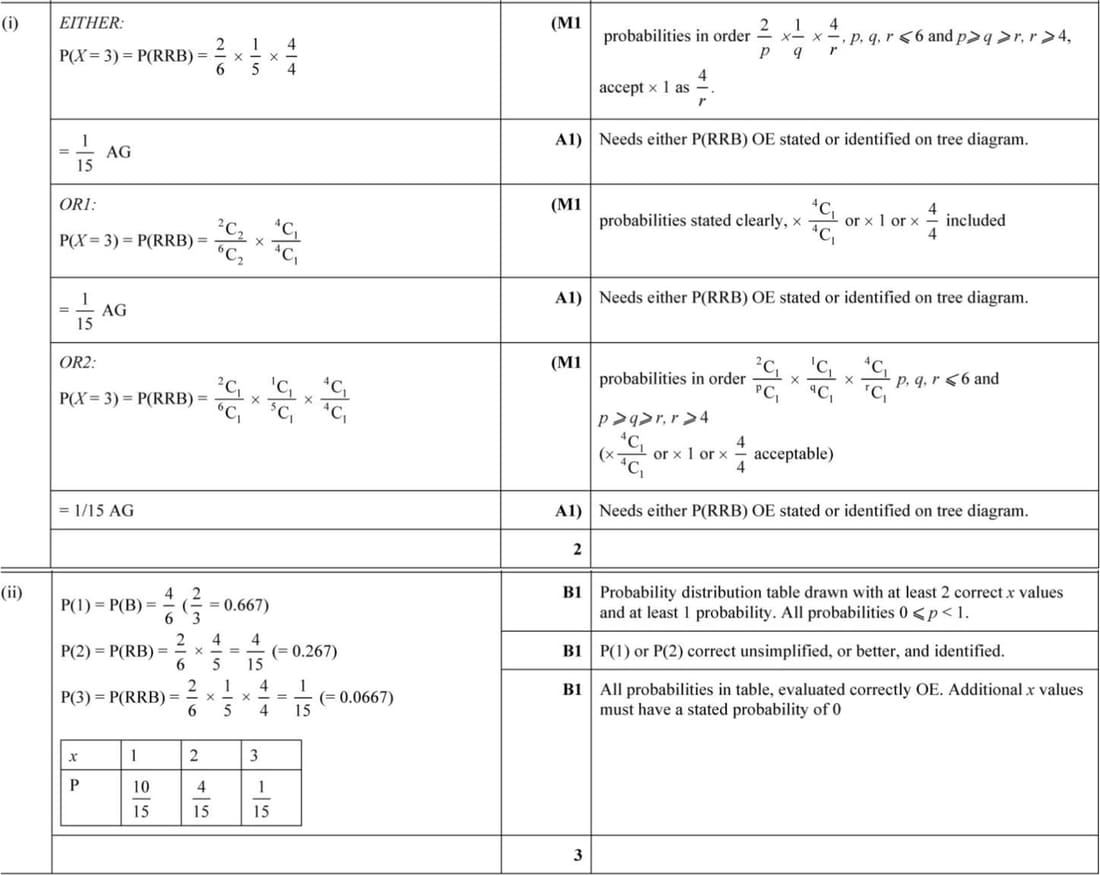
Nov 2017 p62 q3
A box contains 6 identical-sized discs, of which 4 are blue and 2 are red. Discs are taken at random from the box in turn and not replaced. Let X be the number of discs taken, up to and including the first blue one.
(i) Show that \(P(X = 3) = \frac{1}{15}\).
(ii) Draw up the probability distribution table for \(X\).
June 2017 p62 q3
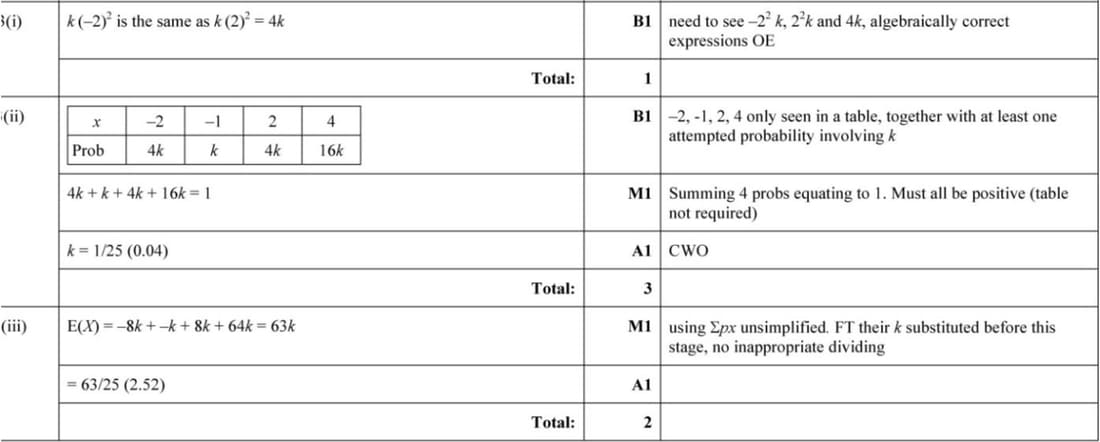
In a probability distribution the random variable \(X\) takes the value \(x\) with probability \(kx^2\), where \(k\) is a constant and \(x\) takes values \(-2, -1, 2, 4\) only.
- Show that \(P(X = -2)\) has the same value as \(P(X = 2)\).
- Draw up the probability distribution table for \(X\), in terms of \(k\), and find the value of \(k\).
- Find \(E(X)\).
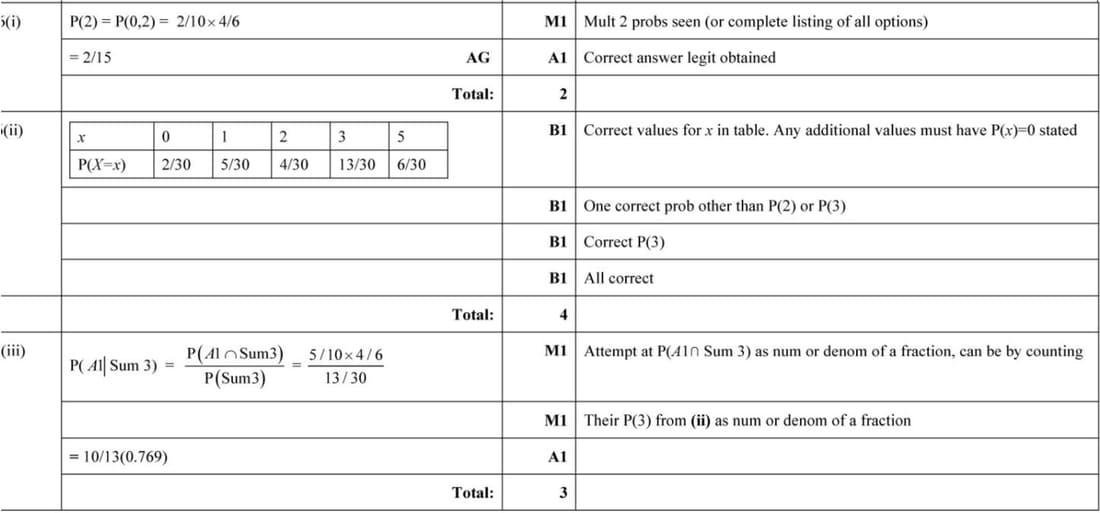
Feb/Mar 2017 p62 q6
Pack A consists of ten cards numbered 0, 0, 1, 1, 1, 1, 3, 3, 3, 3. Pack B consists of six cards numbered 0, 0, 2, 2, 2, 2. One card is chosen at random from each pack. The random variable X is defined as the sum of the two numbers on the cards.
- Show that \(P(X = 2) = \frac{2}{15}\).
- Draw up the probability distribution table for \(X\).
- Given that \(X = 3\), find the probability that the card chosen from pack A is a 1.