Exam-Style Problems
⬅ Back to Subchapter
Browsing as Guest. Progress, bookmarks and attempts are disabled.
Log in to track your work.
Nov 2016 p61 q5
2708
Find the number of different ways of arranging all nine letters of the word PINEAPPLE if no vowel (A, E, I) is next to another vowel.

Log in to record attempts.
June 2016 p63 q6
2709
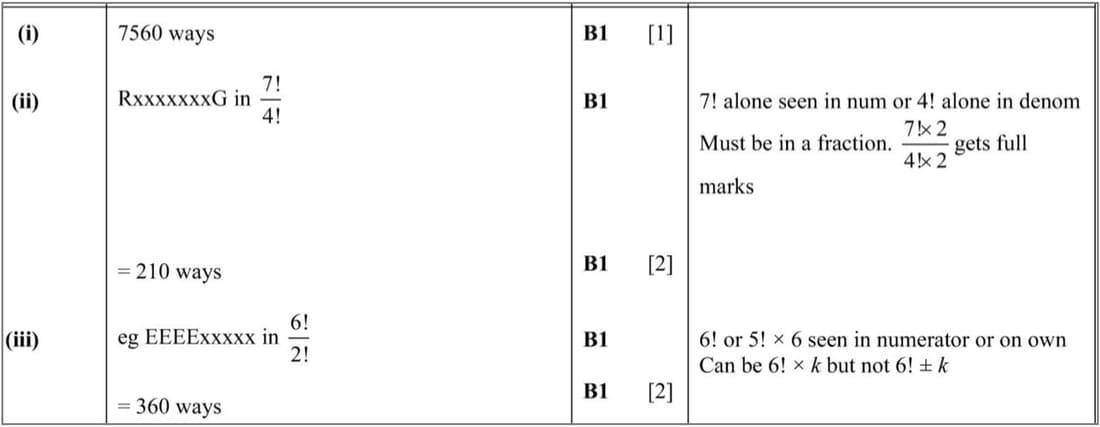
Find the number of ways all 9 letters of the word EVERGREEN can be arranged if
- there are no restrictions,
- the first letter is R and the last letter is G,
- the Es are all together.
Log in to record attempts.
June 2016 p62 q7
2710
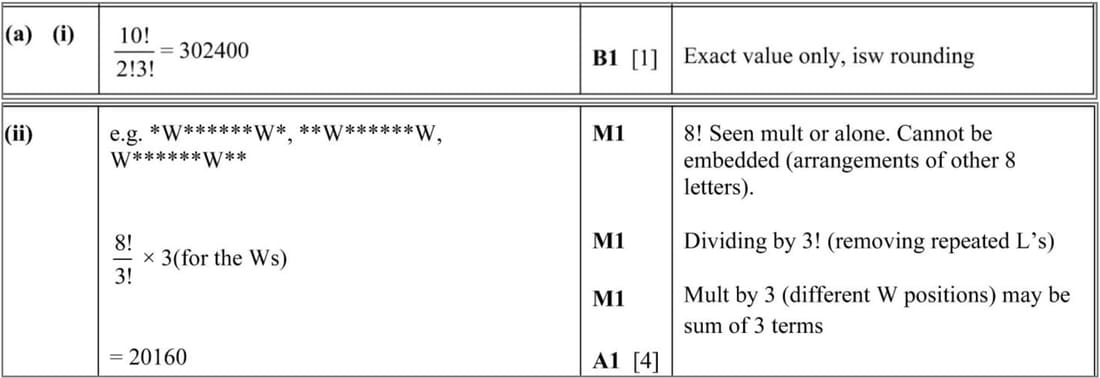
Find the number of different arrangements which can be made of all 10 letters of the word WALLFLOWER if
- there are no restrictions,
- there are exactly six letters between the two Ws.
Log in to record attempts.
June 2016 p61 q6
2711
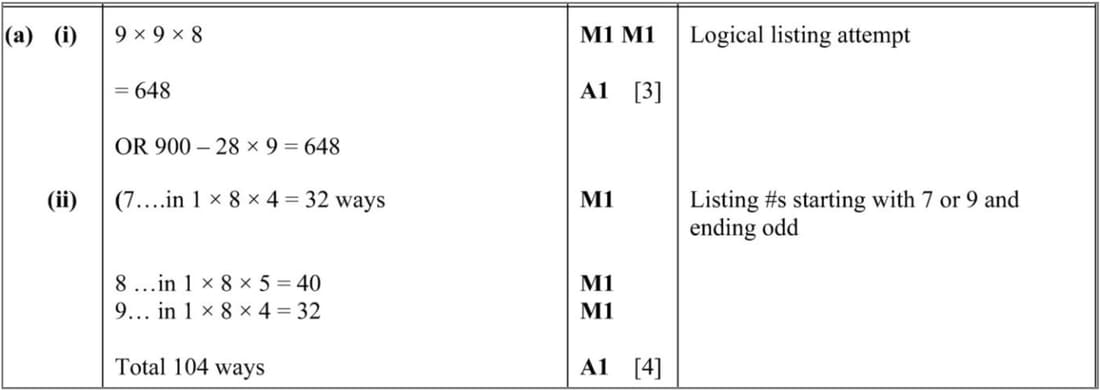
(i) Find how many numbers there are between 100 and 999 in which all three digits are different.
(ii) Find how many of the numbers in part (i) are odd numbers greater than 700.
Log in to record attempts.
Nov 2015 p63 q5
2712
Find the number of different ways that the 13 letters of the word ACCOMMODATION can be arranged in a line if all the vowels (A, I, O) are next to each other.

Log in to record attempts.