Exam-Style Problems
⬅ Back to SubchapterJune 2011 p32 q6
2304
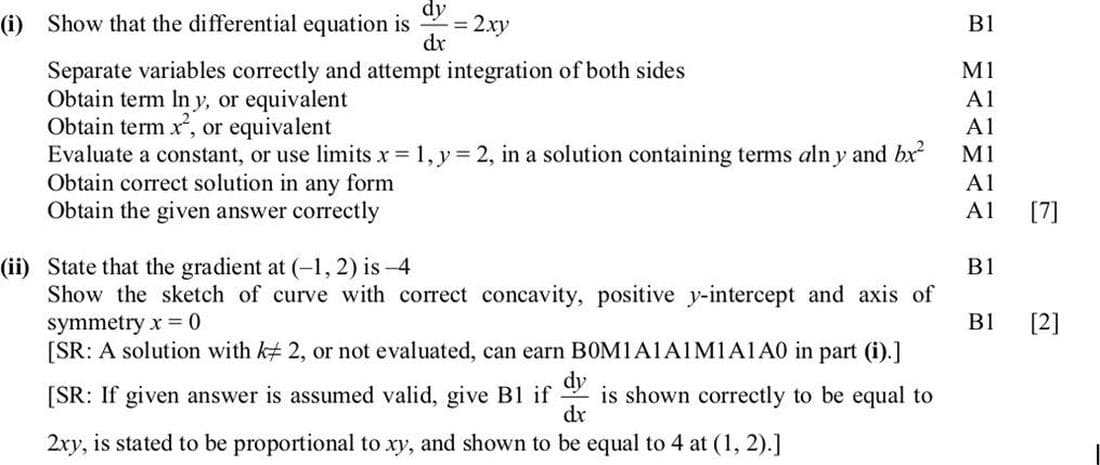
A certain curve is such that its gradient at a point \((x, y)\) is proportional to \(xy\). At the point \((1, 2)\) the gradient is 4.
(i) By setting up and solving a differential equation, show that the equation of the curve is \(y = 2e^{x^2 - 1}\). [7]
(ii) State the gradient of the curve at the point \((-1, 2)\) and sketch the curve. [2]
June 2021 p33 q7
2305
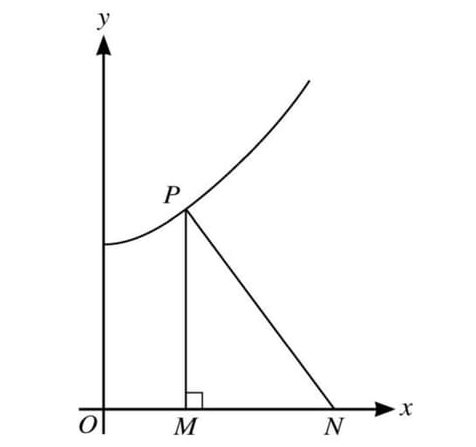
For the curve shown in the diagram, the normal to the curve at the point \(P\) with coordinates \((x, y)\) meets the \(x\)-axis at \(N\). The point \(M\) is the foot of the perpendicular from \(P\) to the \(x\)-axis.
The curve is such that for all values of \(x\) in the interval \(0 \leq x < \frac{1}{2}\pi\), the area of triangle \(PMN\) is equal to \(\tan x\).
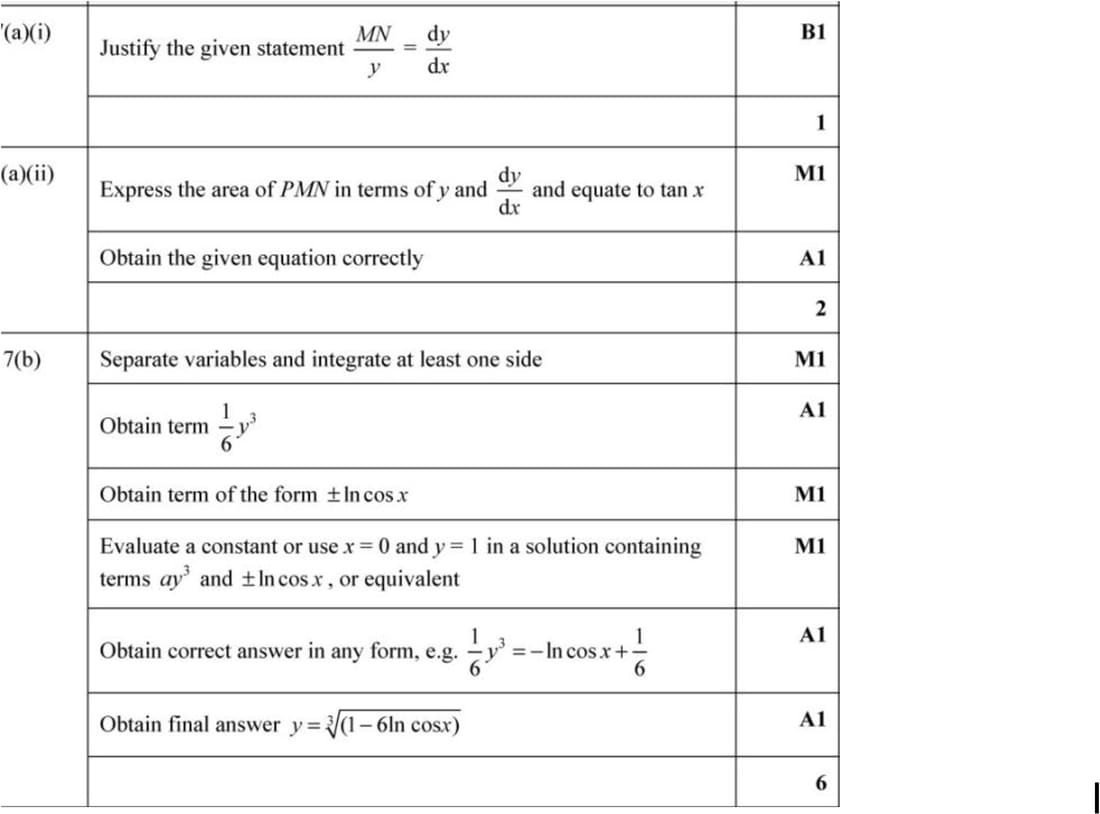
(a) (i) Show that \(\frac{MN}{y} = \frac{dy}{dx}\).
(ii) Hence show that \(x\) and \(y\) satisfy the differential equation \(\frac{1}{2}y^2 \frac{dy}{dx} = \tan x\).
(b) Given that \(y = 1\) when \(x = 0\), solve this differential equation to find the equation of the curve, expressing \(y\) in terms of \(x\).
Nov 2010 p33 q9
2306
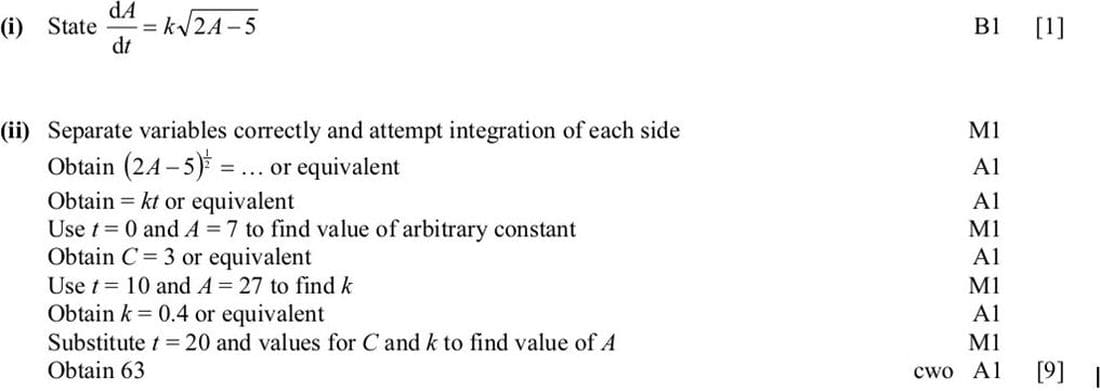
A biologist is investigating the spread of a weed in a particular region. At time \(t\) weeks after the start of the investigation, the area covered by the weed is \(A \text{ m}^2\). The biologist claims that the rate of increase of \(A\) is proportional to \(\sqrt{2A - 5}\).
(i) Write down a differential equation representing the biologist’s claim.
(ii) At the start of the investigation, the area covered by the weed was \(7 \text{ m}^2\) and, 10 weeks later, the area covered was \(27 \text{ m}^2\). Assuming that the biologist’s claim is correct, find the area covered 20 weeks after the start of the investigation.
Nov 2010 p31 q10
2307
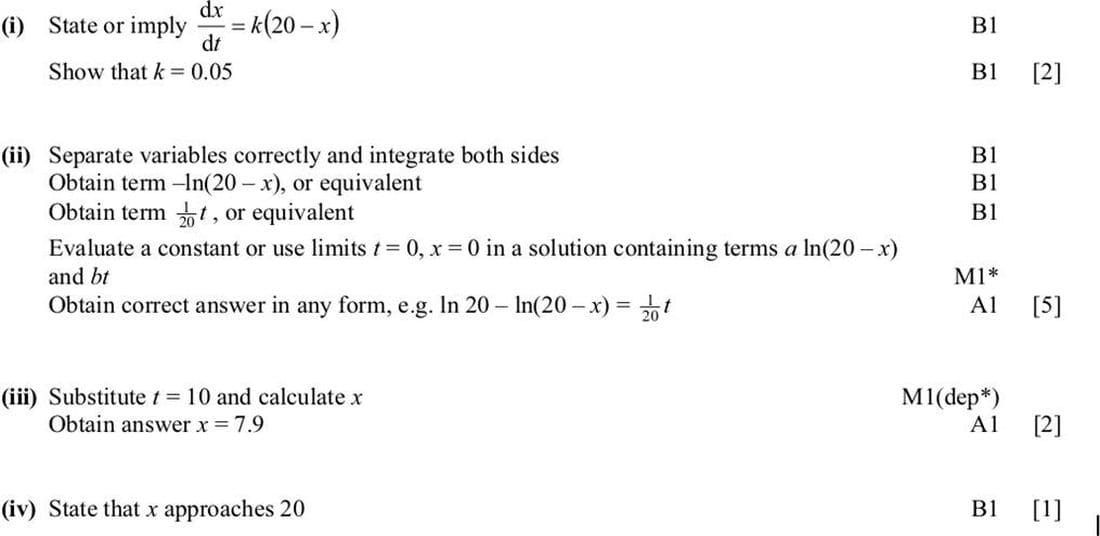
A certain substance is formed in a chemical reaction. The mass of substance formed t seconds after the start of the reaction is x grams. At any time the rate of formation of the substance is proportional to \((20 - x)\). When \(t = 0\), \(x = 0\) and \(\frac{dx}{dt} = 1\).
(i) Show that x and t satisfy the differential equation \(\frac{dx}{dt} = 0.05(20 - x)\). [2]
(ii) Find, in any form, the solution of this differential equation. [5]
(iii) Find x when \(t = 10\), giving your answer correct to 1 decimal place. [2]
(iv) State what happens to the value of x as t becomes very large. [1]
Nov 2009 p31 q10
2308
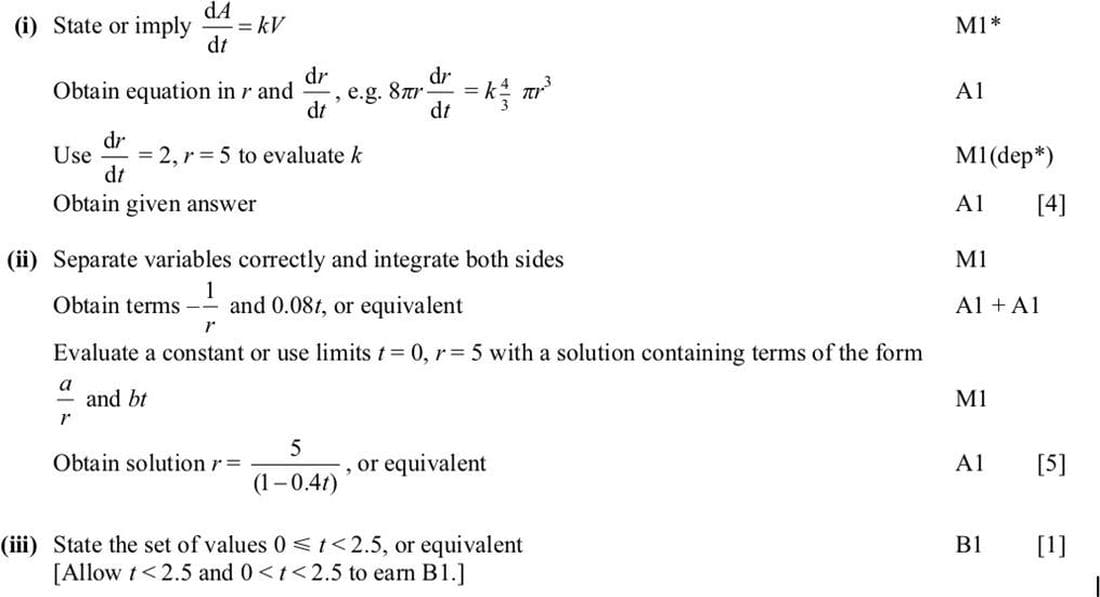
In a model of the expansion of a sphere of radius r cm, it is assumed that, at time t seconds after the start, the rate of increase of the surface area of the sphere is proportional to its volume. When t = 0, r = 5 and \(\frac{dr}{dt} = 2\).
(i) Show that r satisfies the differential equation \(\frac{dr}{dt} = 0.08r^2\).
[The surface area A and volume V of a sphere of radius r are given by the formulae \(A = 4\pi r^2\), \(V = \frac{4}{3}\pi r^3\).]
(ii) Solve this differential equation, obtaining an expression for r in terms of t.
(iii) Deduce from your answer to part (ii) the set of values that t can take, according to this model.