Exam-Style Problems
⬅ Back to SubchapterJune 2016 p33 q8
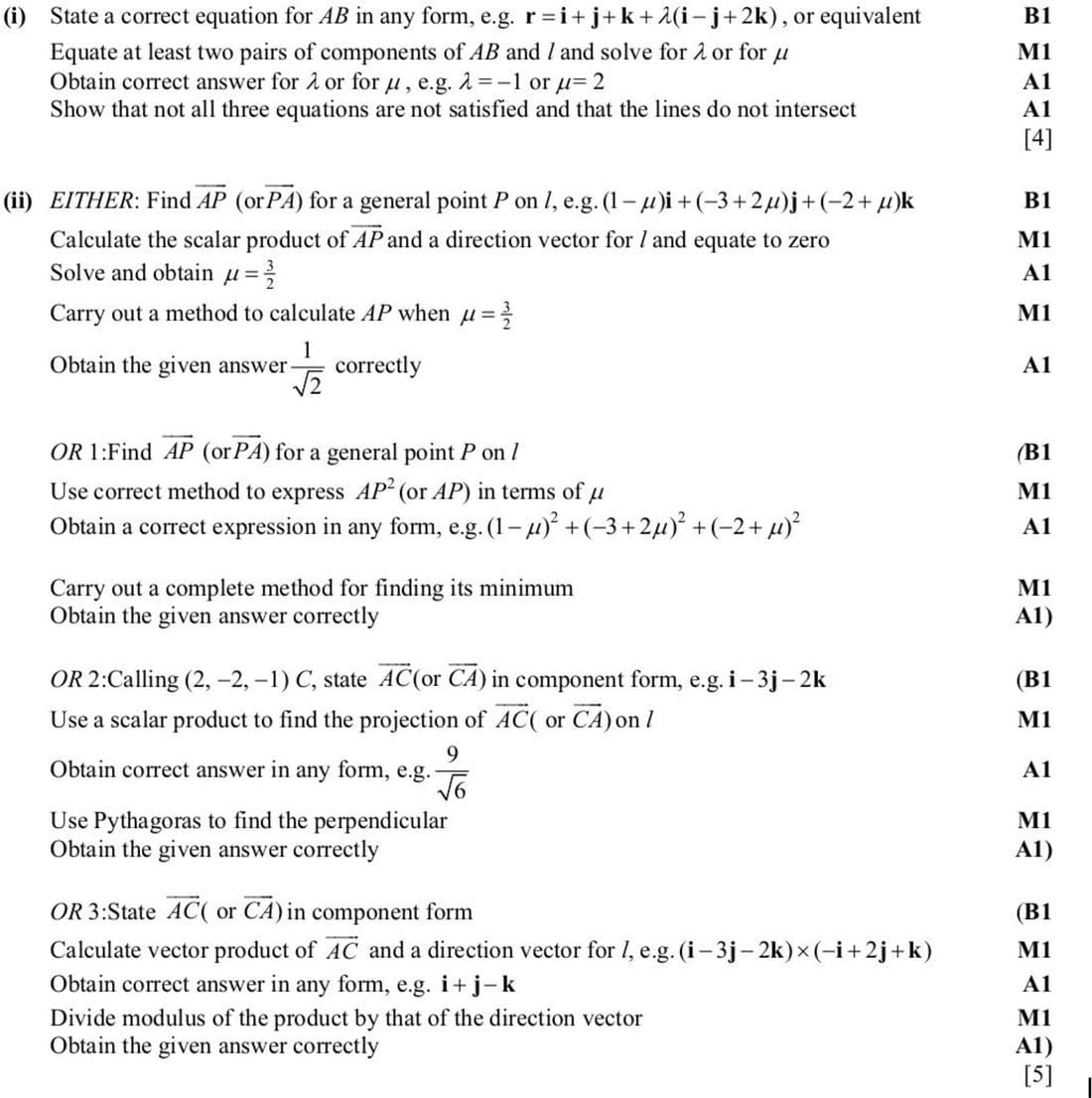
The points A and B have position vectors, relative to the origin O, given by \(\overrightarrow{OA} = \mathbf{i} + \mathbf{j} + \mathbf{k}\) and \(\overrightarrow{OB} = 2\mathbf{i} + 3\mathbf{k}\). The line \(l\) has vector equation \(\mathbf{r} = 2\mathbf{i} - 2\mathbf{j} - \mathbf{k} + \mu(-\mathbf{i} + 2\mathbf{j} + \mathbf{k})\).
(i) Show that the line passing through A and B does not intersect \(l\).
(ii) Show that the length of the perpendicular from A to \(l\) is \(\frac{1}{\sqrt{2}}\).
June 2016 p32 q9
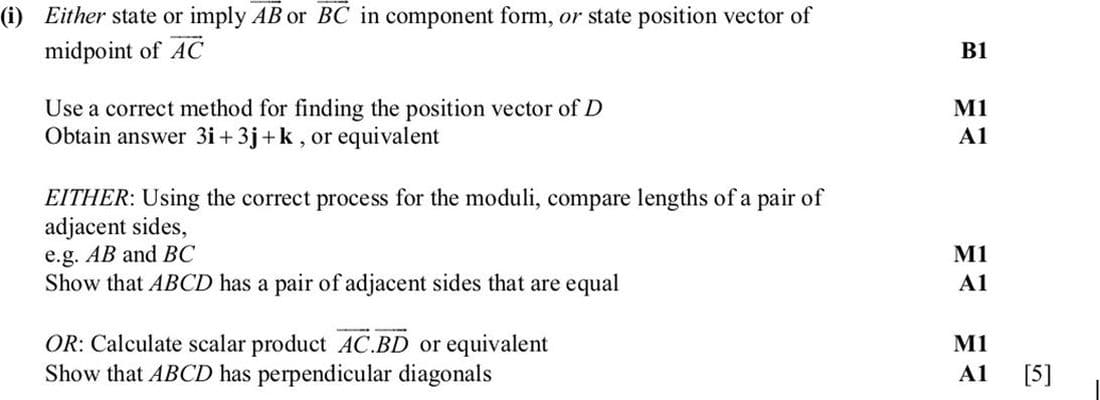
The points A, B and C have position vectors, relative to the origin O, given by \(\overrightarrow{OA} = \mathbf{i} + 2\mathbf{j} + 3\mathbf{k}\), \(\overrightarrow{OB} = 4\mathbf{j} + \mathbf{k}\) and \(\overrightarrow{OC} = 2\mathbf{i} + 5\mathbf{j} - \mathbf{k}\). A fourth point D is such that the quadrilateral ABCD is a parallelogram.
Find the position vector of D and verify that the parallelogram is a rhombus.
June 2015 p32 q10
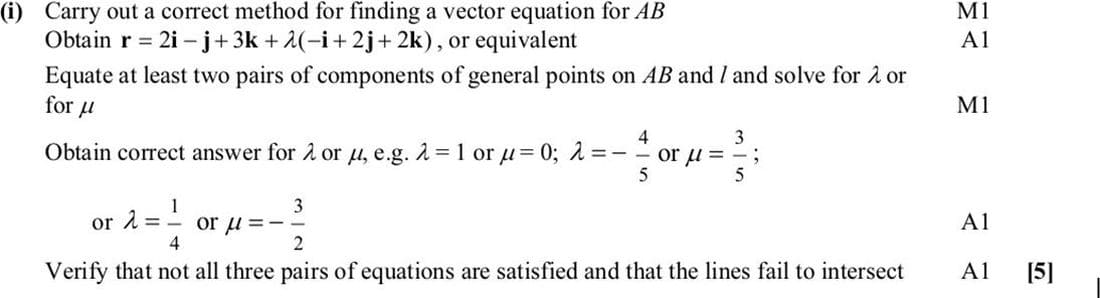
The points A and B have position vectors given by \(\overrightarrow{OA} = 2\mathbf{i} - \mathbf{j} + 3\mathbf{k}\) and \(\overrightarrow{OB} = \mathbf{i} + \mathbf{j} + 5\mathbf{k}\). The line l has equation \(\mathbf{r} = \mathbf{i} + \mathbf{j} + 2\mathbf{k} + \mu(3\mathbf{i} + \mathbf{j} - \mathbf{k})\).
Show that l does not intersect the line passing through A and B.
June 2015 p31 q6
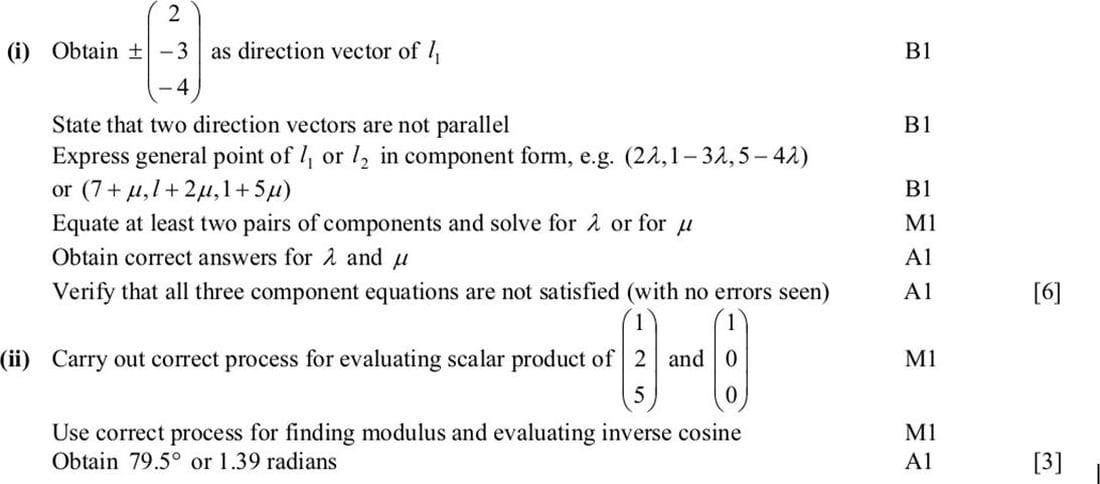
The straight line \(l_1\) passes through the points \((0, 1, 5)\) and \((2, -2, 1)\). The straight line \(l_2\) has equation \(\mathbf{r} = 7\mathbf{i} + \mathbf{j} + \mathbf{k} + \mu(\mathbf{i} + 2\mathbf{j} + 5\mathbf{k})\).
(i) Show that the lines \(l_1\) and \(l_2\) are skew.
(ii) Find the acute angle between the direction of the line \(l_2\) and the direction of the \(x\)-axis.
Nov 2014 p33 q7
The equations of two straight lines are
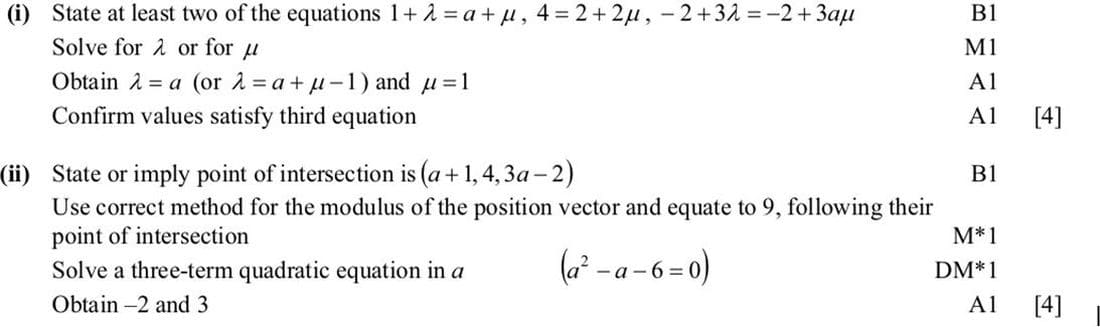
\(\mathbf{r} = \mathbf{i} + 4\mathbf{j} - 2\mathbf{k} + \lambda(\mathbf{i} + 3\mathbf{k})\) and \(\mathbf{r} = a\mathbf{i} + 2\mathbf{j} - 2\mathbf{k} + \mu(\mathbf{i} + 2\mathbf{j} + 3a\mathbf{k})\),
where \(a\) is a constant.
- Show that the lines intersect for all values of \(a\).
- Given that the point of intersection is at a distance of 9 units from the origin, find the possible values of \(a\).