Exam-Style Problems
⬅ Back to SubchapterNov 2003 p3 q2
2041
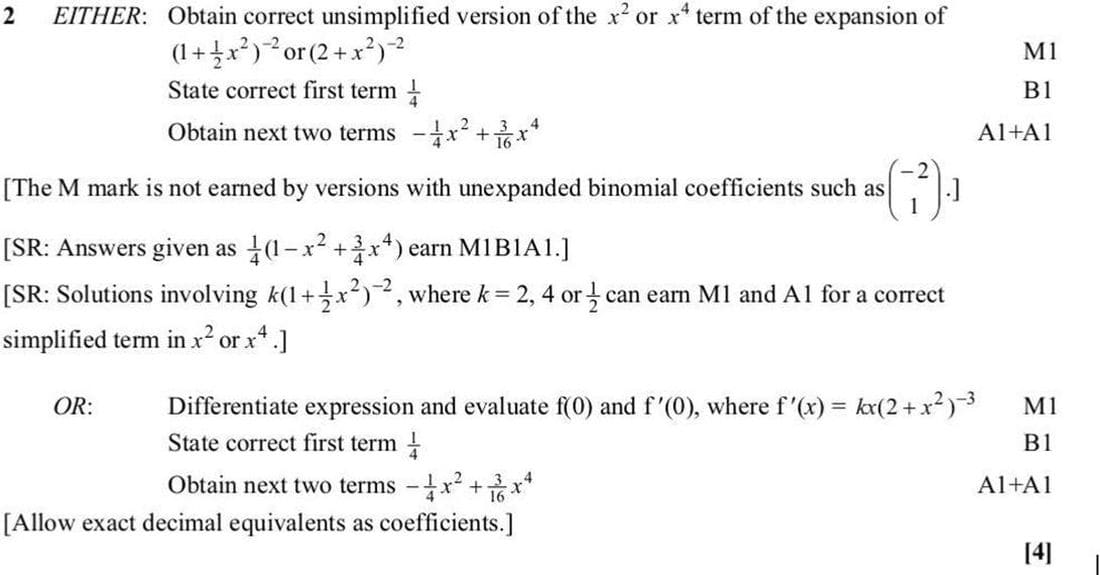
Expand \((2 + x^2)^{-2}\) in ascending powers of \(x\), up to and including the term in \(x^4\), simplifying the coefficients.
June 2002 p3 q2
2042
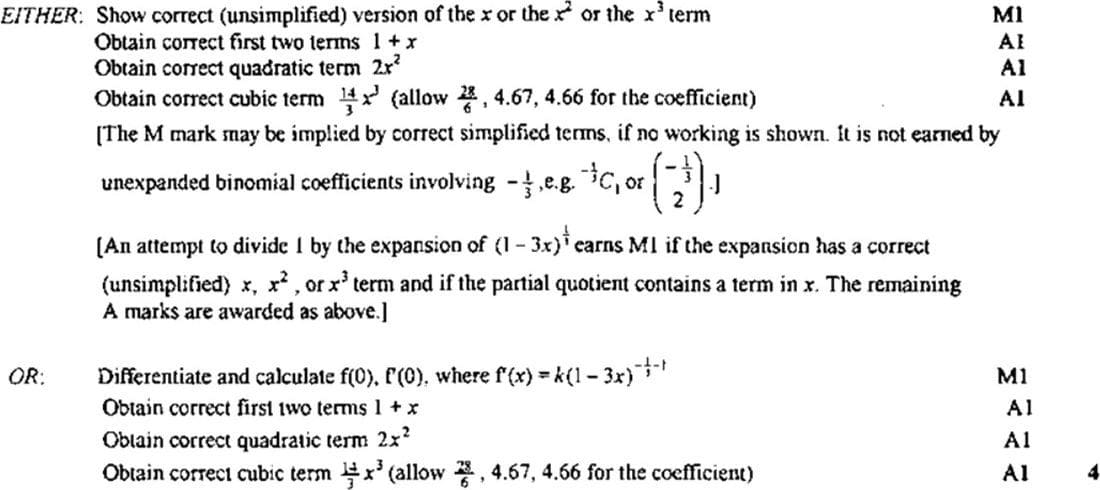
Expand \((1 - 3x)^{-\frac{1}{3}}\) in ascending powers of \(x\), up to and including the term in \(x^3\), simplifying the coefficients.
Nov 2021 p31 q6
2043
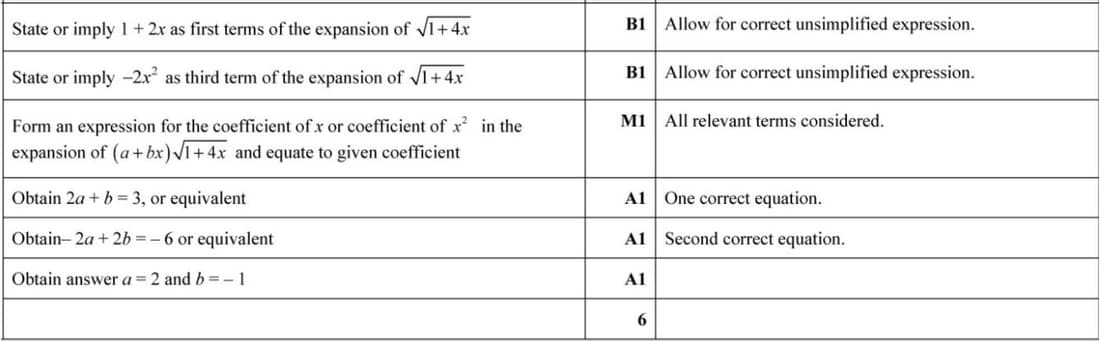
When \((a + bx)\sqrt{1 + 4x}\), where \(a\) and \(b\) are constants, is expanded in ascending powers of \(x\), the coefficients of \(x\) and \(x^2\) are 3 and -6 respectively.
Find the values of \(a\) and \(b\).
June 2021 p33 q1
2044
Expand \((1 + 3x)^{\frac{2}{3}}\) in ascending powers of \(x\), up to and including the term in \(x^3\), simplifying the coefficients.
Nov 2020 p32 q2
2045
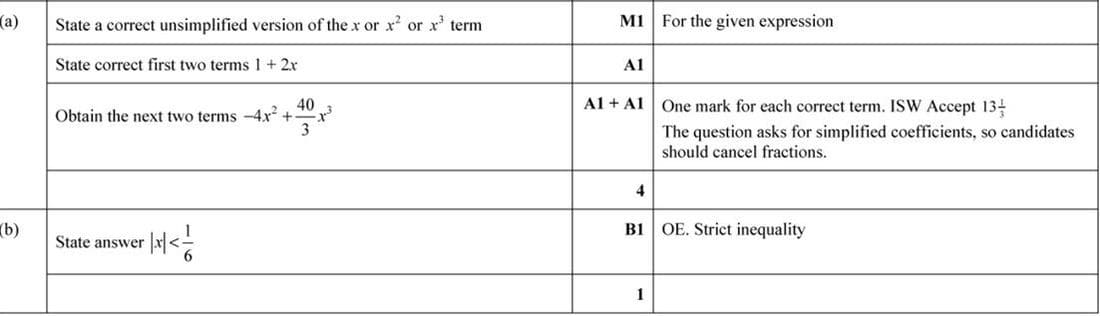
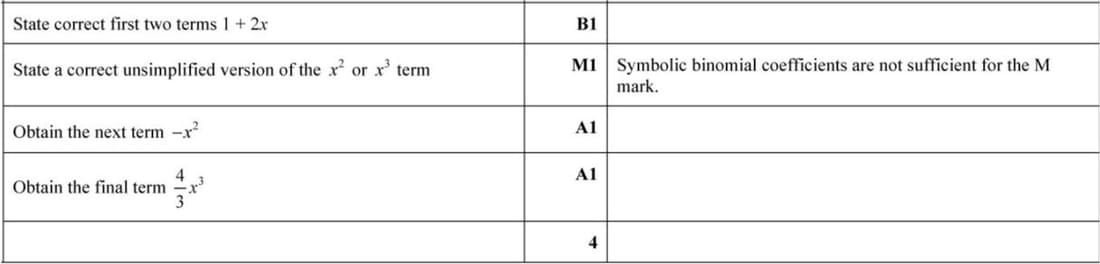
(a) Expand \(\sqrt[3]{1 + 6x}\) in ascending powers of \(x\), up to and including the term in \(x^3\), simplifying the coefficients.
(b) State the set of values of \(x\) for which the expansion is valid.