Exam-Style Problems
⬅ Back to SubchapterJune 2013 p33 q6
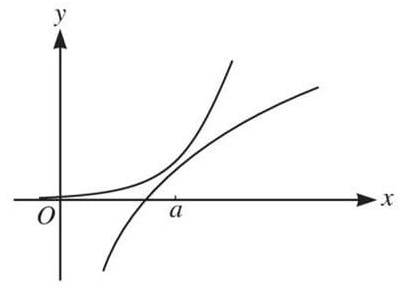
The diagram shows the curves \(y = e^{2x-3}\) and \(y = 2 \ln x\). When \(x = a\) the tangents to the curves are parallel.
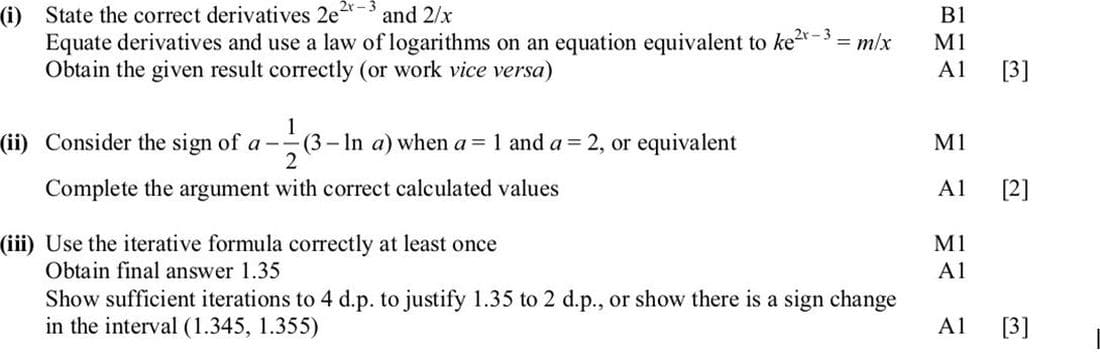
- Show that \(a\) satisfies the equation \(a = \frac{1}{2}(3 - \ln a)\). [3]
- Verify by calculation that this equation has a root between 1 and 2. [2]
- Use the iterative formula \(a_{n+1} = \frac{1}{2}(3 - \ln a_n)\) to calculate \(a\) correct to 2 decimal places, showing the result of each iteration to 4 decimal places. [3]
Nov 2012 p31 q8
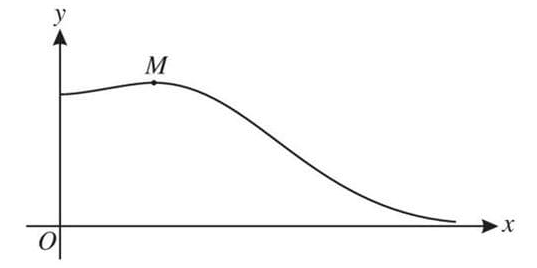
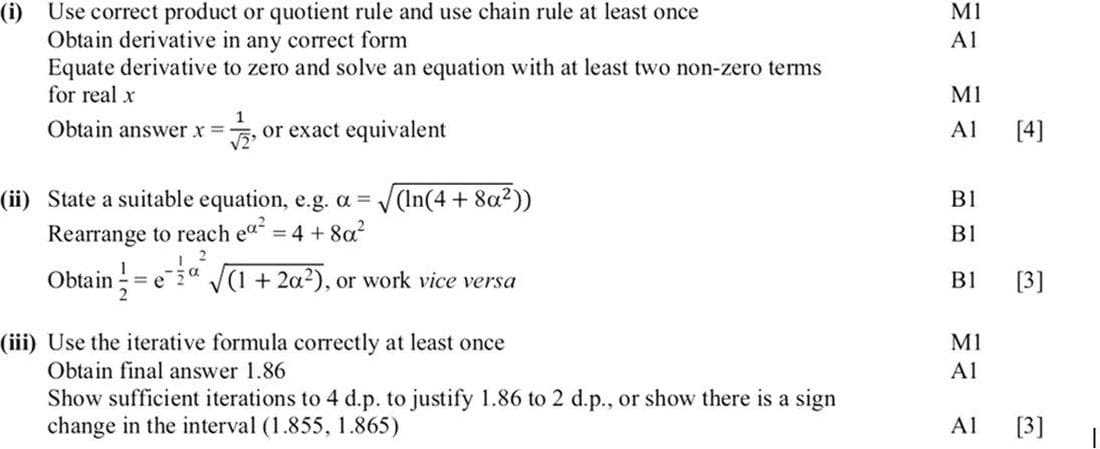
The diagram shows the curve \(y = e^{-\frac{1}{2}x^2} \sqrt{(1 + 2x^2)}\) for \(x \geq 0\), and its maximum point \(M\).
(i) Find the exact value of the \(x\)-coordinate of \(M\). [4]
(ii) The sequence of values given by the iterative formula \(x_{n+1} = \sqrt{(\ln(4 + 8x_n^2))}\), with initial value \(x_1 = 2\), converges to a certain value \(\alpha\). State an equation satisfied by \(\alpha\) and hence show that \(\alpha\) is the \(x\)-coordinate of a point on the curve where \(y = 0.5\). [3]
(iii) Use the iterative formula to determine \(\alpha\) correct to 2 decimal places. Give the result of each iteration to 4 decimal places. [3]
June 2010 p33 q6
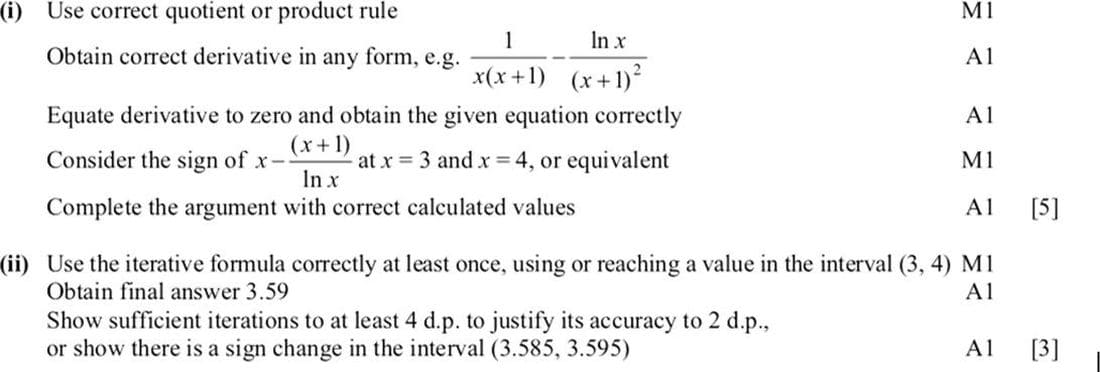
The curve \(y = \frac{\ln x}{x + 1}\) has one stationary point.
(i) Show that the \(x\)-coordinate of this point satisfies the equation \(x = \frac{x + 1}{\ln x}\), and that this \(x\)-coordinate lies between 3 and 4.
(ii) Use the iterative formula \(x_{n+1} = \frac{x_n + 1}{\ln x_n}\) to determine the \(x\)-coordinate correct to 2 decimal places. Give the result of each iteration to 4 decimal places.
June 2010 p32 q4
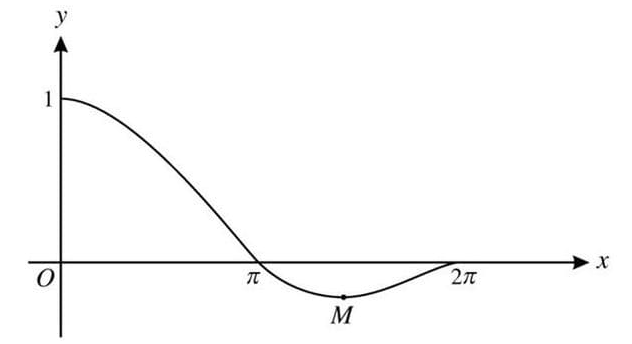
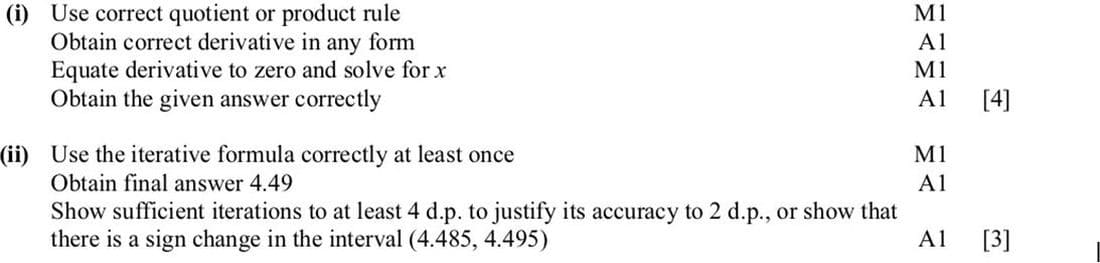
The diagram shows the curve \(y = \frac{\sin x}{x}\) for \(0 < x \leq 2\pi\), and its minimum point \(M\).
(i) Show that the \(x\)-coordinate of \(M\) satisfies the equation \(x = \tan x\).
(ii) The iterative formula \(x_{n+1} = \arctan(x_n) + \pi\) can be used to determine the \(x\)-coordinate of \(M\). Use this formula to determine the \(x\)-coordinate of \(M\) correct to 2 decimal places. Give the result of each iteration to 4 decimal places.
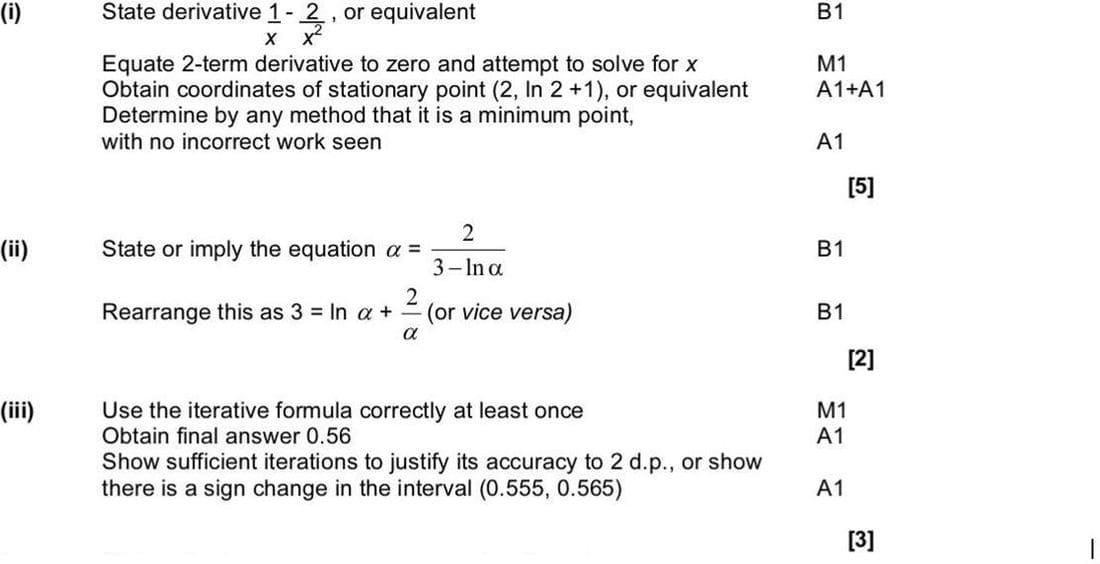
June 2003 p3 q8
The equation of a curve is \(y = \ln x + \frac{2}{x}\), where \(x > 0\).
(i) Find the coordinates of the stationary point of the curve and determine whether it is a maximum or a minimum point.
(ii) The sequence of values given by the iterative formula \(x_{n+1} = \frac{2}{3 - \ln x_n}\), with initial value \(x_1 = 1\), converges to \(\alpha\). State an equation satisfied by \(\alpha\), and hence show that \(\alpha\) is the \(x\)-coordinate of a point on the curve where \(y = 3\).
(iii) Use this iterative formula to find \(\alpha\) correct to 2 decimal places, showing the result of each iteration.