Exam-Style Problems
⬅ Back to SubchapterJune 2013 p33 q4
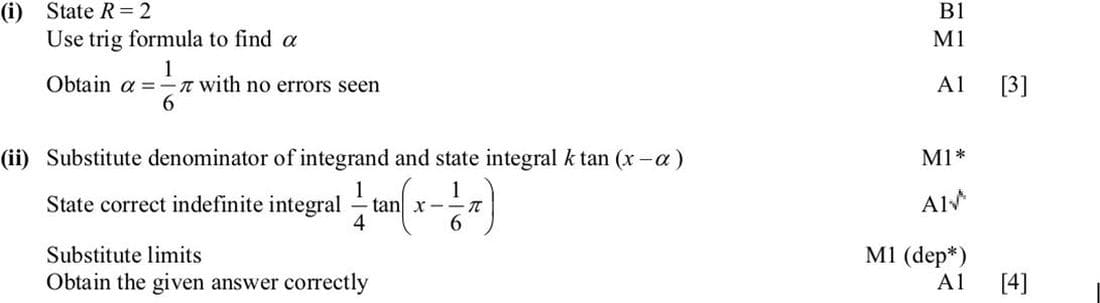
(i) Express \((\sqrt{3}) \cos x + \sin x\) in the form \(R \cos(x - \alpha)\), where \(R > 0\) and \(0 < \alpha < \frac{1}{2}\pi\), giving the exact values of \(R\) and \(\alpha\).
(ii) Hence show that
\(\int_{\frac{1}{6}\pi}^{\frac{1}{2}\pi} \frac{1}{((\sqrt{3}) \cos x + \sin x)^2} \, dx = \frac{1}{4}\sqrt{3}.\)
June 2013 p31 q9
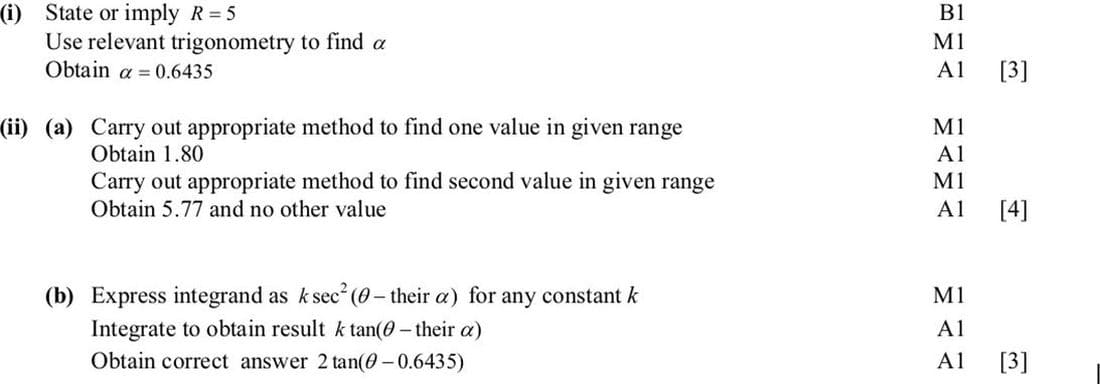
(i) Express \(4 \cos \theta + 3 \sin \theta\) in the form \(R \cos(\theta - \alpha)\), where \(R > 0\) and \(0 < \alpha < \frac{1}{2}\pi\). Give the value of \(\alpha\) correct to 4 decimal places.
(ii) Hence
(a) solve the equation \(4 \cos \theta + 3 \sin \theta = 2\) for \(0 < \theta < 2\pi\),
(b) find \(\int \frac{50}{(4 \cos \theta + 3 \sin \theta)^2} \, d\theta\).
Nov 2012 p33 q7
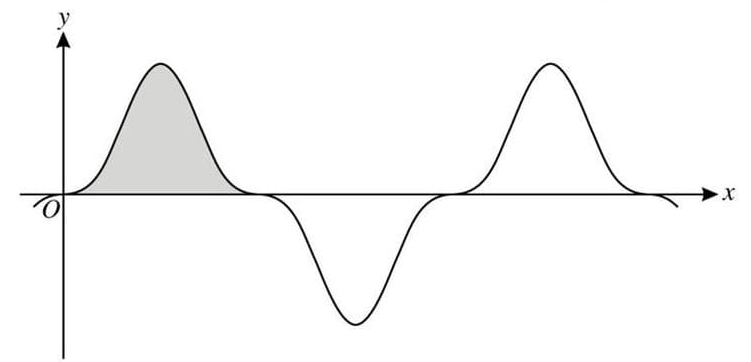
The diagram shows part of the curve \(y = \\sin^3 2x \\cos^3 2x\). The shaded region shown is bounded by the curve and the \(x\)-axis and its exact area is denoted by \(A\).
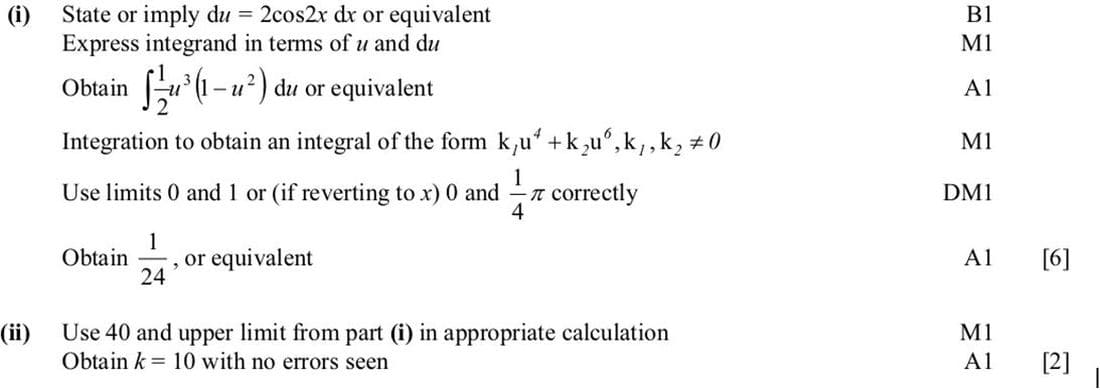
(i) Use the substitution \(u = \\sin 2x\) in a suitable integral to find the value of \(A\). [6]
(ii) Given that \(\\int_0^{k\\pi} |\\sin^3 2x \\cos^3 2x| \, dx = 40A\), find the value of the constant \(k\). [2]
Nov 2012 p31 q5
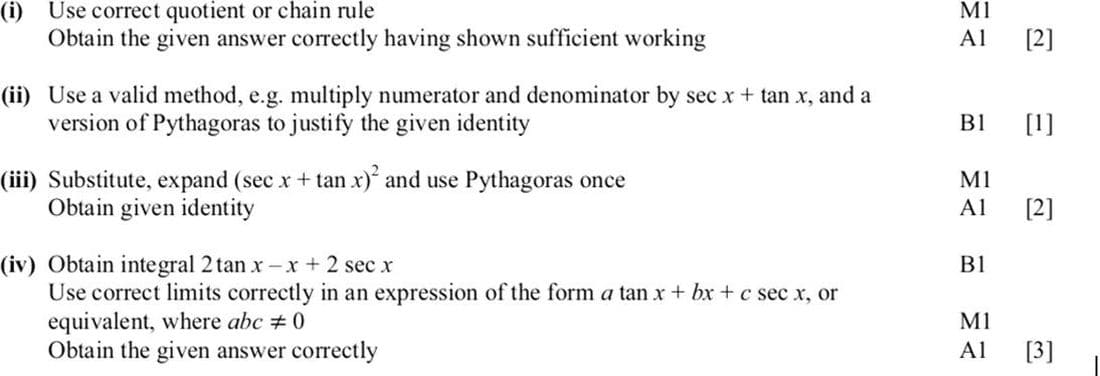
(i) By differentiating \(\frac{1}{\cos x}\), show that if \(y = \sec x\) then \(\frac{dy}{dx} = \sec x \tan x\).
(ii) Show that \(\frac{1}{\sec x - \tan x} \equiv \sec x + \tan x\).
(iii) Deduce that \(\frac{1}{(\sec x - \tan x)^2} \equiv 2 \sec^2 x - 1 + 2 \sec x \tan x\).
(iv) Hence show that \(\int_0^{\frac{1}{4}\pi} \frac{1}{(\sec x - \tan x)^2} \, dx = \frac{1}{4}(8\sqrt{2} - \pi)\).
Nov 2011 p33 q10
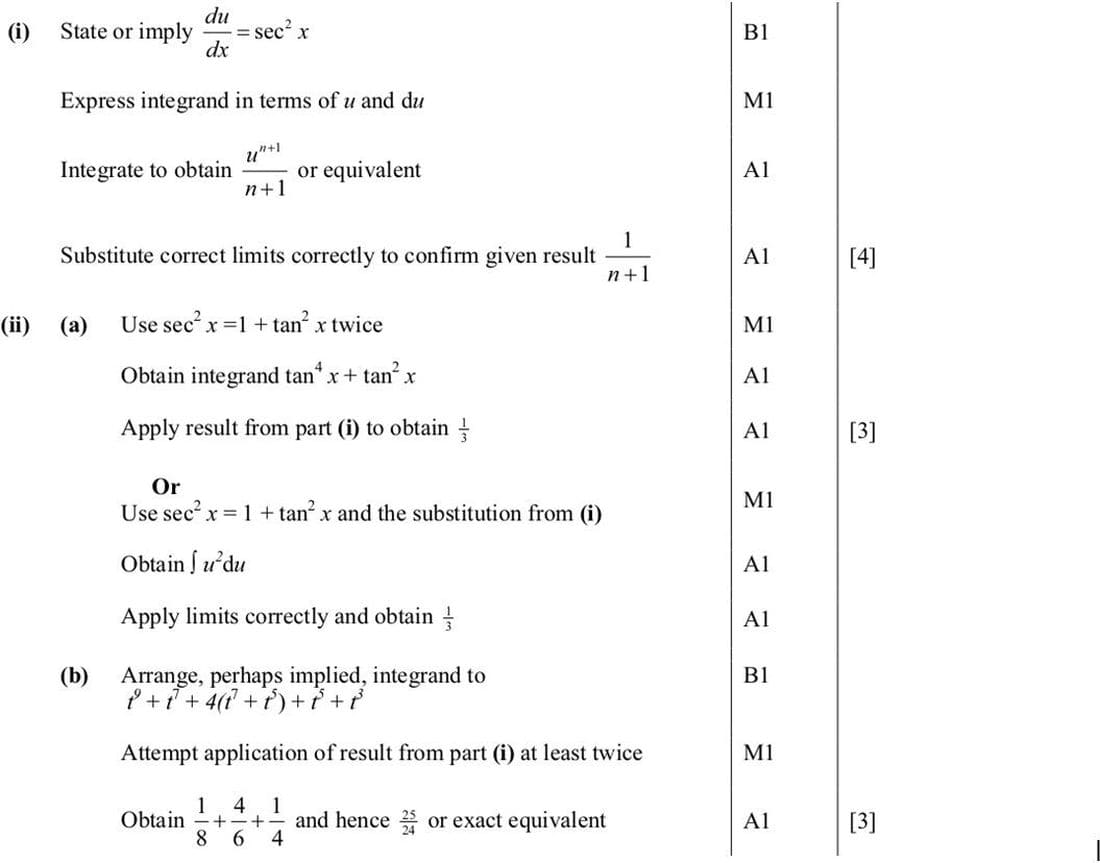
(i) Use the substitution \(u = \tan x\) to show that, for \(n \neq -1\),
\(\int_0^{\frac{\pi}{4}} (\tan^{n+2} x + \tan^n x) \, dx = \frac{1}{n+1}.\)
(ii) Hence find the exact value of
(a) \(\int_0^{\frac{\pi}{4}} (\sec^4 x - \sec^2 x) \, dx,\)
(b) \(\int_0^{\frac{\pi}{4}} (\tan^9 x + 5 \tan^7 x + 5 \tan^5 x + \tan^3 x) \, dx.\)