Exam-Style Problems
⬅ Back to SubchapterJune 2006 p3 q3
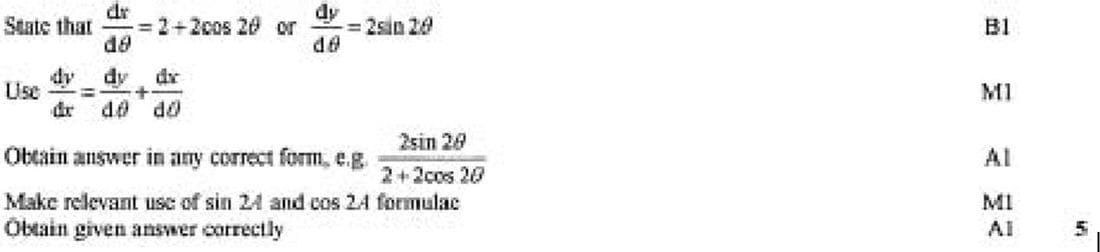
The parametric equations of a curve are
\(x = 2\theta + \sin 2\theta, \quad y = 1 - \cos 2\theta.\)
Show that \(\frac{dy}{dx} = \tan \theta.\)
Feb/Mar 2023 p32 q5
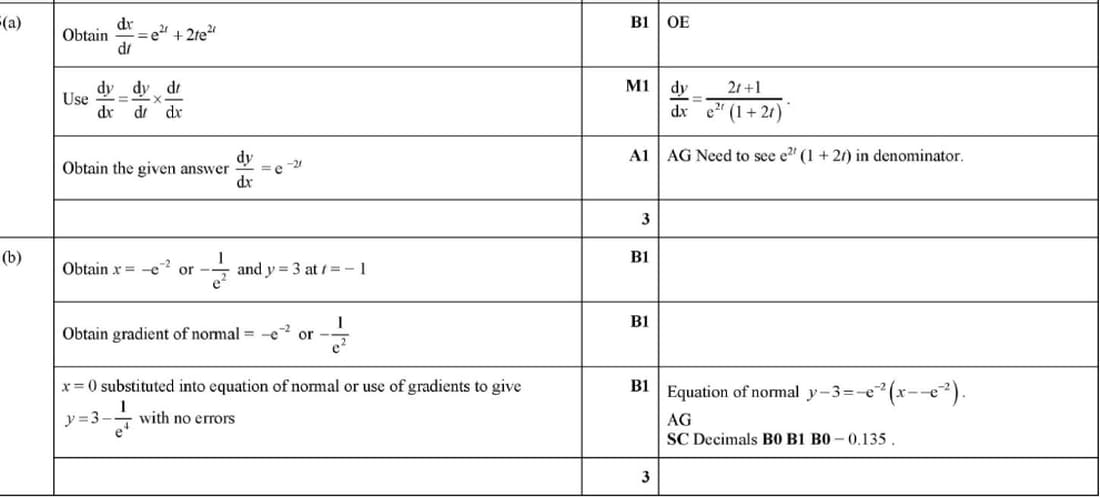
The parametric equations of a curve are
\(x = te^{2t}\), \(y = t^2 + t + 3\).
(a) Show that \(\frac{dy}{dx} = e^{-2t}\).
(b) Hence show that the normal to the curve, where \(t = -1\), passes through the point \(\left( 0, 3 - \frac{1}{e^4} \right)\).
Nov 2022 p33 q4
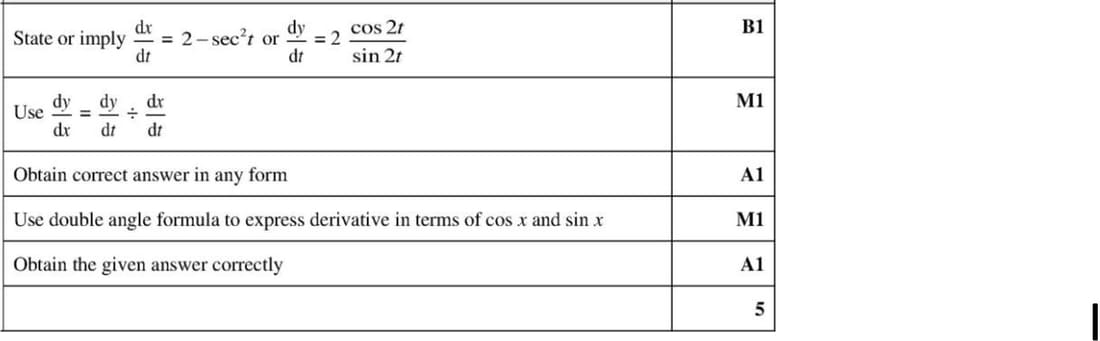
The parametric equations of a curve are
\(x = 2t - an t\), \(y = \\ln(\\\sin 2t)\),
for \(0 < t < \\frac{1}{2}\\pi\).
Show that \(\\frac{dy}{dx} = \\cot t\).
June 2022 p33 q6
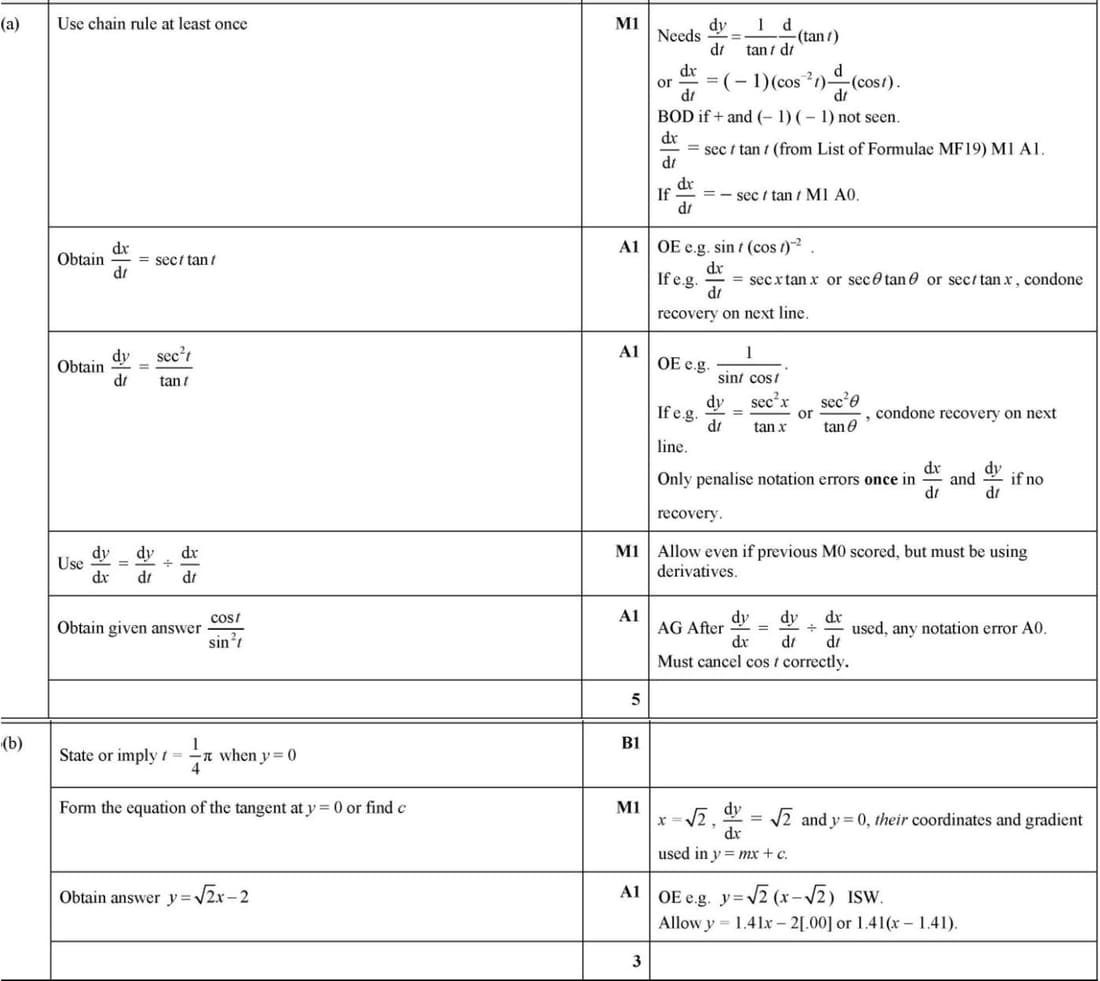
The parametric equations of a curve are \(x = \frac{1}{\cos t}\), \(y = \ln \tan t\), where \(0 < t < \frac{1}{2}\pi\).
(a) Show that \(\frac{dy}{dx} = \frac{\cos t}{\sin^2 t}\).
(b) Find the equation of the tangent to the curve at the point where \(y = 0\).
Feb/Mar 2022 p32 q4
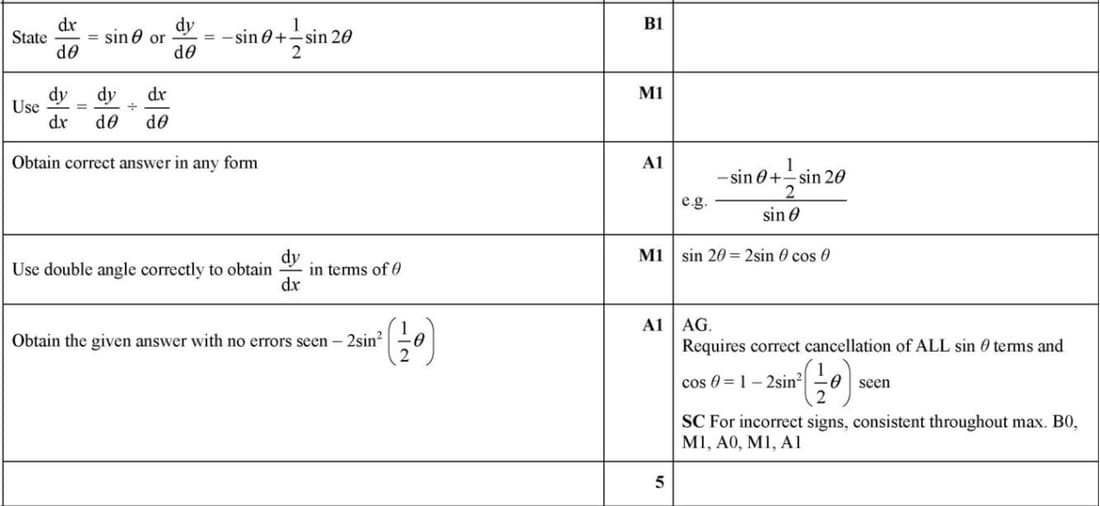
The parametric equations of a curve are
\(x = 1 - \\cos \theta\),
\(y = \\cos \theta - \frac{1}{4} \\cos 2\theta\).
Show that \(\frac{dy}{dx} = -2 \\sin^2 \left( \frac{1}{2} \theta \right)\).