Exam-Style Problems
⬅ Back to SubchapterJune 2014 p11 q12
1389
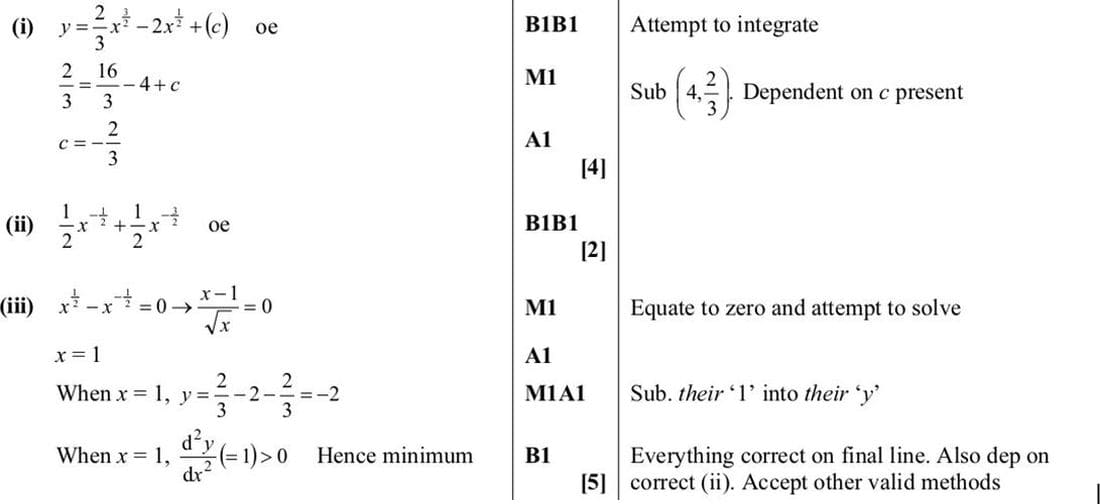
A curve is such that \(\frac{dy}{dx} = x^{\frac{1}{2}} - x^{-\frac{1}{2}}\). The curve passes through the point \((4, \frac{2}{3})\).
(i) Find the equation of the curve.
(ii) Find \(\frac{d^2y}{dx^2}\).
(iii) Find the coordinates of the stationary point and determine its nature.
Nov 2012 p12 q10
1390
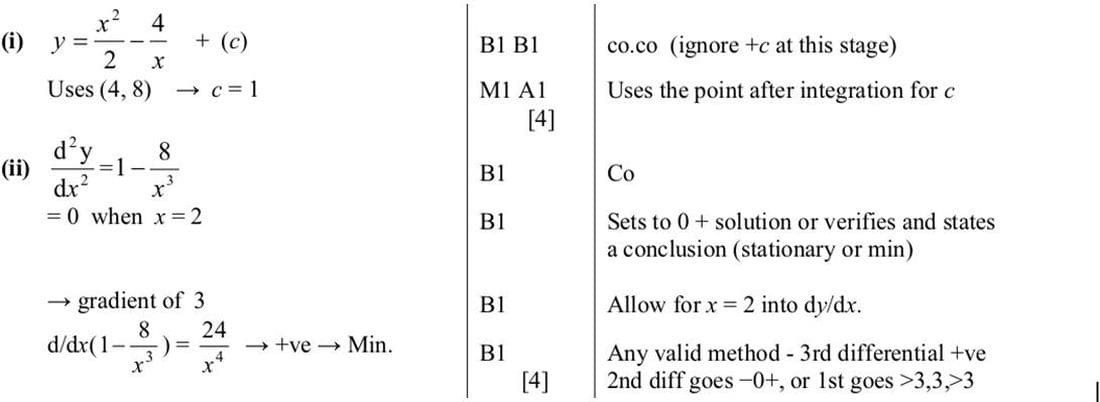
A curve is defined for \(x > 0\) and is such that \(\frac{dy}{dx} = x + \frac{4}{x^2}\). The point \(P(4, 8)\) lies on the curve.
(i) Find the equation of the curve.
(ii) Show that the gradient of the curve has a minimum value when \(x = 2\) and state this minimum value.
Feb/Mar 2020 p12 q10
1391
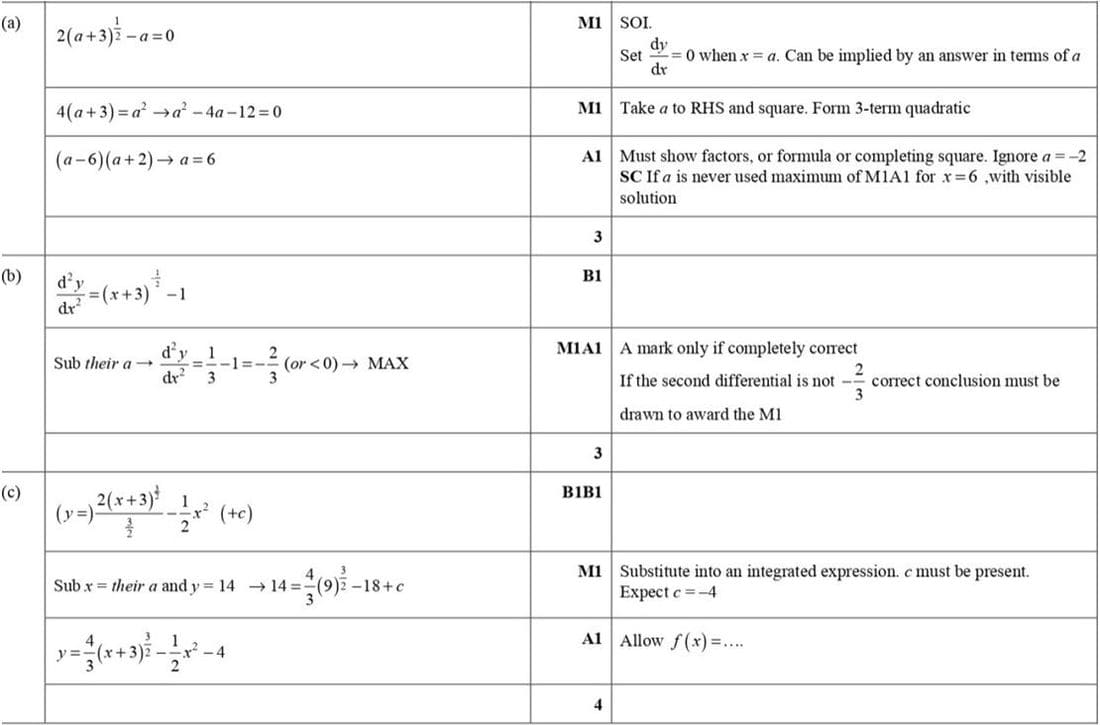
The gradient of a curve at the point \((x, y)\) is given by \(\frac{dy}{dx} = 2(x + 3)^{\frac{1}{2}} - x\). The curve has a stationary point at \((a, 14)\), where \(a\) is a positive constant.
(a) Find the value of \(a\).
(b) Determine the nature of the stationary point.
(c) Find the equation of the curve.
June 2012 p13 q9
1392
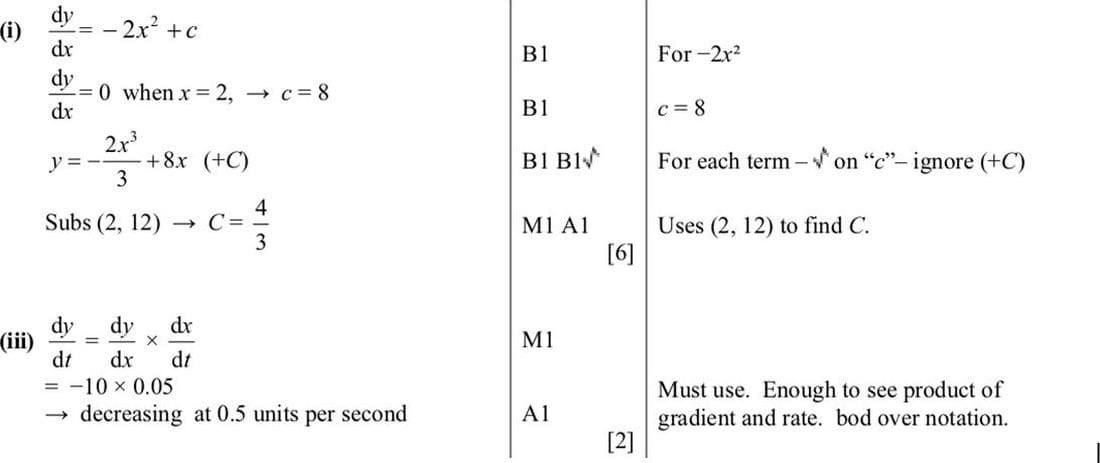
A curve is such that \(\frac{d^2y}{dx^2} = -4x\). The curve has a maximum point at (2, 12).
(i) Find the equation of the curve.
A point \(P\) moves along the curve in such a way that the \(x\)-coordinate is increasing at 0.05 units per second.
(ii) Find the rate at which the \(y\)-coordinate is changing when \(x = 3\), stating whether the \(y\)-coordinate is increasing or decreasing.
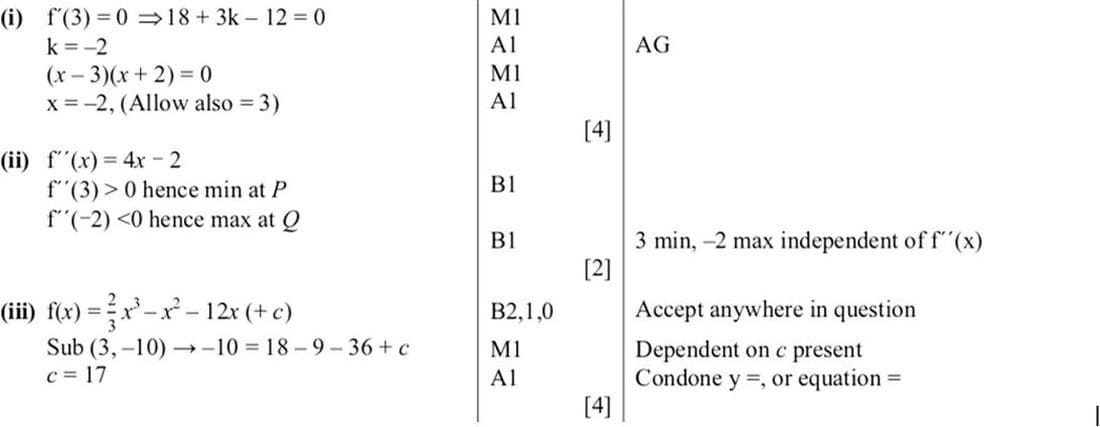
Nov 2011 p13 q8
1393
A curve \(y = f(x)\) has a stationary point at \(P(3, -10)\). It is given that \(f'(x) = 2x^2 + kx - 12\), where \(k\) is a constant.
- Show that \(k = -2\) and hence find the \(x\)-coordinate of the other stationary point, \(Q\).
- Find \(f''(x)\) and determine the nature of each of the stationary points \(P\) and \(Q\).
- Find \(f(x)\).