Exam-Style Problems
⬅ Back to SubchapterNov 2017 p12 q10
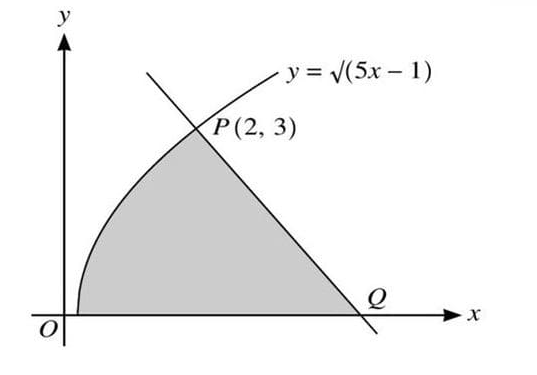
The diagram shows part of the curve \(y = \sqrt{5x - 1}\) and the normal to the curve at the point \(P(2, 3)\). This normal meets the x-axis at \(Q\).
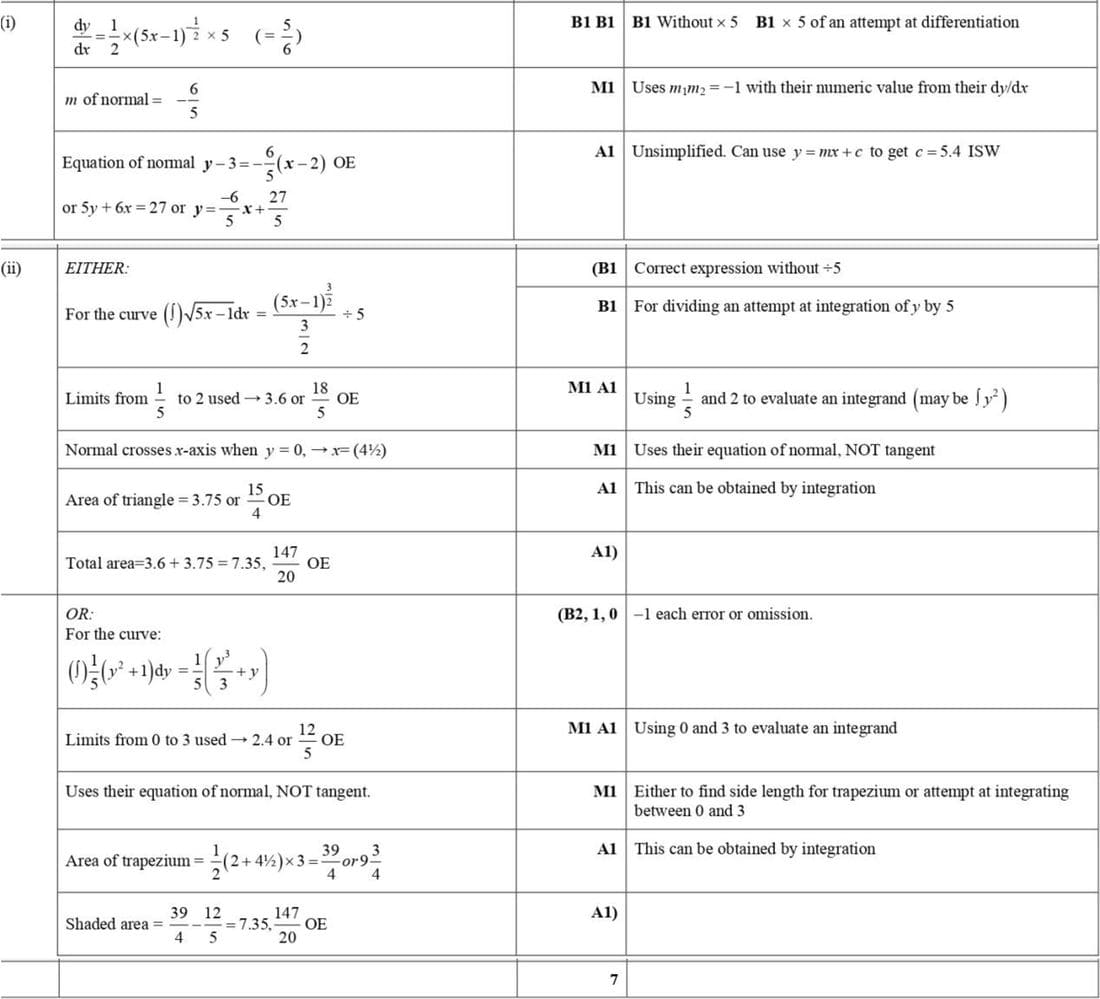
(i) Find the equation of the normal at \(P\).
(ii) Find, showing all necessary working, the area of the shaded region.
Feb/Mar 2017 p12 q10
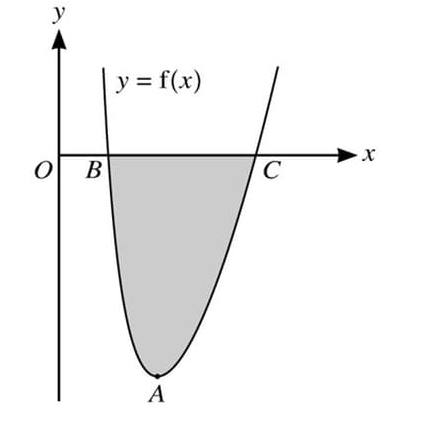
The diagram shows the curve \(y = f(x)\) defined for \(x > 0\). The curve has a minimum point at \(A\) and crosses the \(x\)-axis at \(B\) and \(C\). It is given that \(\frac{dy}{dx} = 2x - \frac{2}{x^3}\) and that the curve passes through the point \(\left(4, \frac{189}{16}\right)\).
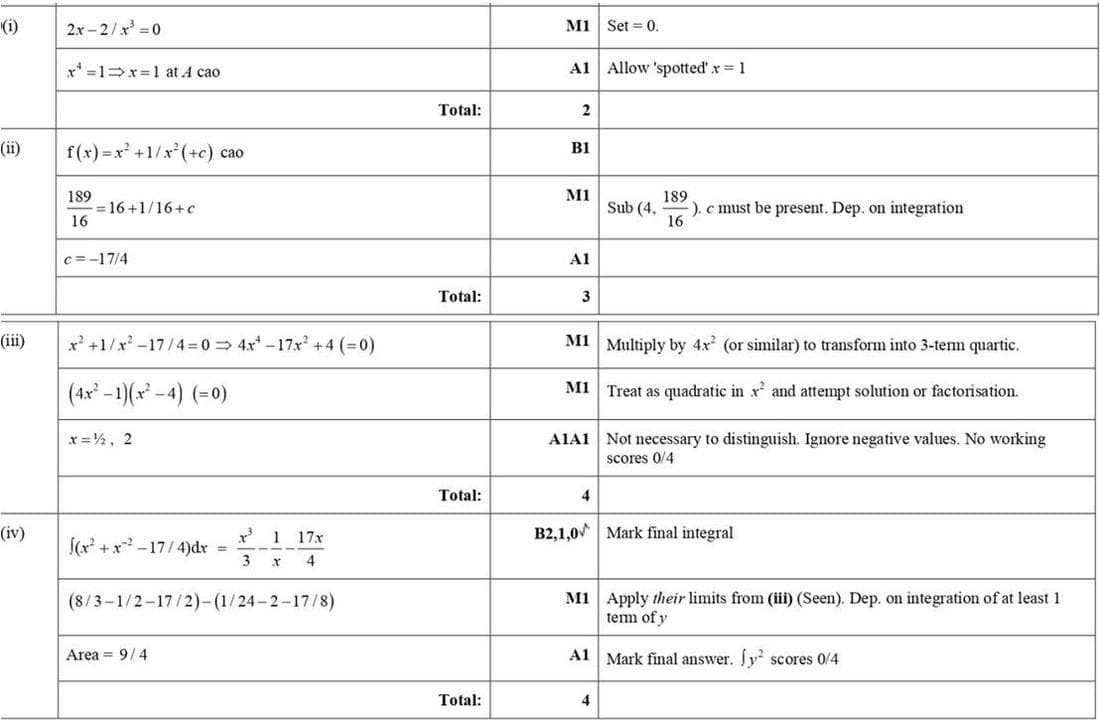
(i) Find the \(x\)-coordinate of \(A\).
(ii) Find \(f(x)\).
(iii) Find the \(x\)-coordinates of \(B\) and \(C\).
(iv) Find, showing all necessary working, the area of the shaded region.
Nov 2023 p11 q8
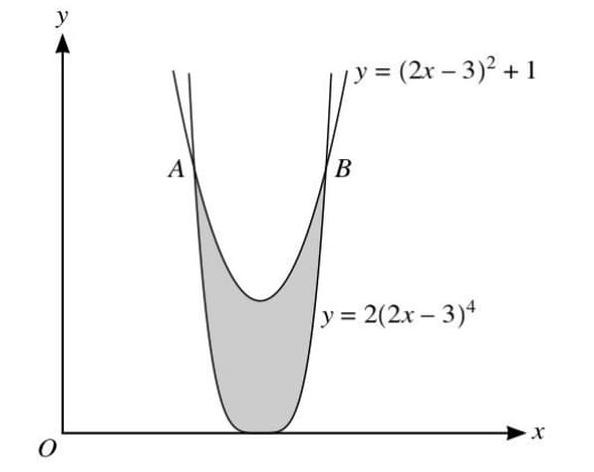
The diagram shows the curves with equations \(y = 2(2x - 3)^4\) and \(y = (2x - 3)^2 + 1\) meeting at points \(A\) and \(B\).
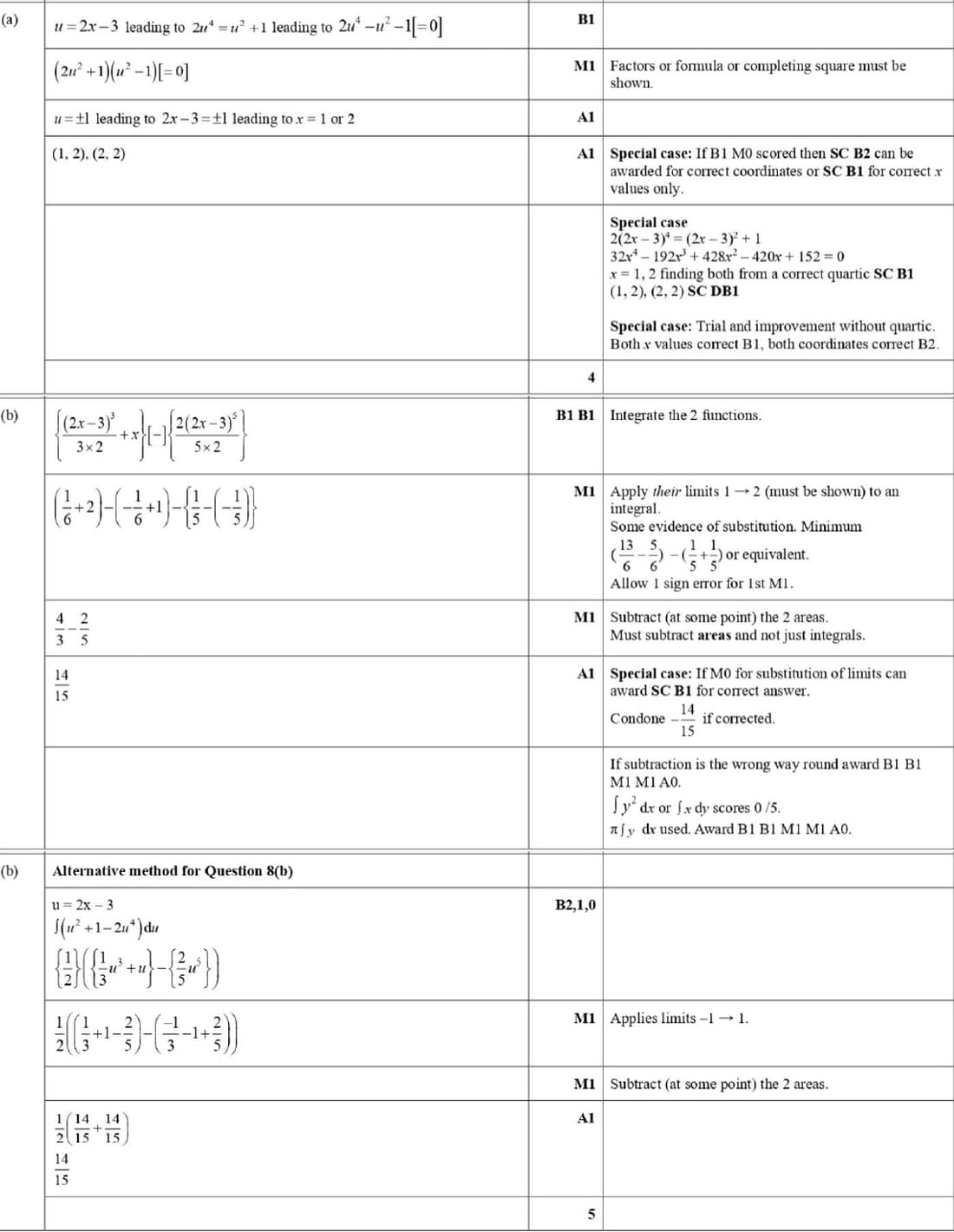
(a) By using the substitution \(u = 2x - 3\), find, by calculation, the coordinates of \(A\) and \(B\). [4]
(b) Find the exact area of the shaded region. [5]
Nov 2016 p11 q7
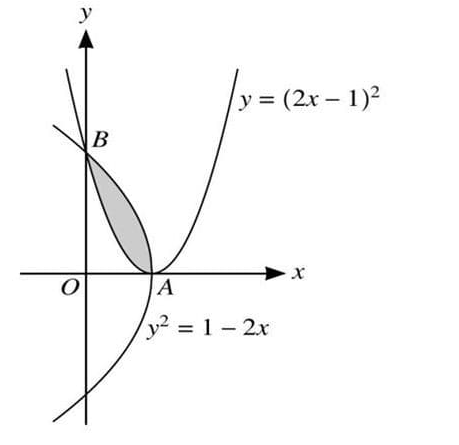
The diagram shows parts of the curves \(y = (2x - 1)^2\) and \(y^2 = 1 - 2x\), intersecting at points \(A\) and \(B\).
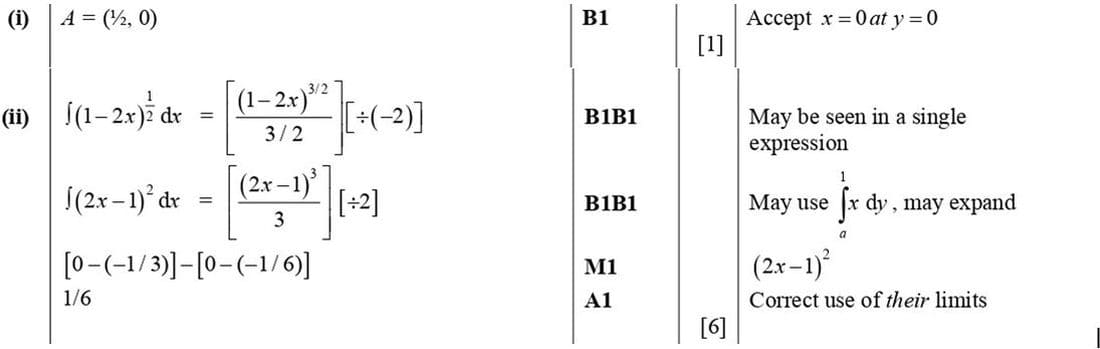
(i) State the coordinates of \(A\).
(ii) Find, showing all necessary working, the area of the shaded region.
Problem 1284
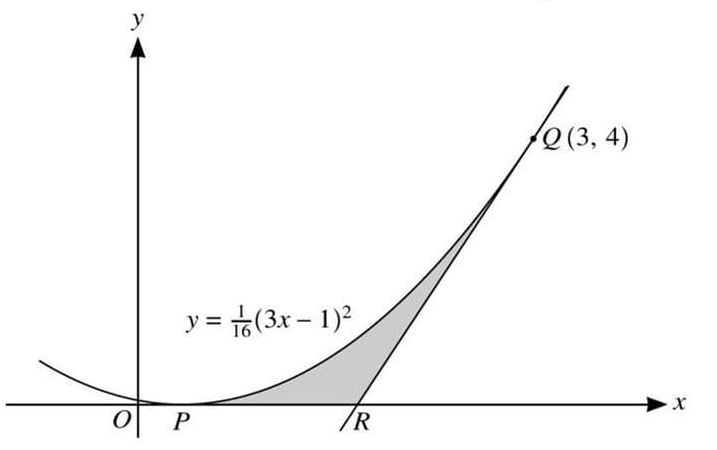
The diagram shows part of the curve \(y = \frac{1}{16}(3x-1)^2\), which touches the \(x\)-axis at the point \(P\). The point \(Q (3, 4)\) lies on the curve and the tangent to the curve at \(Q\) crosses the \(x\)-axis at \(R\).
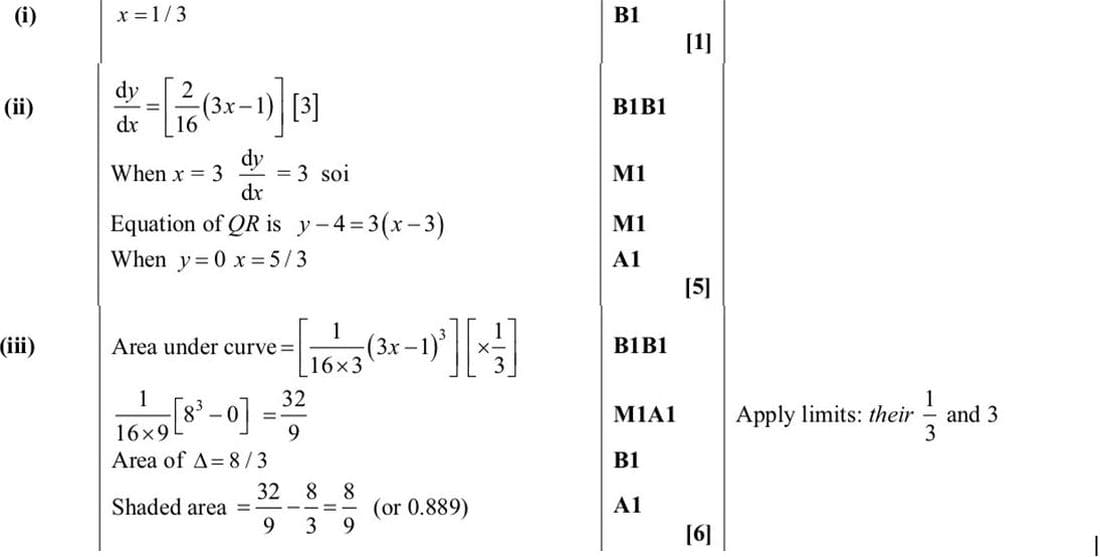
(i) State the \(x\)-coordinate of \(P\).
Showing all necessary working, find by calculation
(ii) the \(x\)-coordinate of \(R\),
(iii) the area of the shaded region \(PQR\).