Exam-Style Problems
⬅ Back to SubchapterNov 2014 p12 q4
1119
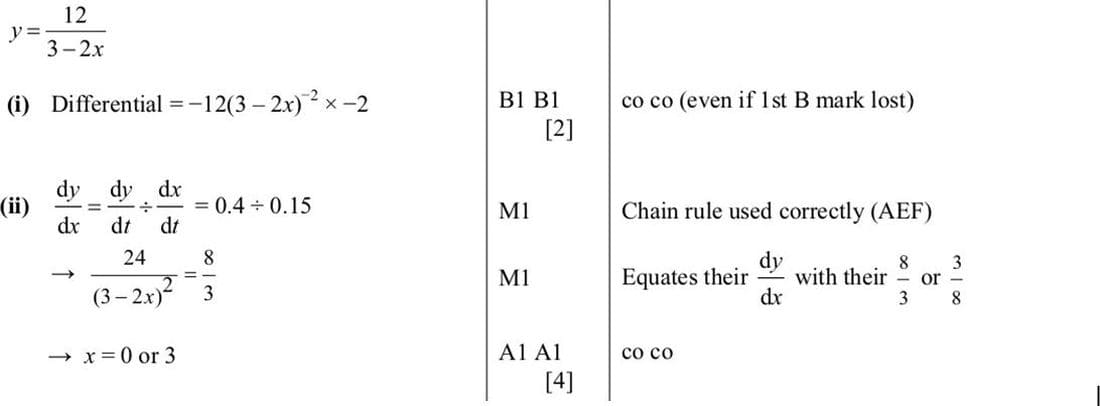
A curve has equation \(y = \frac{12}{3 - 2x}\).
(i) Find \(\frac{dy}{dx}\).
A point moves along this curve. As the point passes through \(A\), the x-coordinate is increasing at a rate of 0.15 units per second and the y-coordinate is increasing at a rate of 0.4 units per second.
(ii) Find the possible x-coordinates of \(A\).
Nov 2013 p12 q9
1120
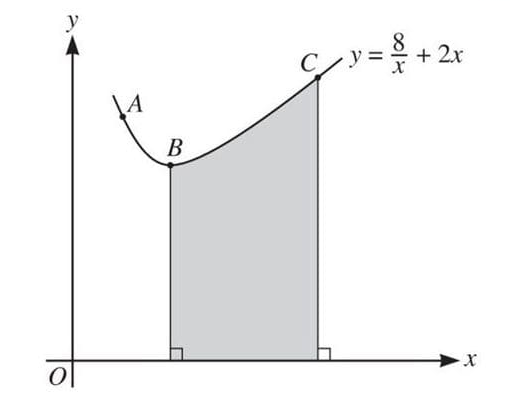
The diagram shows part of the curve \(y = \frac{8}{x} + 2x\) and three points \(A, B,\) and \(C\) on the curve with \(x\)-coordinates 1, 2, and 5 respectively.
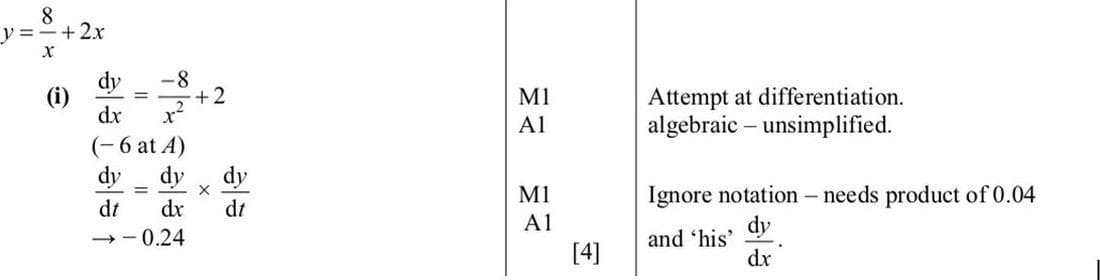
A point \(P\) moves along the curve in such a way that its \(x\)-coordinate increases at a constant rate of 0.04 units per second. Find the rate at which the \(y\)-coordinate of \(P\) is changing as \(P\) passes through \(A\).
June 2023 p11 q9
1121
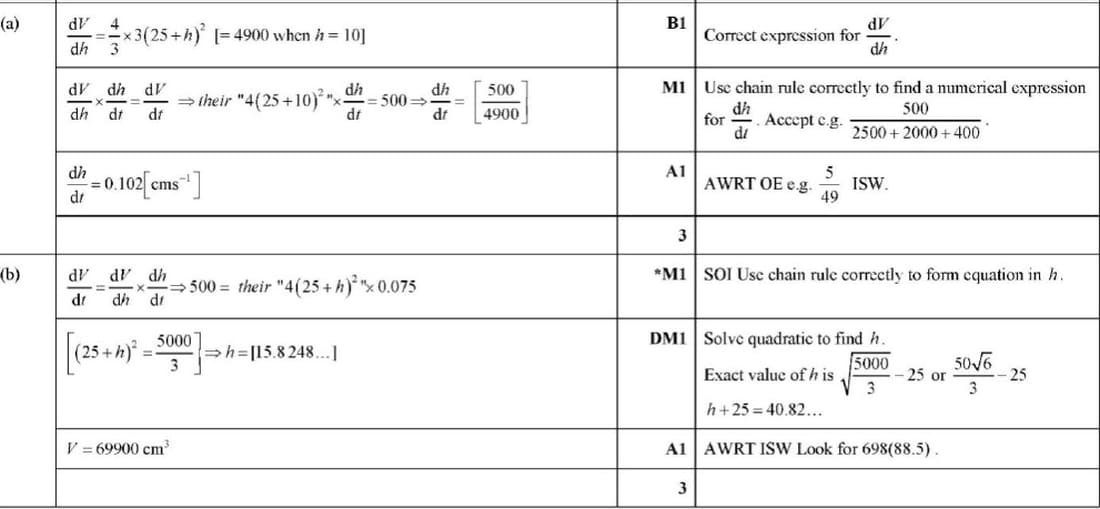
Water is poured into a tank at a constant rate of 500 cm3 per second. The depth of water in the tank, t seconds after filling starts, is h cm. When the depth of water in the tank is h cm, the volume, V cm3, of water in the tank is given by the formula \(V = \frac{4}{3}(25 + h)^3 - \frac{62500}{3}\).
\((a) Find the rate at which h is increasing at the instant when h = 10 cm.\)
(b) At another instant, the rate at which h is increasing is 0.075 cm per second. Find the value of V at this instant.
Nov 2012 p11 q3
1122
An oil pipeline under the sea is leaking oil and a circular patch of oil has formed on the surface of the sea. At midday the radius of the patch of oil is 50 m and is increasing at a rate of 3 metres per hour. Find the rate at which the area of the oil is increasing at midday.

June 2012 p12 q2
1123
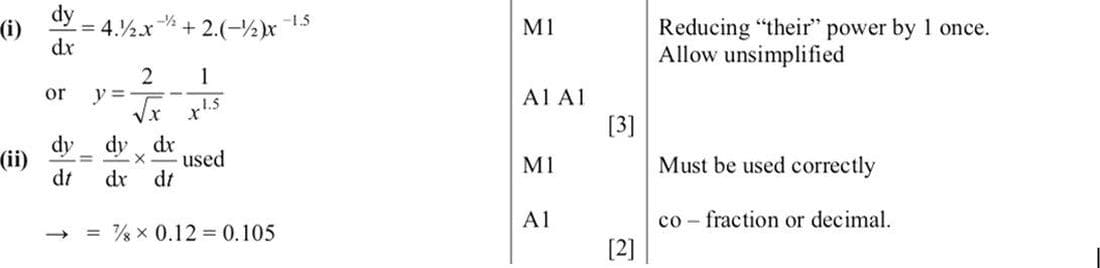
The equation of a curve is \(y = 4\sqrt{x} + \frac{2}{\sqrt{x}}\).
(i) Obtain an expression for \(\frac{dy}{dx}\).
(ii) A point is moving along the curve in such a way that the \(x\)-coordinate is increasing at a constant rate of 0.12 units per second. Find the rate of change of the \(y\)-coordinate when \(x = 4\).