Exam-Style Problems
⬅ Back to SubchapterFeb/Mar 2020 p12 q1
The function \(f\) is defined by \(f(x) = \frac{1}{3x+2} + x^2\) for \(x < -1\).
Determine whether \(f\) is an increasing function, a decreasing function or neither.

Nov 2019 p11 q2
An increasing function, \(f\), is defined for \(x > n\), where \(n\) is an integer. It is given that \(f'(x) = x^2 - 6x + 8\). Find the least possible value of \(n\).

Nov 2018 p13 q2
The function \(f\) is defined by \(f'(x) = x^3 + 2x^2 - 4x + 7\) for \(x \geq -2\). Determine, showing all necessary working, whether \(f\) is an increasing function, a decreasing function or neither.

June 2018 p13 q8
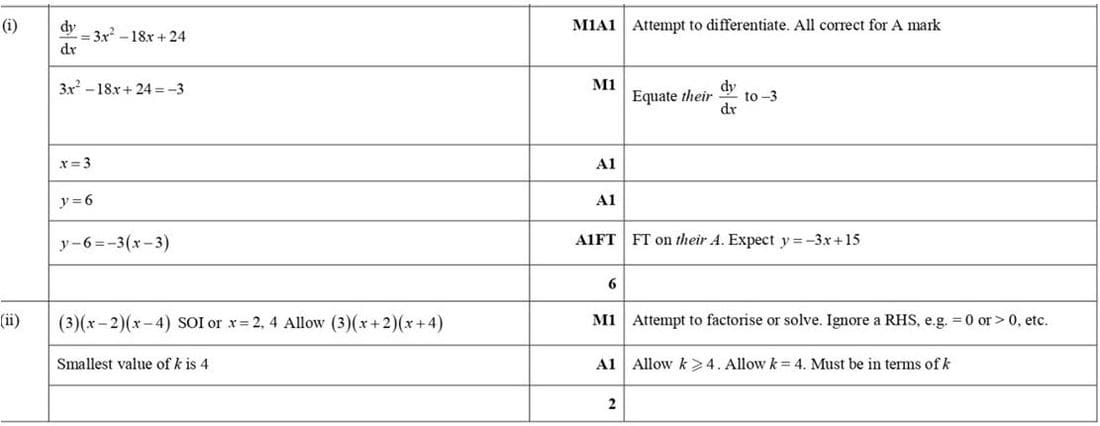
(i) The tangent to the curve \(y = x^3 - 9x^2 + 24x - 12\) at a point \(A\) is parallel to the line \(y = 2 - 3x\). Find the equation of the tangent at \(A\).
(ii) The function \(f\) is defined by \(f(x) = x^3 - 9x^2 + 24x - 12\) for \(x > k\), where \(k\) is a constant. Find the smallest value of \(k\) for \(f\) to be an increasing function.
Nov 2017 p13 q4
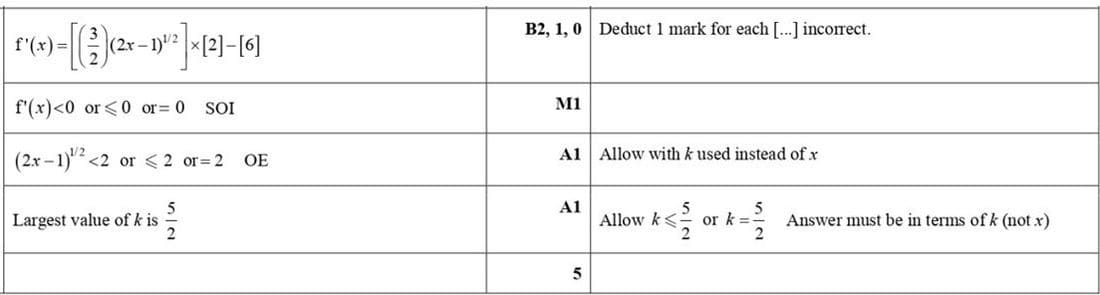
The function \(f\) is such that \(f(x) = (2x - 1)^{\frac{3}{2}} - 6x\) for \(\frac{1}{2} < x < k\), where \(k\) is a constant. Find the largest value of \(k\) for which \(f\) is a decreasing function.