Exam-Style Problems
⬅ Back to SubchapterNov 2021 p11 q4
816
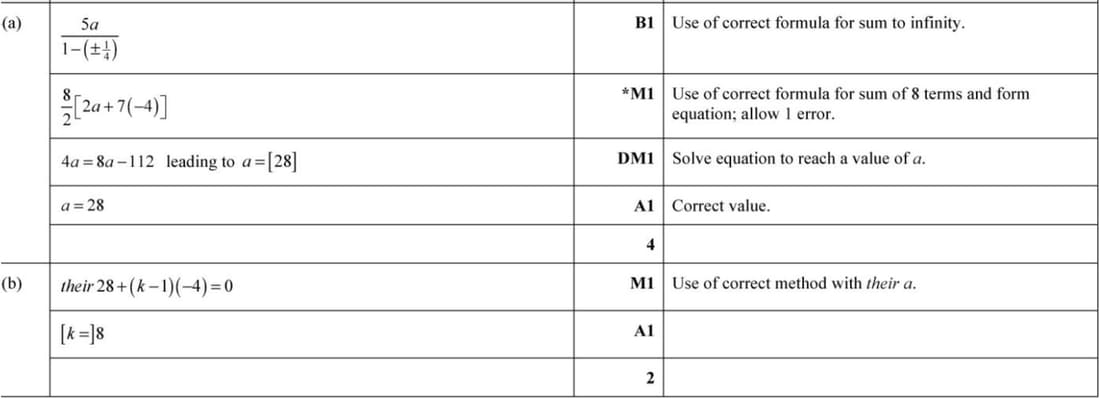
The first term of an arithmetic progression is \(a\) and the common difference is \(-4\). The first term of a geometric progression is \(5a\) and the common ratio is \(-\frac{1}{4}\). The sum to infinity of the geometric progression is equal to the sum of the first eight terms of the arithmetic progression.
(a) Find the value of \(a\).
The \(k\)th term of the arithmetic progression is zero.
(b) Find the value of \(k\).
June 2021 p12 q8
817
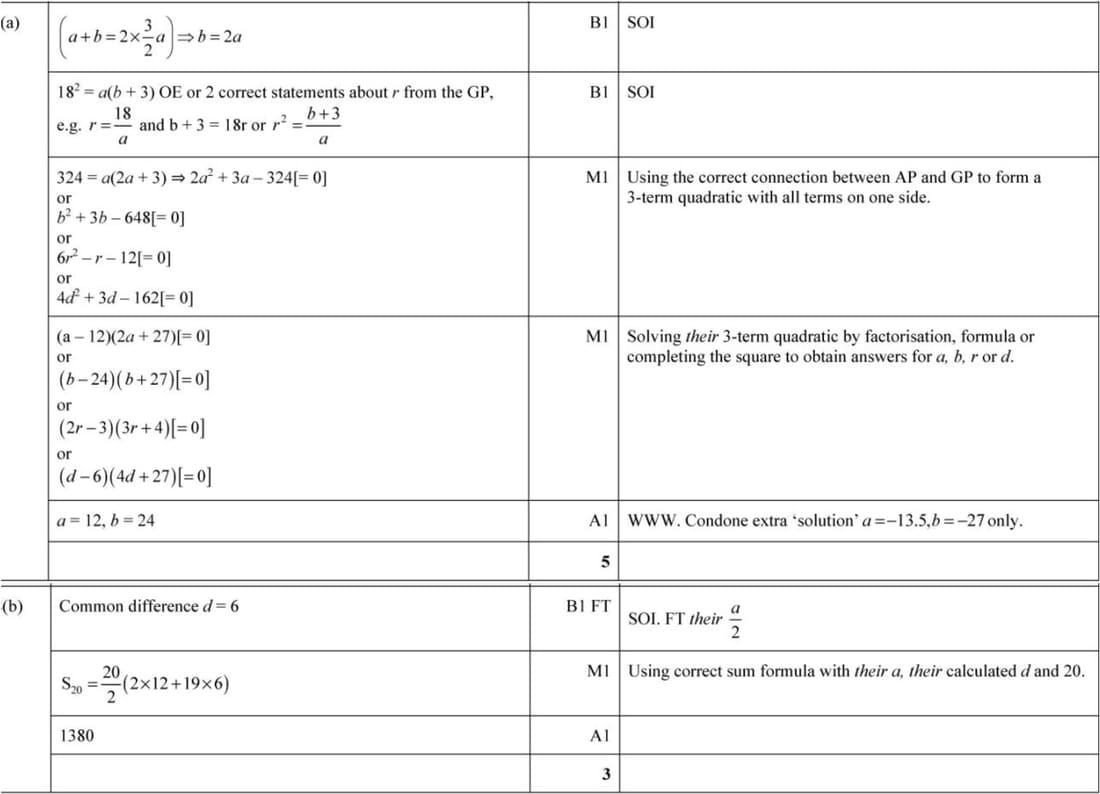
The first, second and third terms of an arithmetic progression are \(a\), \(\frac{3}{2}a\) and \(b\) respectively, where \(a\) and \(b\) are positive constants. The first, second and third terms of a geometric progression are \(a\), 18 and \(b + 3\) respectively.
(a) Find the values of \(a\) and \(b\).
(b) Find the sum of the first 20 terms of the arithmetic progression.
June 2019 p13 q5
818
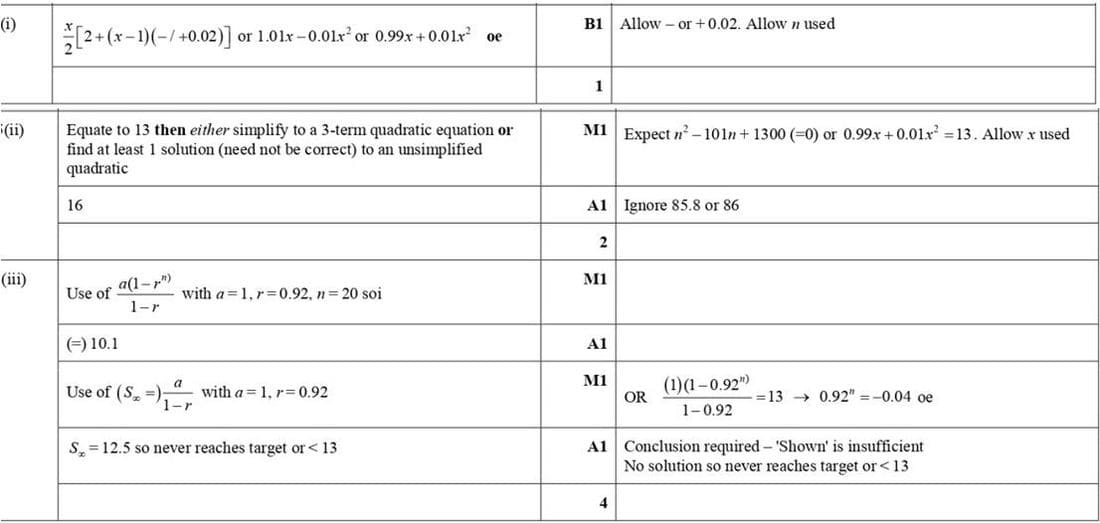
Two heavyweight boxers decide that they would be more successful if they competed in a lower weight class. For each boxer this would require a total weight loss of 13 kg. At the end of week 1 they have each recorded a weight loss of 1 kg and they both find that in each of the following weeks their weight loss is slightly less than the week before.
Boxer A’s weight loss in week 2 is 0.98 kg. It is given that his weekly weight loss follows an arithmetic progression.
- Write down an expression for his total weight loss after x weeks.
- He reaches his 13 kg target during week n. Use your answer to part (i) to find the value of n.
Boxer B’s weight loss in week 2 is 0.92 kg and it is given that his weekly weight loss follows a geometric progression.
- Calculate his total weight loss after 20 weeks and show that he can never reach his target.
June 2019 p11 q8
819
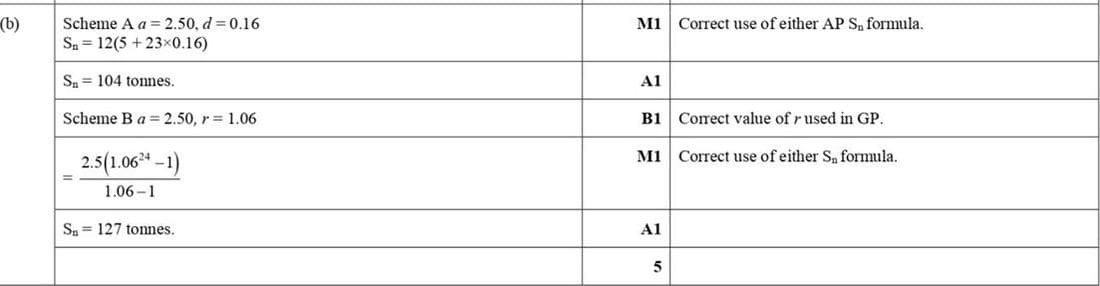
Two schemes are proposed for increasing the amount of household waste that is recycled each week.
Scheme A is to increase the amount of waste recycled each month by 0.16 tonnes.
Scheme B is to increase the amount of waste recycled each month by 6% of the amount recycled in the previous month.
The proposal is to operate the scheme for a period of 24 months. The amount recycled in the first month is 2.5 tonnes.
For each scheme, find the total amount of waste that would be recycled over the 24-month period.
Nov 2018 p12 q5
820
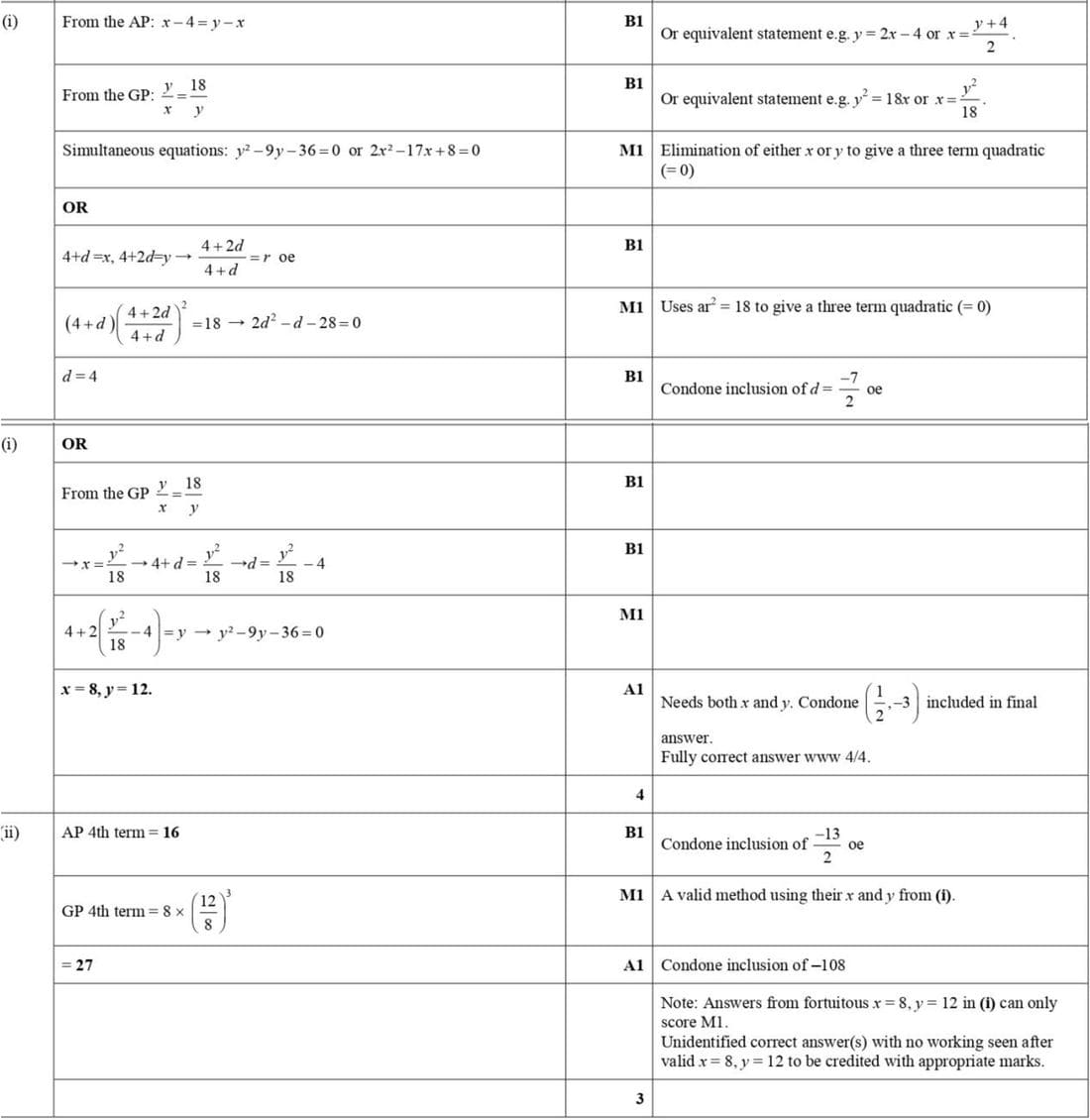
The first three terms of an arithmetic progression are 4, x and y respectively. The first three terms of a geometric progression are x, y and 18 respectively. It is given that both x and y are positive.
(i) Find the value of x and the value of y.
(ii) Find the fourth term of each progression.