Exam-Style Problems
⬅ Back to SubchapterJune 2012 p13 q1
586
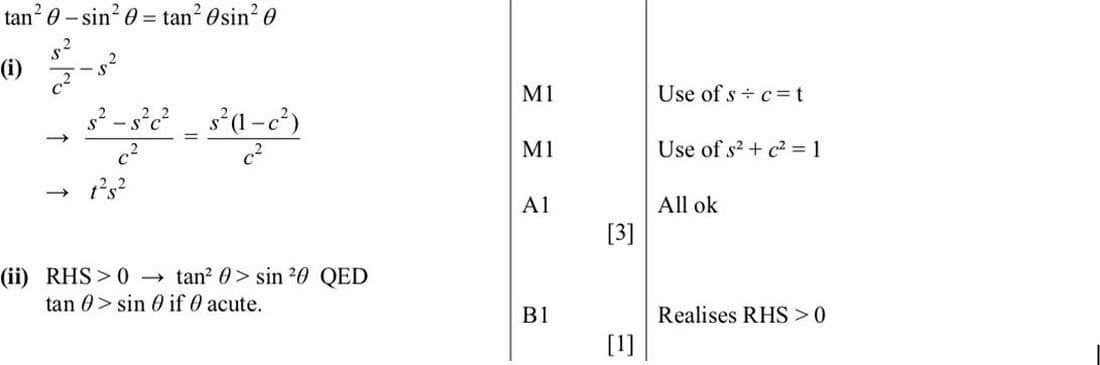
(i) Prove the identity \(\tan^2 \theta - \sin^2 \theta \equiv \tan^2 \theta \sin^2 \theta\).
(ii) Use this result to explain why \(\tan \theta > \sin \theta\) for \(0^\circ < \theta < 90^\circ\).
June 2010 p13 q3
587
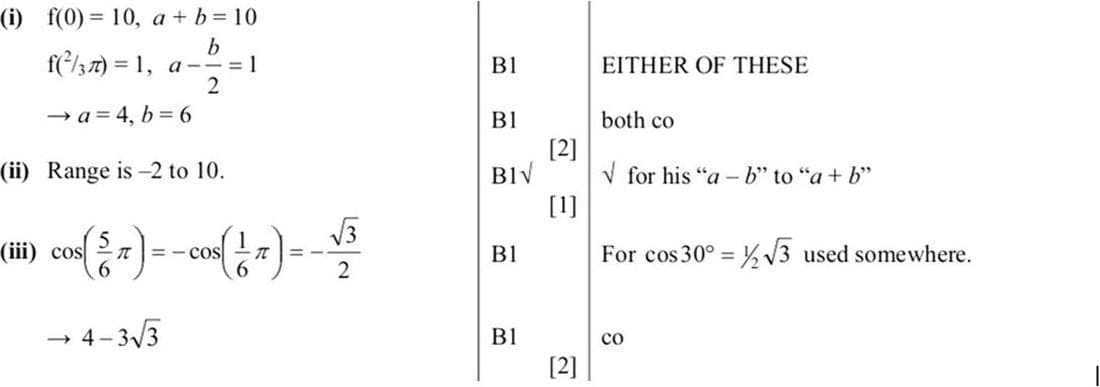
The function \(f : x \mapsto a + b \cos x\) is defined for \(0 \leq x \leq 2\pi\). Given that \(f(0) = 10\) and that \(f\left( \frac{2}{3}\pi \right) = 1\), find
- the values of \(a\) and \(b\),
- the range of \(f\),
- the exact value of \(f\left( \frac{5}{6}\pi \right)\).
June 2020 p12 q2
588
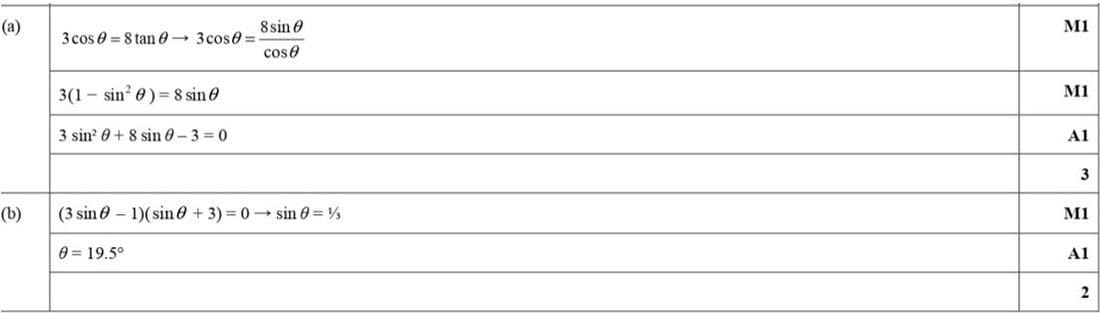
(a) Express the equation \(3 \cos \theta = 8 \tan \theta\) as a quadratic equation in \(\sin \theta\).
(b) Hence find the acute angle, in degrees, for which \(3 \cos \theta = 8 \tan \theta\).
June 2010 p11 q5
589
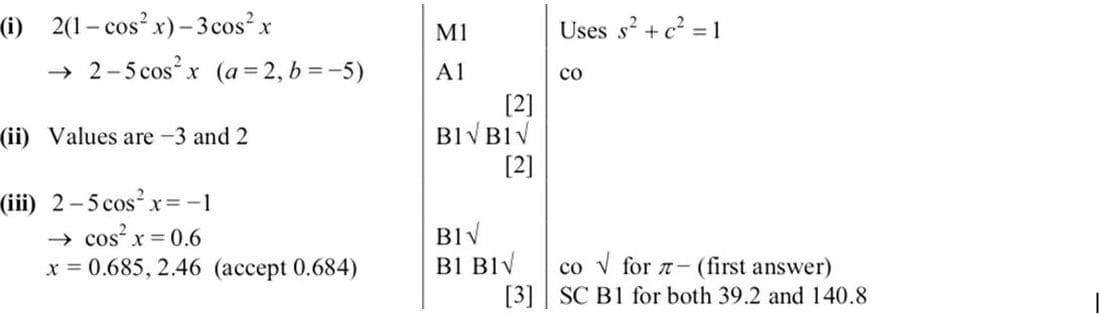
The function \(f\) is such that \(f(x) = 2 \sin^2 x - 3 \cos^2 x\) for \(0 \leq x \leq \pi\).
(i) Express \(f(x)\) in the form \(a + b \cos^2 x\), stating the values of \(a\) and \(b\).
(ii) State the greatest and least values of \(f(x)\).
(iii) Solve the equation \(f(x) + 1 = 0\).
June 2010 p11 q1
590
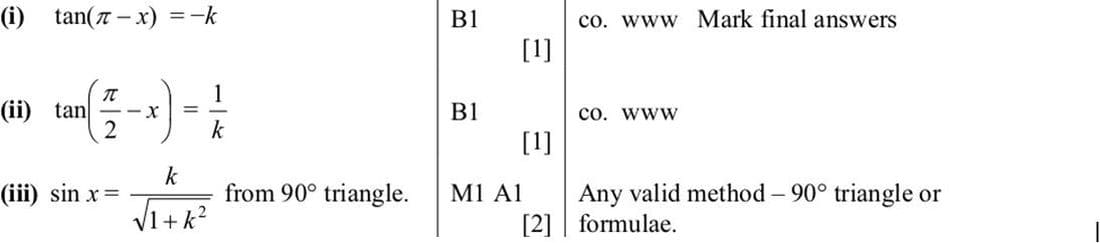
The acute angle x radians is such that \(\tan x = k\), where \(k\) is a positive constant. Express, in terms of \(k\),
- \(\tan(\pi - x)\),
- \(\tan\left(\frac{1}{2}\pi - x\right)\),
- \(\sin x\).