Exam-Style Problems
⬅ Back to SubchapterProblem 552
552
Another curve, with equation \(y = f(x)\), has a single stationary point at the point \((p, q)\), where \(p\) and \(q\) are constants. This curve is transformed to a curve with equation
\(y = -3f\left(\frac{1}{4}(x + 8)\right).\)
For the transformed curve, find the coordinates of the stationary point, giving your answer in terms of \(p\) and \(q\).

Problem 553
553
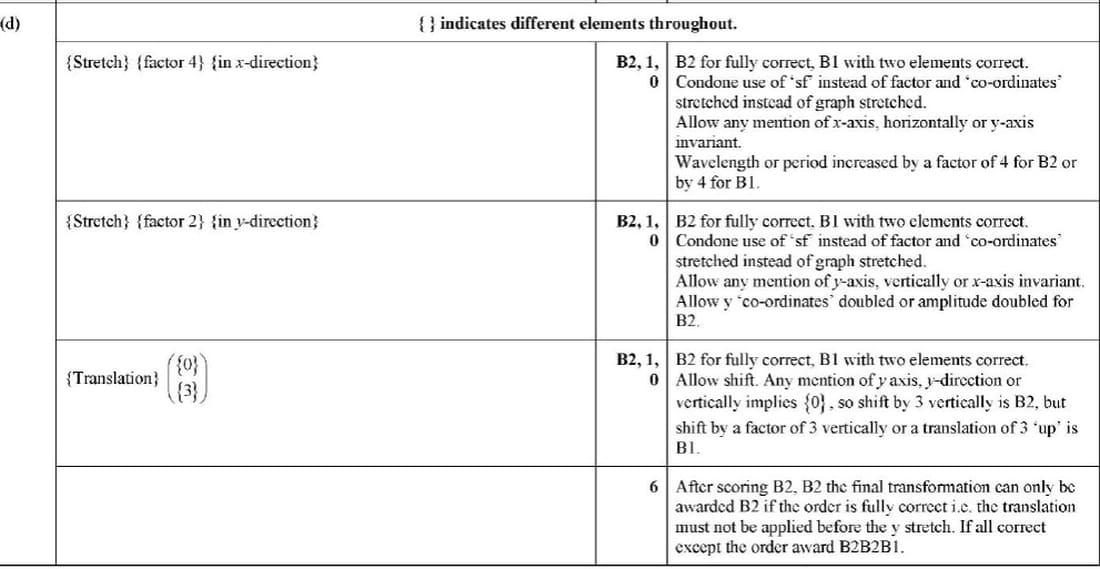
Describe fully a sequence of three transformations which can be combined to transform the graph of \(y = \sin x\) for \(0 \leq x \leq \frac{1}{2}\pi\) to the graph of \(y = f(x)\), where \(f(x) = 3 + 2 \sin \frac{1}{4}x\), making clear the order in which the transformations are applied.
Problem 554
554
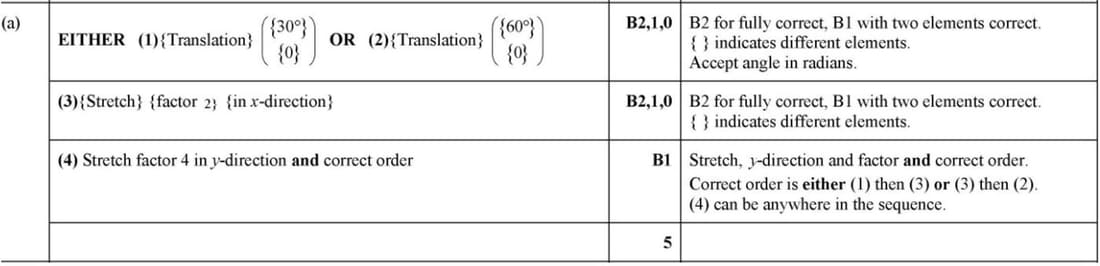
The curve \(y = \sin x\) is transformed to the curve \(y = 4 \sin\left(\frac{1}{2}x - 30^\circ\right)\).
Describe fully a sequence of transformations that have been combined, making clear the order in which the transformations are applied.
Problem 555
555
The curve \(y = \\sin 2x - 5x\) is reflected in the \(y\)-axis and then stretched by scale factor \(\frac{1}{3}\) in the \(x\)-direction.
Write down the equation of the transformed curve.

Problem 556
556
Functions f, g and h are defined for \(x \in \mathbb{R}\) by
\(f(x) = 3 \cos 2x + 2\),
\(g(x) = f(2x) + 4\),
\(h(x) = 2f\left(x + \frac{1}{2}\pi\right)\).
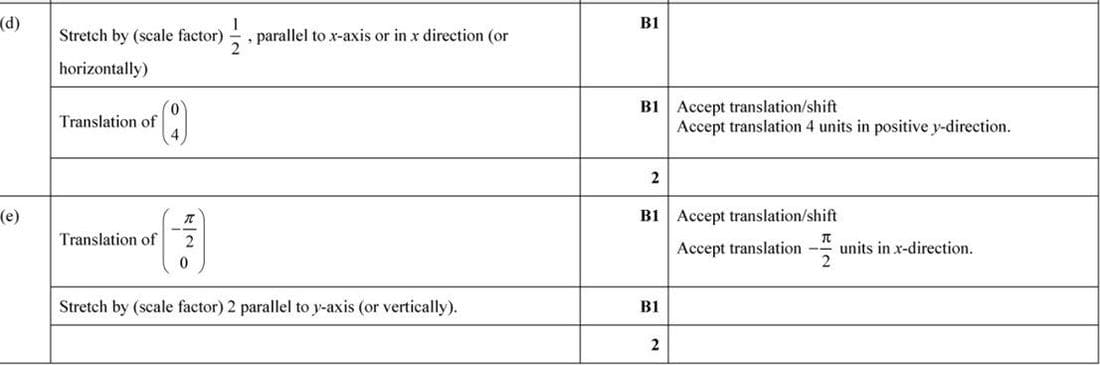
(d) Describe fully a sequence of transformations that maps the graph of \(y = f(x)\) on to \(y = g(x)\). [2]
(e) Describe fully a sequence of transformations that maps the graph of \(y = f(x)\) on to \(y = h(x)\). [2]