Exam-Style Problems
⬅ Back to SubchapterNov 2017 p11 q9
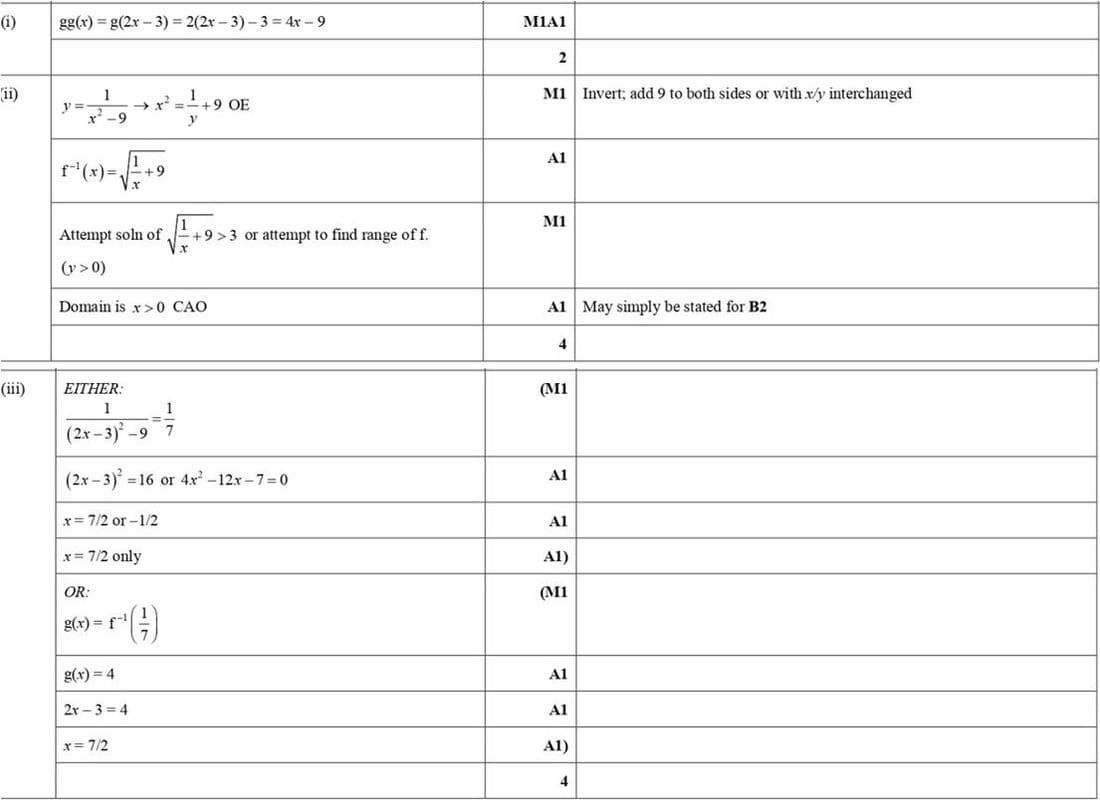
Functions f and g are defined for \(x > 3\) by
\(f : x \mapsto \frac{1}{x^2 - 9}\),
\(g : x \mapsto 2x - 3\).
- Find and simplify an expression for \(gg(x)\).
- Find an expression for \(f^{-1}(x)\) and state the domain of \(f^{-1}\).
- Solve the equation \(fg(x) = \frac{1}{7}\).
Feb/Mar 2017 p12 q8
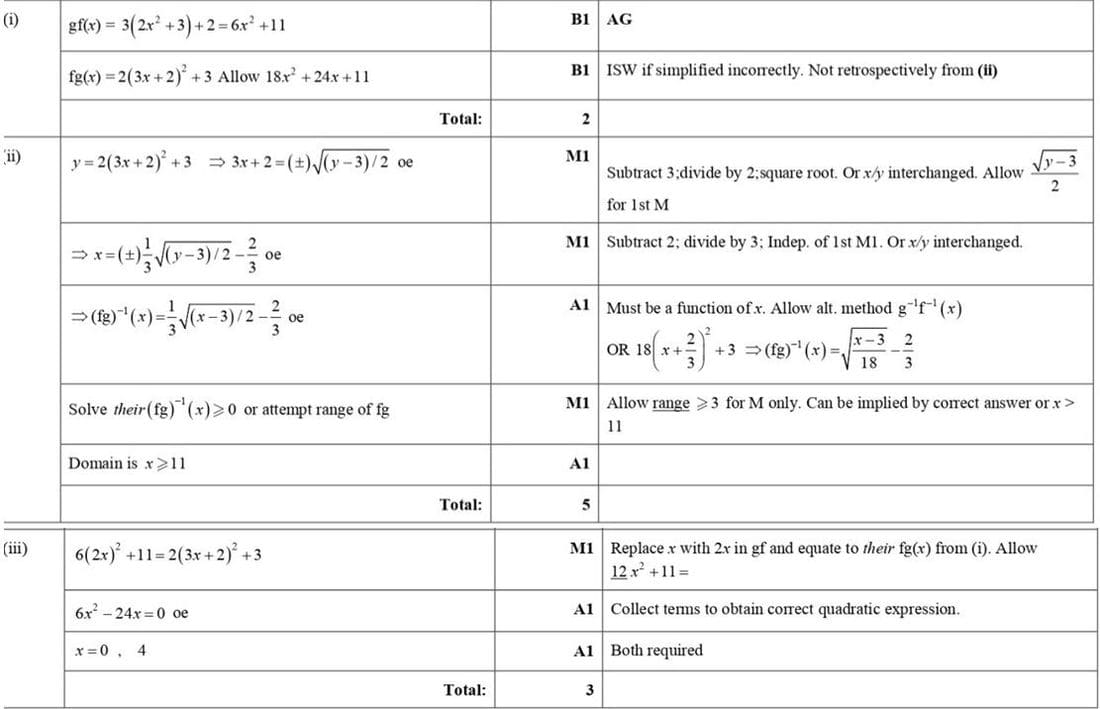
The functions f and g are defined for \(x > 0\) by
\(f : x \mapsto 2x^2 + 3\),
\(g : x \mapsto 3x + 2\).
(i) Show that \(gf(x) = 6x^2 + 11\) and obtain an unsimplified expression for \(fg(x)\). [2]
(ii) Find an expression for \((fg)^{-1}(x)\) and determine the domain of \((fg)^{-1}\). [5]
(iii) Solve the equation \(gf(2x) = fg(x)\). [3]
Nov 2023 p11 q9
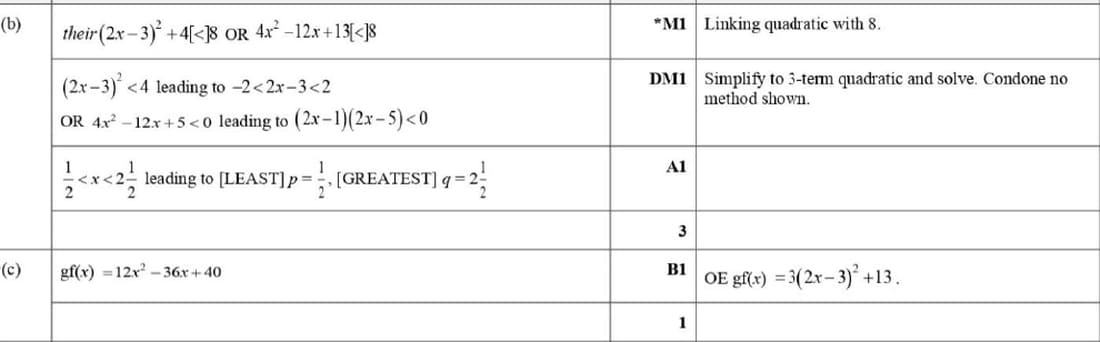
The function f is defined by \(f(x) = 4x^2 - 12x + 13\) for \(p < x < q\), where \(p\) and \(q\) are constants. The function g is defined by \(g(x) = 3x + 1\) for \(x < 8\).
(b) Given that it is possible to form the composite function gf, find the least possible value of \(p\) and the greatest possible value of \(q\).
(c) Find an expression for \(gf(x)\).
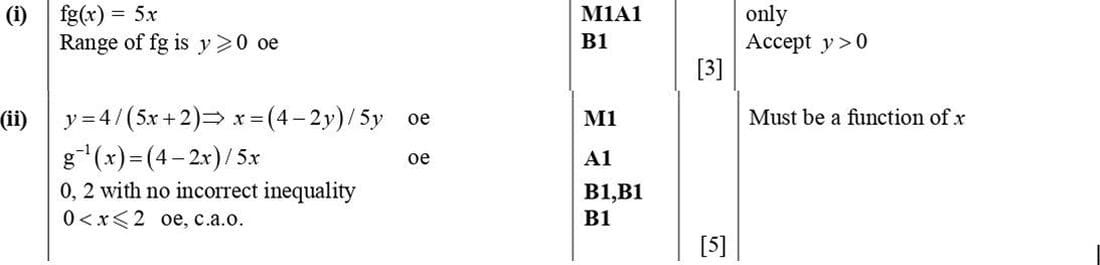
Nov 2016 p11 q8
The functions f and g are defined by
\(f(x) = \frac{4}{x} - 2\) for \(x > 0\),
\(g(x) = \frac{4}{5x + 2}\) for \(x \geq 0\).
(i) Find and simplify an expression for \(fg(x)\) and state the range of \(fg\).
(ii) Find an expression for \(g^{-1}(x)\) and find the domain of \(g^{-1}\).
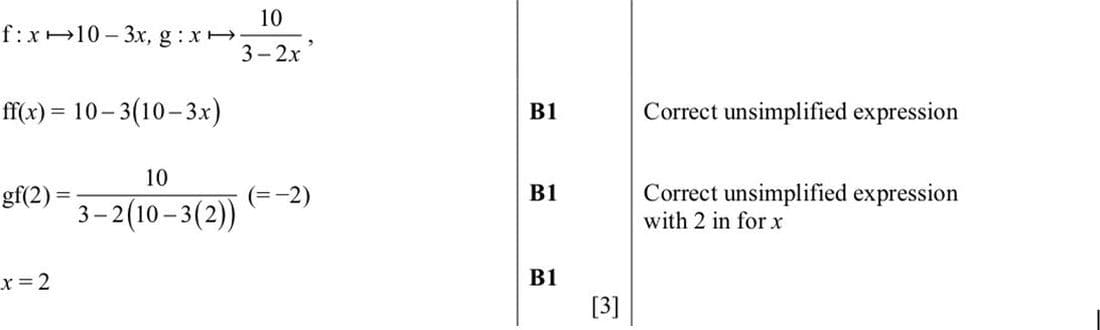
June 2016 p12 q1
Functions f and g are defined by
\(f : x \mapsto 10 - 3x, \quad x \in \mathbb{R},\)
\(g : x \mapsto \frac{10}{3 - 2x}, \quad x \in \mathbb{R}, \; x \neq \frac{3}{2}.\)
Solve the equation \(ff(x) = gf(2)\).