Exam-Style Problems
⬅ Back to SubchapterFM June 2025 p13 q07
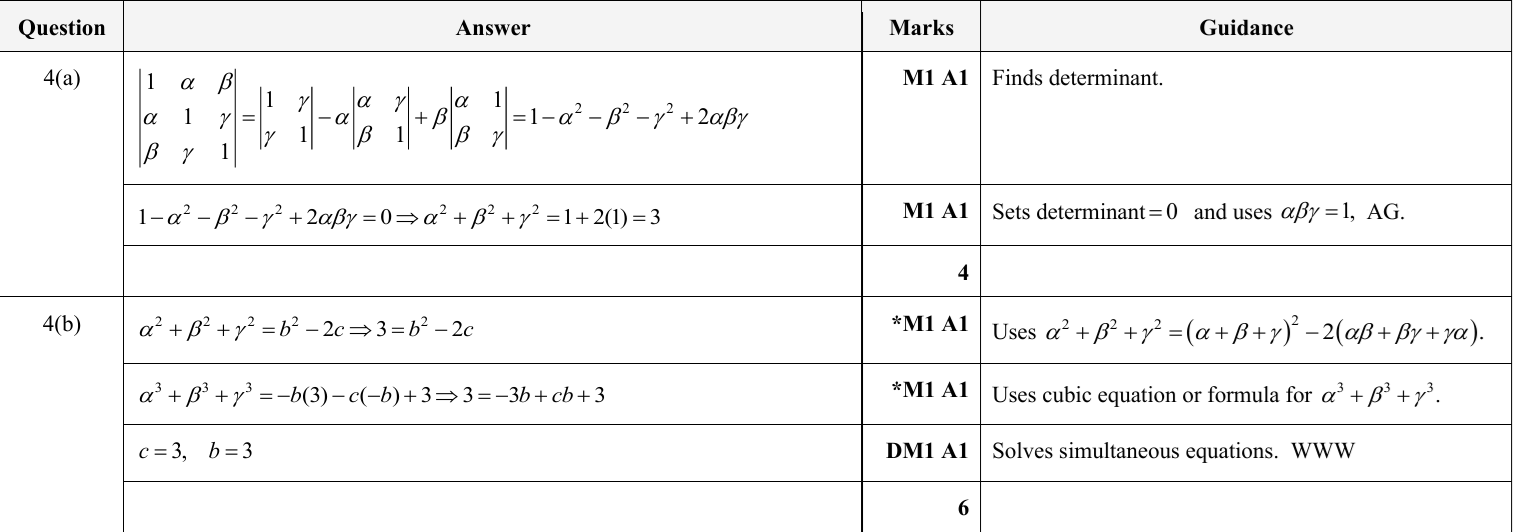
The curve C has polar equation \(r^2 = e^{\sin \theta} \cos \theta\), for \(-\frac{1}{2}\pi \leq \theta \leq \frac{1}{2}\pi\).
- Find the polar coordinates of the point on C that is furthest from the pole, giving your answers correct to 3 decimal places.
- Find the polar coordinates of the point on C that is furthest from the half-line \(\theta = \frac{1}{2}\pi\), giving your answers correct to 3 decimal places.
- Sketch C.
- Find the area of the region bounded by C, giving your answer in exact form.
FM June 2025 p14 q01
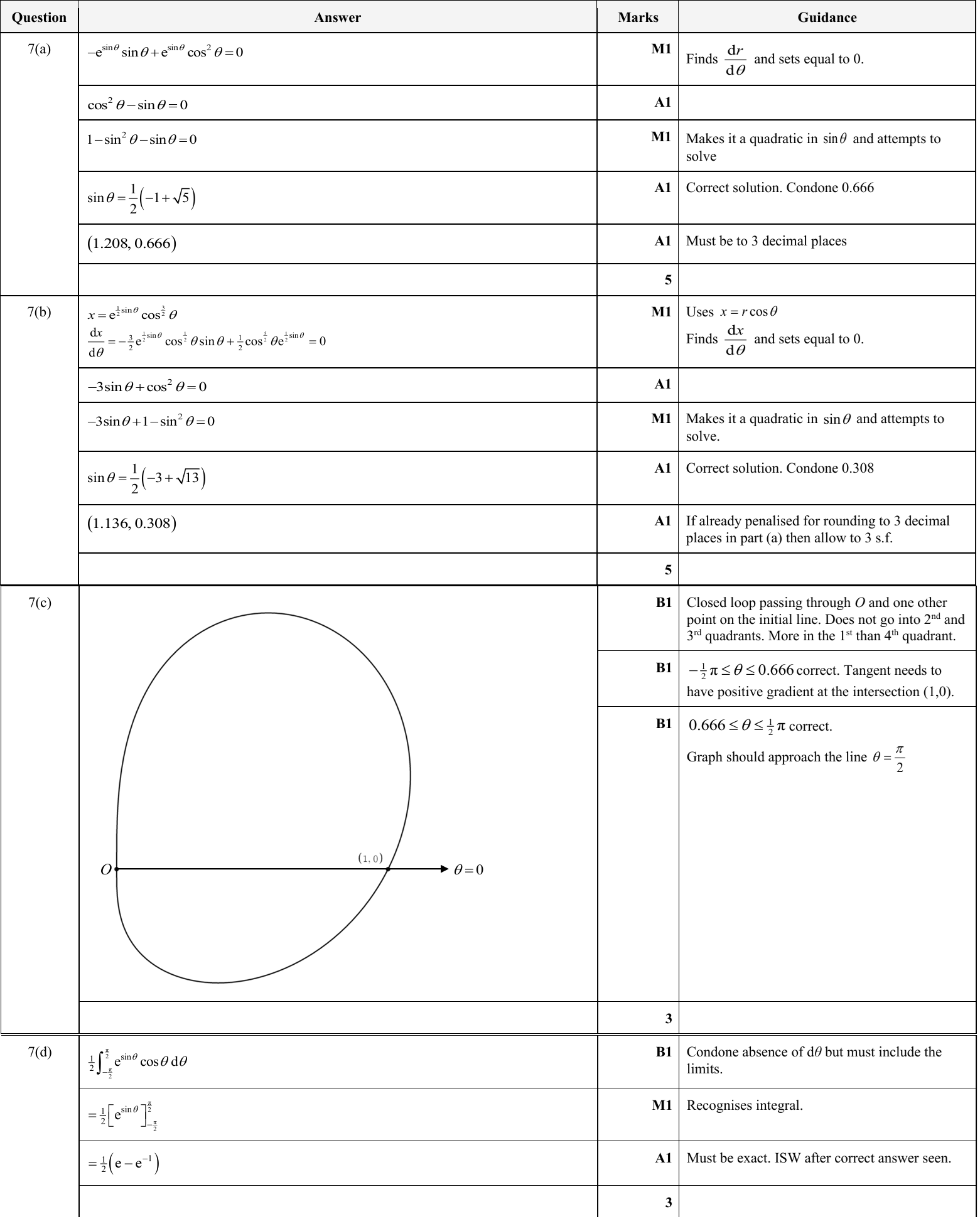
- Use the List of formulae (MF19) to find \(\sum_{r=1}^{n} (2r+1)\) in terms of \(n\), simplifying your answer.
- Show that \(\frac{2r+1}{(r^2+1)(r^2+2r+2)} = \frac{1}{r^2+1} - \frac{1}{r^2+2r+2}\).
- Use the method of differences to find \(\sum_{r=1}^{n} \frac{2r+1}{(r^2+1)(r^2+2r+2)}\).
- Deduce the value of \(\sum_{r=1}^{\infty} \frac{2r+1}{(r^2+1)(r^2+2r+2)}\).
FM June 2025 p14 q02
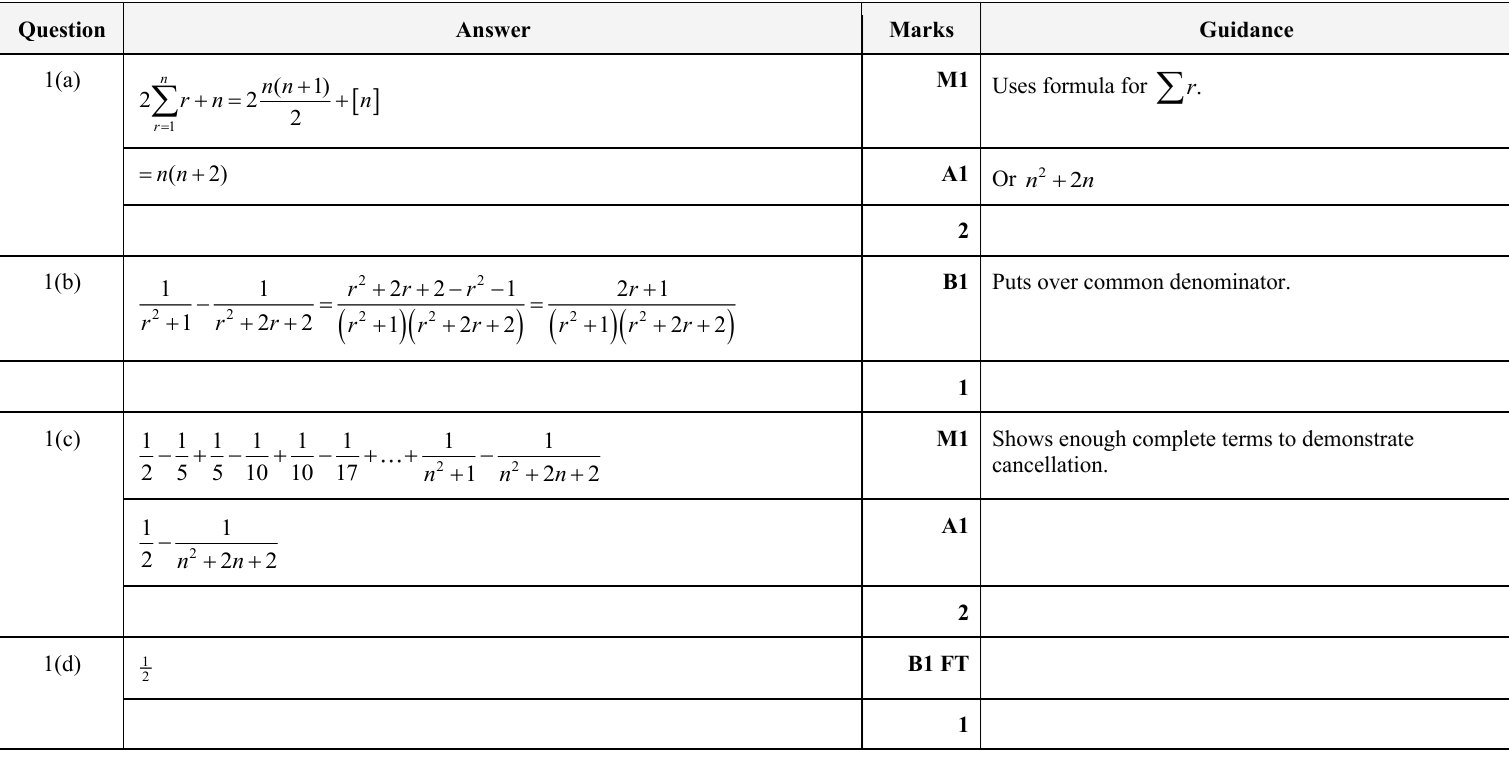
Prove by mathematical induction that, for every integer \(n \geq 2\),
\(\frac{d^n}{dx^n}(x \ln x) = (-1)^n (n-2)! x^{1-n}.\)
FM June 2025 p14 q03
The points A, B and C have position vectors
\(2\mathbf{j} + 3\mathbf{k}, \quad -5\mathbf{i} + 3\mathbf{j} + \mathbf{k} \quad \text{and} \quad \mathbf{i} + 2\mathbf{j} + 5\mathbf{k}\)
respectively, relative to the origin O.
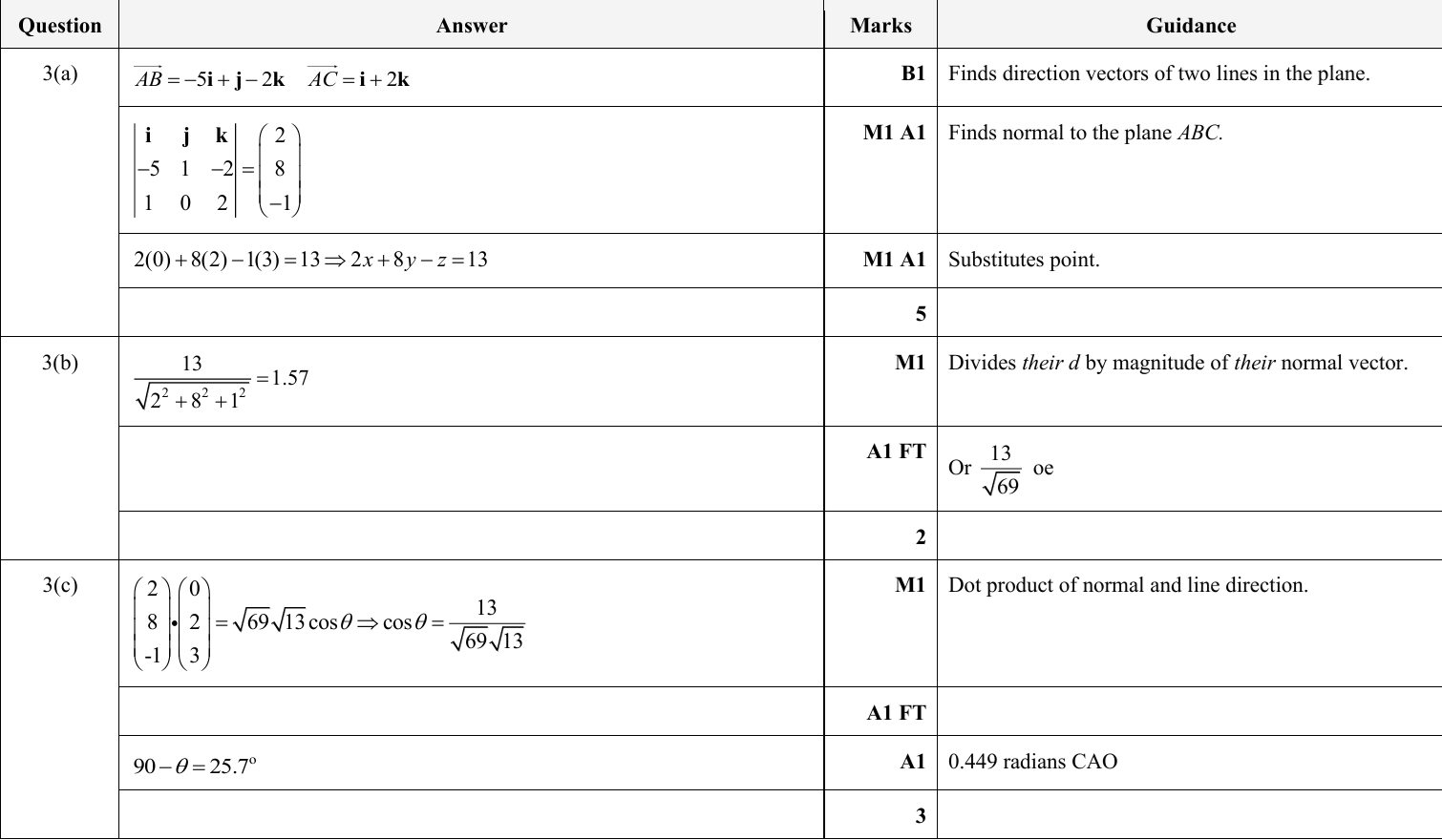
(a) Find the equation of the plane ABC, giving your answer in the form \(ax + by + cz = d\).
(b) Find the perpendicular distance from O to the plane ABC.
(c) Find the acute angle between the line OA and the plane ABC.
FM June 2025 p14 q04
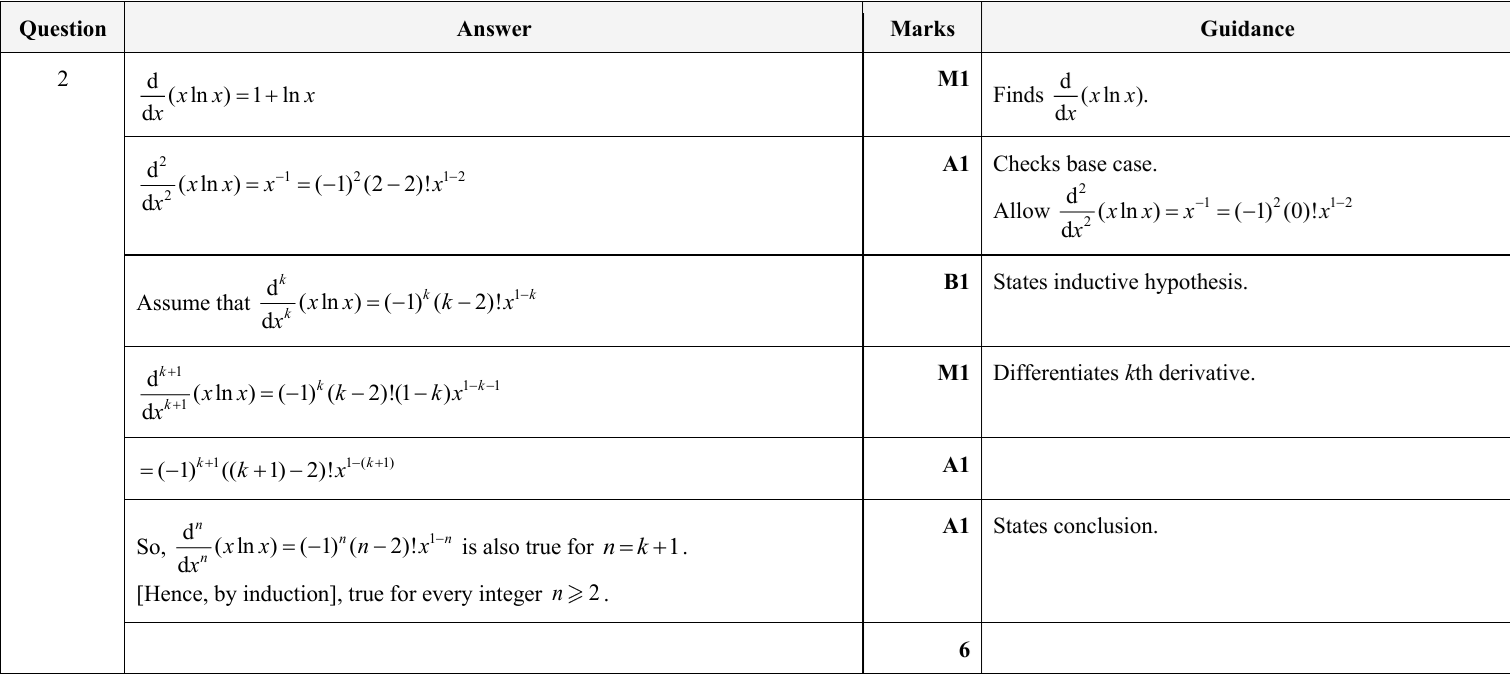
The cubic equation \(x^3 + bx^2 + cx - 1 = 0\), where \(b\) and \(c\) are constants, has roots \(\alpha, \beta, \gamma\).
It is given that the matrix \(\begin{pmatrix} 1 & \alpha & \beta \\ \alpha & 1 & \gamma \\ \beta & \gamma & 1 \end{pmatrix}\) is singular.
(a) Show that \(\alpha^2 + \beta^2 + \gamma^2 = 3\).
(b) It is given that \(\alpha^3 + \beta^3 + \gamma^3 = 3\) and that the constants \(b\) and \(c\) are positive.
Find the values of \(b\) and \(c\).