Exam-Style Problems
⬅ Back to SubchapterNov 2018 p41 q2
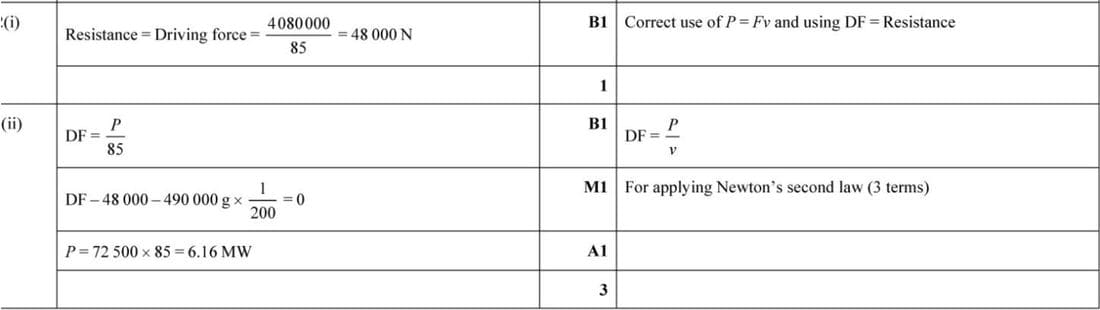
A high-speed train of mass 490,000 kg is moving along a straight horizontal track at a constant speed of 85 m s-1. The engines are supplying 4080 kW of power.
(i) Show that the resistance force is 48,000 N.
(ii) The train comes to a hill inclined at an angle \(\theta\) above the horizontal, where \(\sin \theta = \frac{1}{200}\). Given that the resistance force is unchanged, find the power required for the train to keep moving at the same constant speed of 85 m s-1.
June 2018 p43 q6
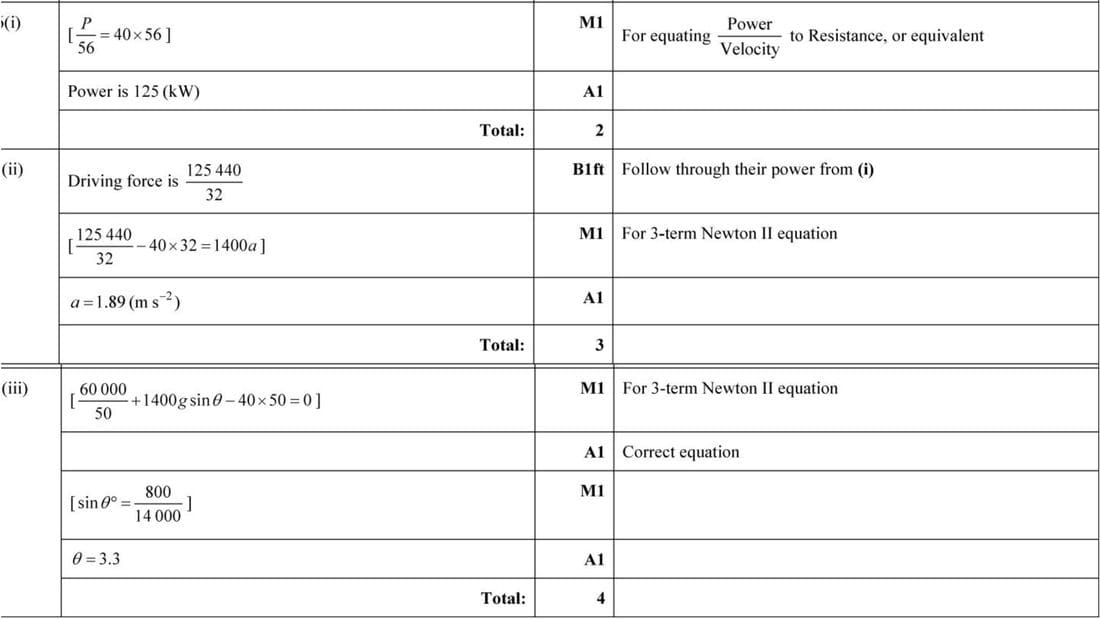
A car of mass 1400 kg travelling at a speed of \(v \text{ m s}^{-1}\) experiences a resistive force of magnitude \(40v \text{ N}\). The greatest possible constant speed of the car along a straight level road is \(56 \text{ m s}^{-1}\).
- Find, in kW, the greatest possible power of the car’s engine.
- Find the greatest possible acceleration of the car at an instant when its speed on a straight level road is \(32 \text{ m s}^{-1}\).
- The car travels down a hill inclined at an angle of \(\theta^\circ\) to the horizontal at a constant speed of \(50 \text{ m s}^{-1}\). The power of the car’s engine is \(60 \text{ kW}\). Find the value of \(\theta\).
June 2023 p43 q4
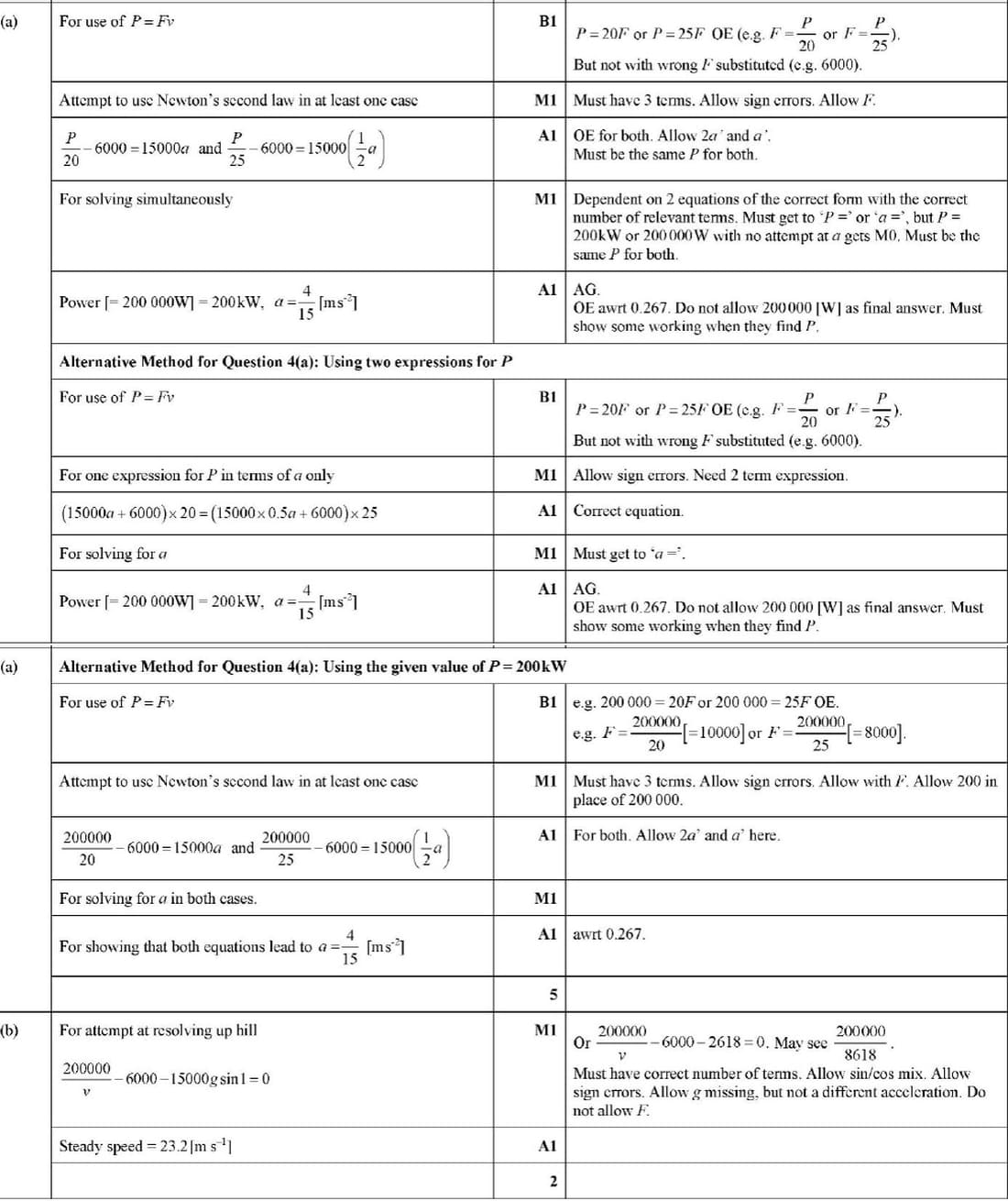
A lorry of mass 15,000 kg moves on a straight horizontal road in the direction from A to B. It passes A and B with speeds 20 m/s and 25 m/s respectively. The power of the lorry’s engine is constant and there is a constant resistance to motion of magnitude 6000 N. The acceleration of the lorry at B is 0.5 times the acceleration of the lorry at A.
(a) Show that the power of the lorry’s engine is 200 kW, and hence find the acceleration of the lorry when it is travelling at 20 m/s.
The lorry begins to ascend a straight hill inclined at 1° to the horizontal. It is given that the power of the lorry’s engine and the resistance force do not change.
(b) Find the steady speed up the hill that the lorry could maintain.
June 2018 p42 q2
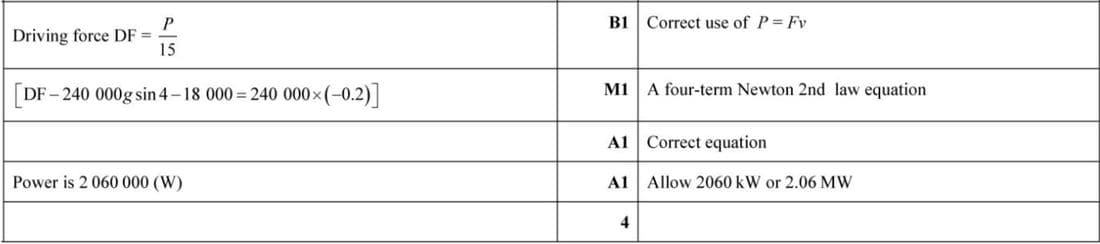
A train of mass 240,000 kg travels up a slope inclined at an angle of 4° to the horizontal. There is a constant resistance of magnitude 18,000 N acting on the train. At an instant when the speed of the train is 15 m/s, its deceleration is 0.2 m/s². Find the power of the engine of the train.
Feb/Mar 2018 p42 q6
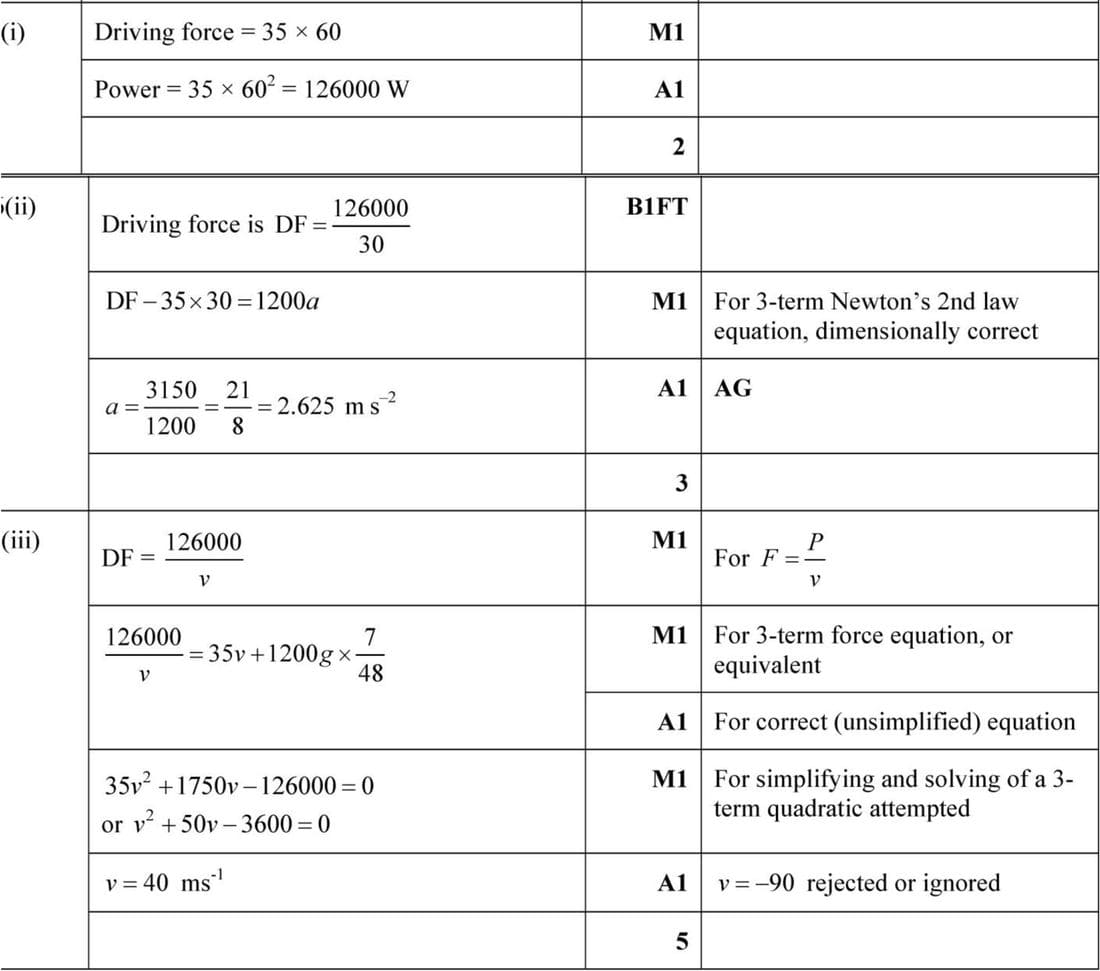
A car of mass 1200 kg has a greatest possible constant speed of 60 m s-1 along a straight level road. When the car is travelling at a speed of v m s-1 there is a resistive force of magnitude 35v N.
- Find the greatest possible power of the car. [2]
- The car travels along a straight level road. Show that, at an instant when its speed is 30 m s-1, the greatest possible acceleration of the car is 2.625 m s-2. [3]
- The car travels at a constant speed up a hill inclined at an angle of sin-1(7/48) to the horizontal. Find the greatest possible speed of the car. [5]