Exam-Style Problems
⬅ Back to SubchapterFeb/Mar 2020 p42 q3
3513
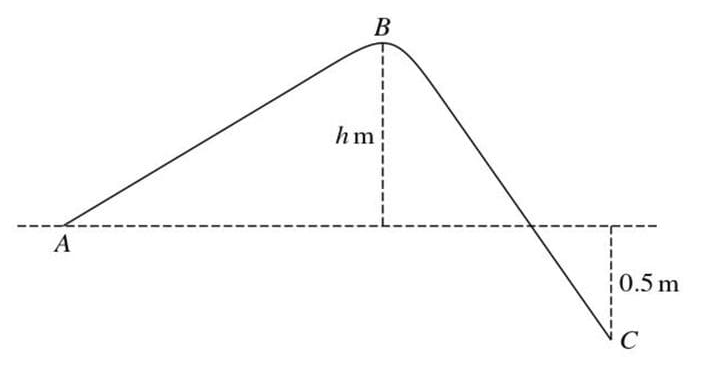
The diagram shows the vertical cross-section of a surface. A, B, and C are three points on the cross-section. The level of B is h m above the level of A. The level of C is 0.5 m below the level of A. A particle of mass 0.2 kg is projected up the slope from A with initial speed 5 m/s. The particle remains in contact with the surface as it travels from A to C.
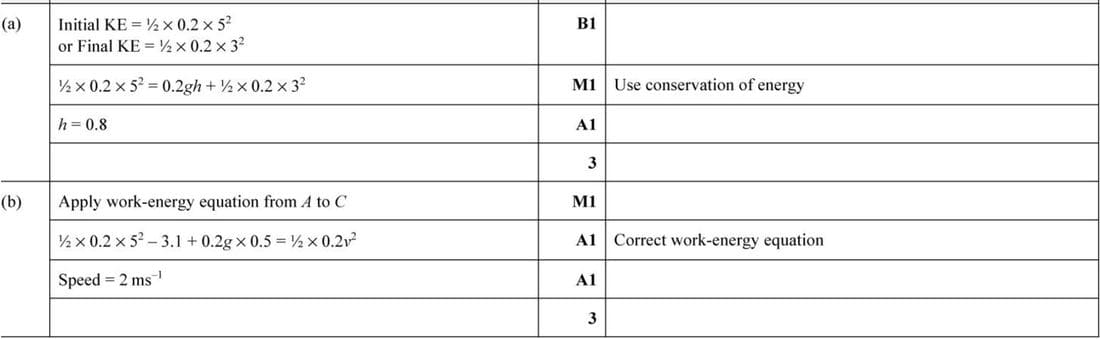
(a) Given that the particle reaches B with a speed of 3 m/s and that there is no resistance force, find h.
(b) It is given instead that there is a resistance force and that the particle does 3.1 J of work against the resistance force as it travels from A to C. Find the speed of the particle when it reaches C.
Nov 2019 p43 q2
3514
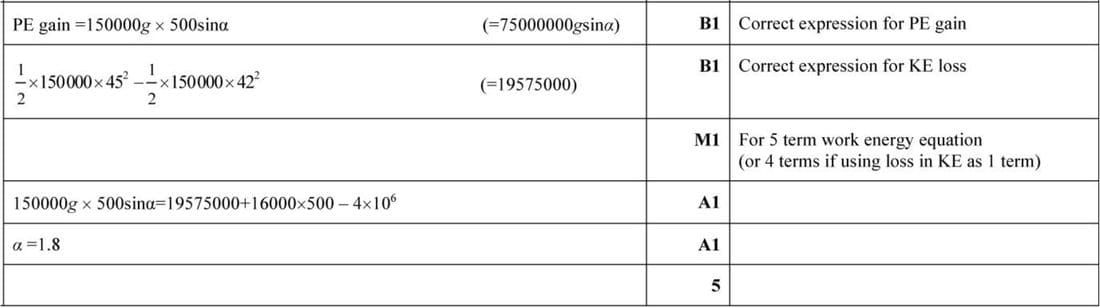
A train of mass 150,000 kg ascends a straight slope inclined at \(\alpha^\circ\) to the horizontal with a constant driving force of 16,000 N. At a point \(A\) on the slope the speed of the train is 45 m s\(^{-1}\). Point \(B\) on the slope is 500 m beyond \(A\). At \(B\) the speed of the train is 42 m s\(^{-1}\). There is a resistance force acting on the train and the train does \(4 \times 10^6\) J of work against this resistance force between \(A\) and \(B\). Find the value of \(\alpha\).
June 2023 p43 q7
3515
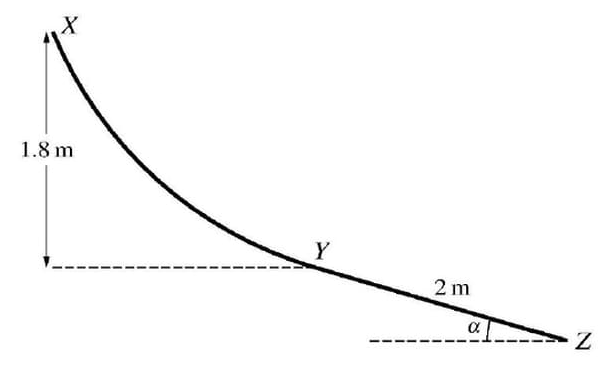
The diagram shows the vertical cross-section XYZ of a rough slide. The section YZ is a straight line of length 2 m inclined at an angle of \(\alpha\) to the horizontal, where \(\sin \alpha = 0.28\). The section YZ is tangential to the curved section XY at Y, and X is 1.8 m above the level of Y. A child of mass 25 kg slides down the slide, starting from rest at X. The work done by the child against the resistance force in moving from X to Y is 50 J.
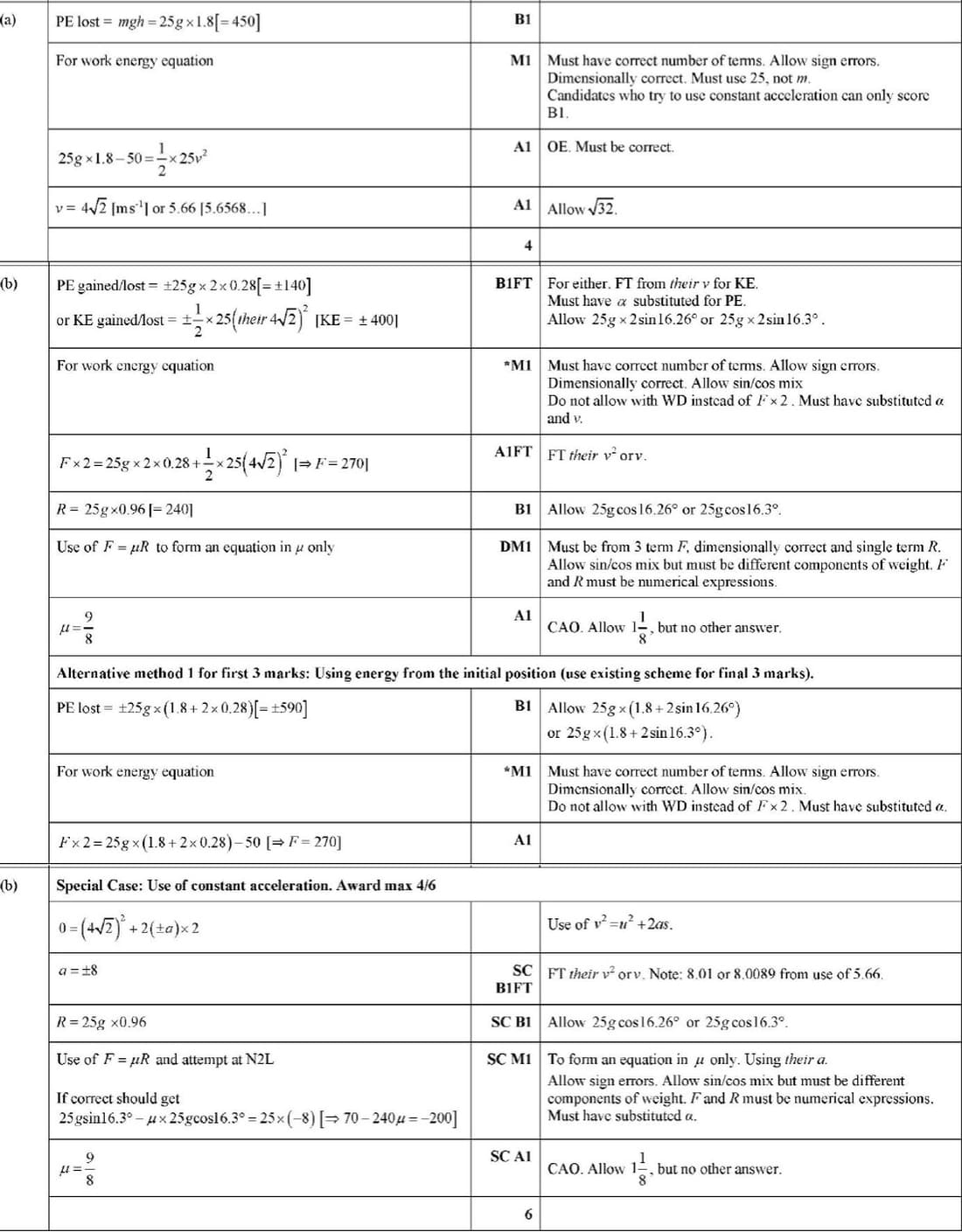
(a) Find the speed of the child at Y.
It is given that the child comes to rest at Z.
(b) Use an energy method to find the coefficient of friction between the child and YZ, giving your answer as a fraction in its simplest form.
Nov 2019 p42 q4
3516
A lorry of mass 25,000 kg travels along a straight horizontal road. There is a constant force of 3000 N resisting the motion.
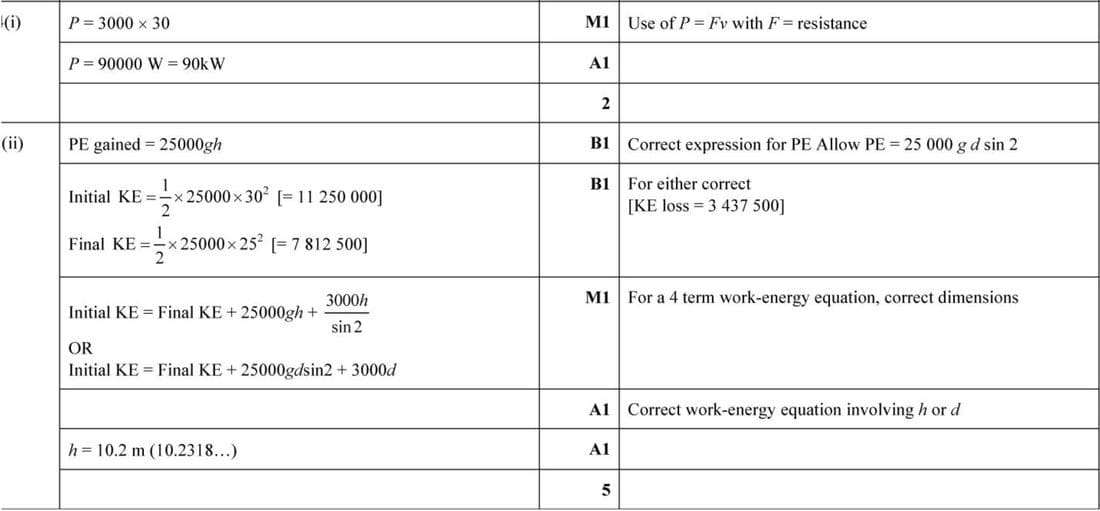
- Find the power required to maintain a constant speed of 30 m s-1.
The lorry comes to a straight hill inclined at 2° to the horizontal. The driver switches off the engine of the lorry at the point A which is at the foot of the hill. Point B is further up the hill. The speeds of the lorry at A and B are 30 m s-1 and 25 m s-1 respectively. The resistance force is still 3000 N.
- Use an energy method to find the height of B above the level of A.
Nov 2019 p41 q2
3517
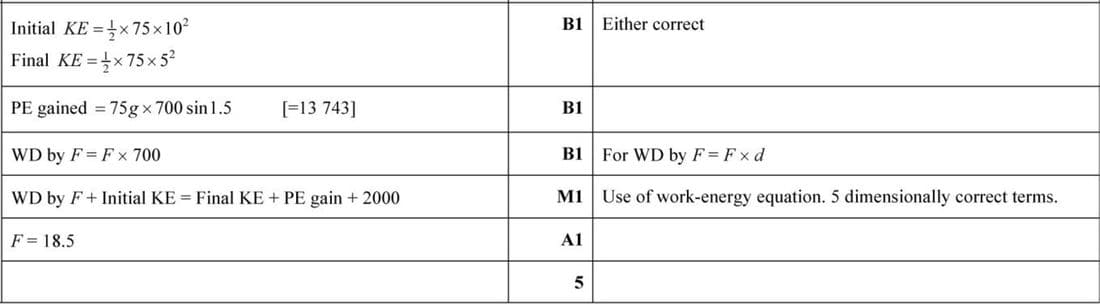
The total mass of a cyclist and her bicycle is 75 kg. The cyclist ascends a straight hill of length 0.7 km inclined at 1.5° to the horizontal. Her speed at the bottom of the hill is 10 m/s and at the top it is 5 m/s. There is a resistance to motion, and the work done against this resistance as the cyclist ascends the hill is 2000 J. The cyclist exerts a constant force of magnitude \(F\) N in the direction of motion. Find \(F\).