Exam-Style Problems
⬅ Back to SubchapterJune 2023 p43 q1
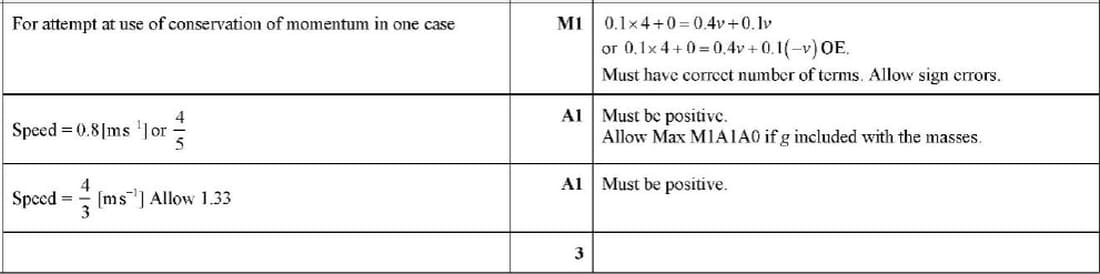
Two particles P and Q, of masses 0.1 kg and 0.4 kg respectively, are free to move on a smooth horizontal plane. Particle P is projected with speed 4 m/s-1 towards Q which is stationary. After P and Q collide, the speeds of P and Q are equal.
Find the two possible values of the speed of P after the collision.
June 2023 p42 q2
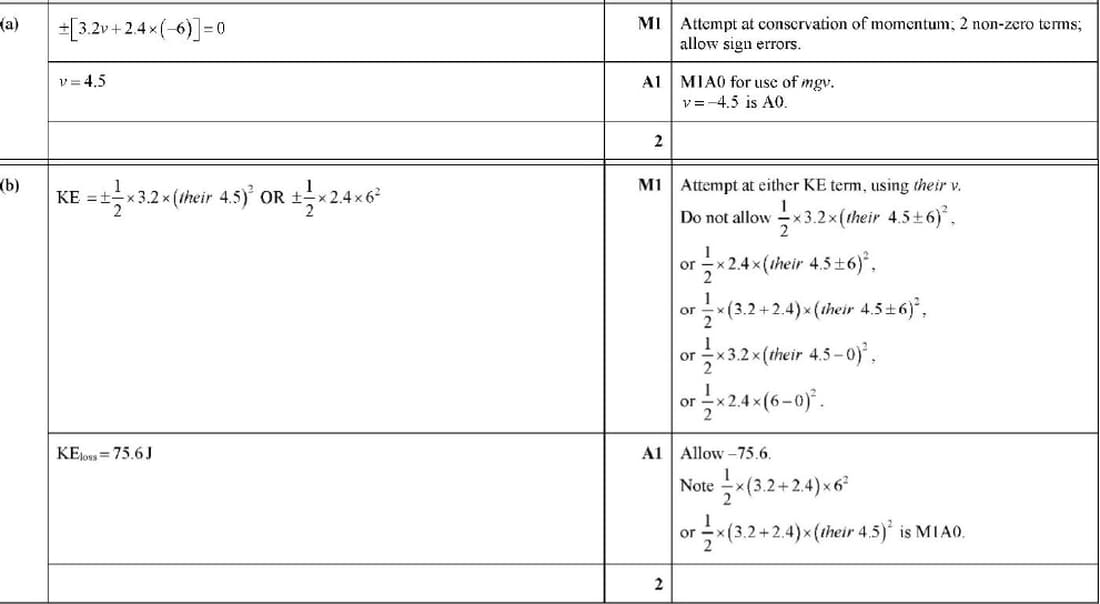
Two particles A and B, of masses 3.2 kg and 2.4 kg respectively, lie on a smooth horizontal table. A moves towards B with a speed of v m/s and collides with B, which is moving towards A with a speed of 6 m/s. In the collision the two particles come to rest.
(a) Find the value of v.
(b) Find the loss of kinetic energy of the system due to the collision.
June 2023 p41 q1
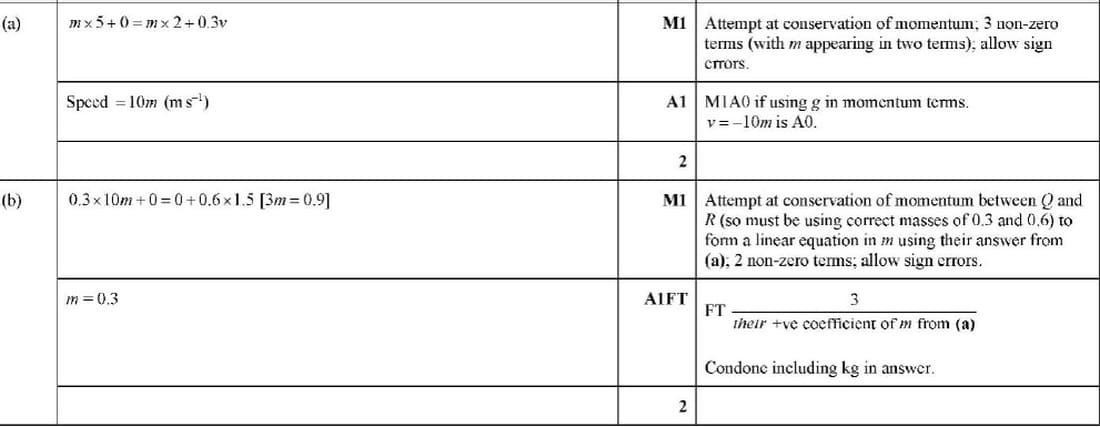
Two particles P and Q, of masses m kg and 0.3 kg respectively, are at rest on a smooth horizontal plane. P is projected at a speed of 5 m s-1 directly towards Q. After P and Q collide, P moves with a speed of 2 m s-1 in the same direction as it was originally moving.
(a) Find, in terms of m, the speed of Q after the collision.
After this collision, Q moves directly towards a third particle R, of mass 0.6 kg, which is at rest on the plane. Q is brought to rest in the collision with R, and R begins to move with a speed of 1.5 m s-1.
(b) Find the value of m.
Feb/Mar 2023 p42 q7
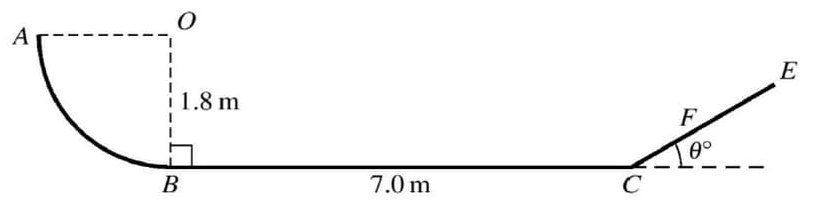
The diagram shows a smooth track which lies in a vertical plane. The section AB is a quarter circle of radius 1.8 m with centre O. The section BC is a horizontal straight line of length 7.0 m and OB is perpendicular to BC. The section CFE is a straight line inclined at an angle of \(\theta\) above the horizontal.
A particle P of mass 0.5 kg is released from rest at A. Particle P collides with a particle Q of mass 0.1 kg which is at rest at B. Immediately after the collision, the speed of P is 4 m/s in the direction BC. You should assume that P is moving horizontally when it collides with Q.
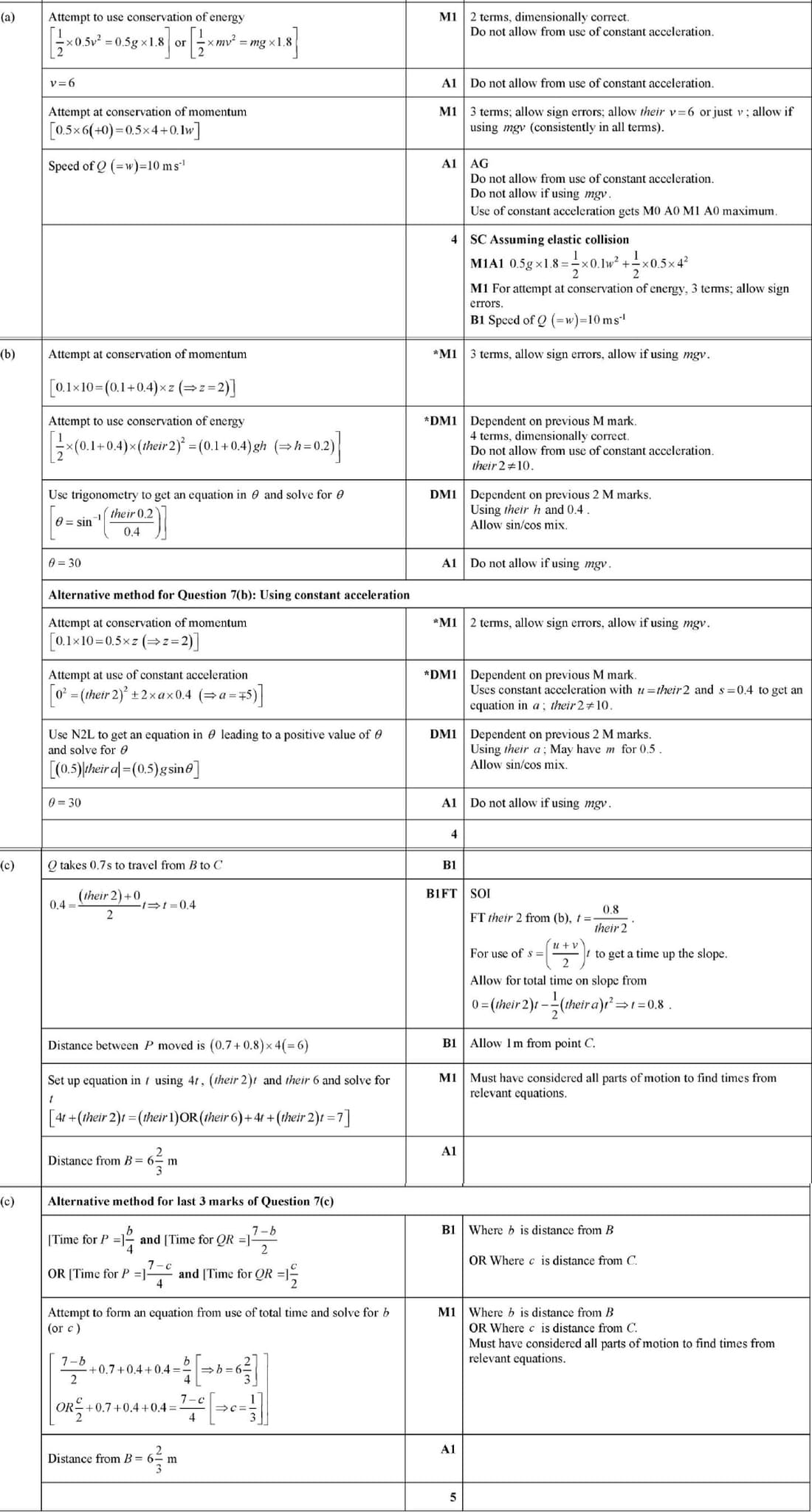
(a) Show that the speed of Q immediately after the collision is 10 m/s.
When Q reaches C, it collides with a particle R of mass 0.4 kg which is at rest at C. The two particles coalesce. The combined particle comes instantaneously to rest at F. You should assume that there is no instantaneous change in speed as the combined particle leaves C, nor when it passes through C again as it returns down the slope.
(b) Given that the distance CF is 0.4 m, find the value of \(\theta\).
(c) Find the distance from B at which P collides with the combined particle.
Nov 2022 p43 q7
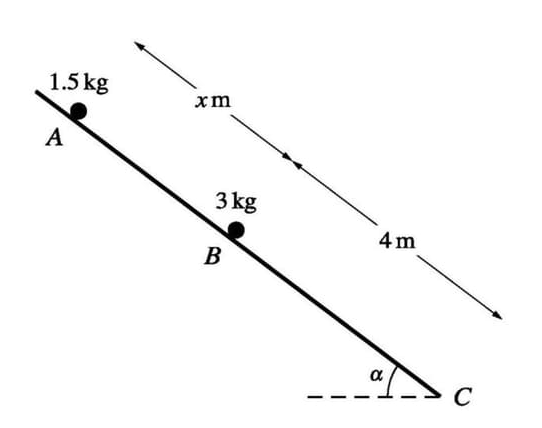
Particles of masses 1.5 kg and 3 kg lie on a plane which is inclined at an angle of \(\alpha\) to the horizontal, where \(\tan \alpha = \frac{3}{4}\). The section of the plane from \(A\) to \(B\) is smooth and the section of the plane from \(B\) to \(C\) is rough. The 1.5 kg particle is held at rest at \(A\) and the 3 kg particle is in limiting equilibrium at \(B\). The distance \(AB\) is \(x\) m and the distance \(BC\) is 4 m (see diagram).
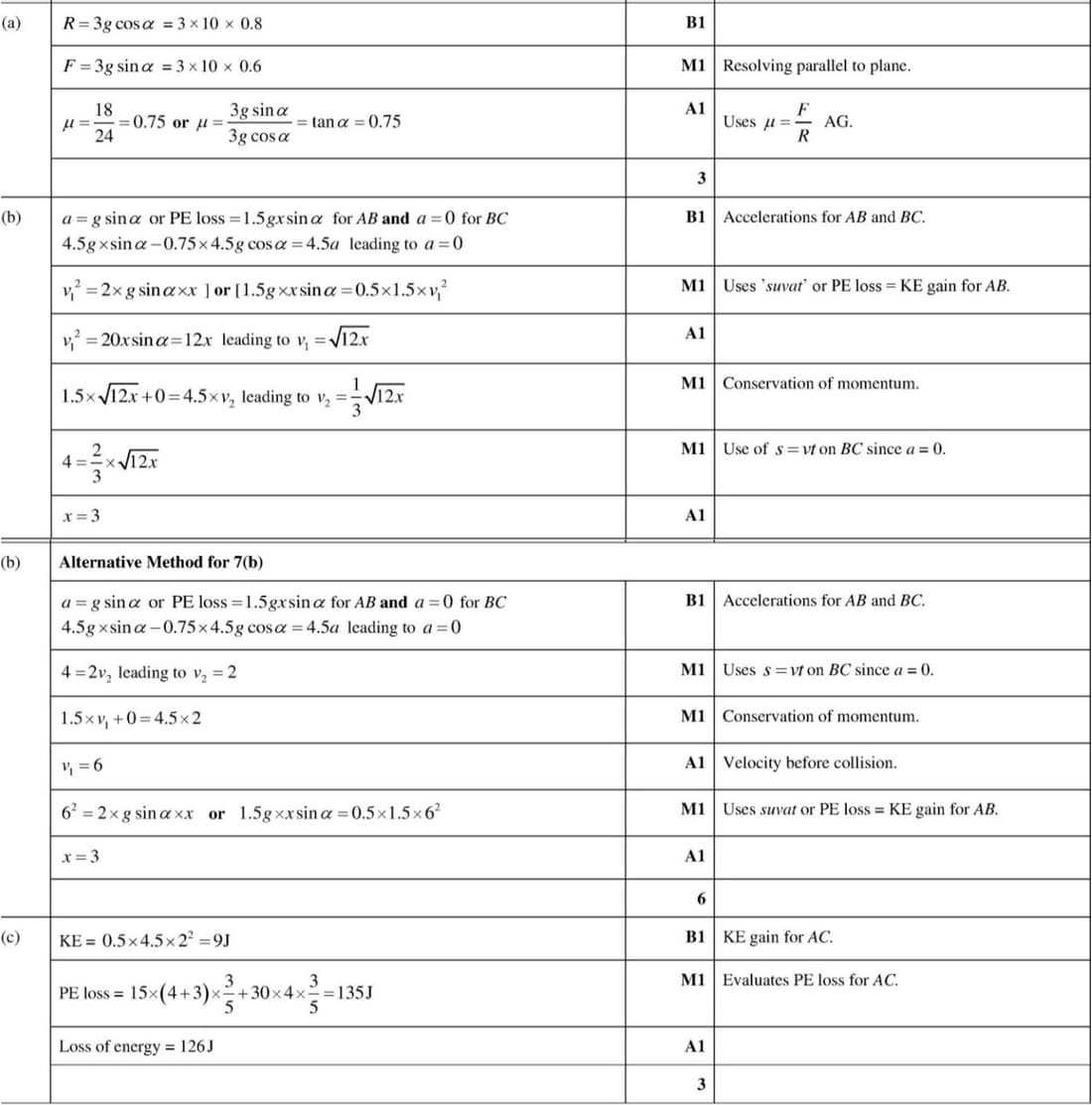
(a) Show that the coefficient of friction between the particle at \(B\) and the plane is 0.75.
The 1.5 kg particle is released from rest. In the subsequent motion the two particles collide and coalesce. The time taken for the combined particle to travel from \(B\) to \(C\) is 2 s. The coefficient of friction between the combined particle and the plane is still 0.75.
(b) Find \(x\).
(c) Find the total loss of energy of the particles from the time the 1.5 kg particle is released until the combined particle reaches \(C\).