Exam-Style Problems
⬅ Back to SubchapterFeb/Mar 2021 p42 q5
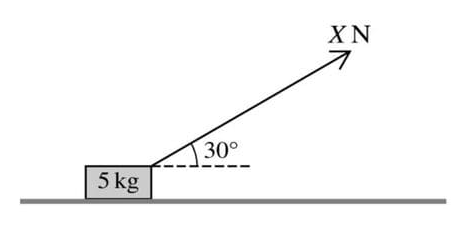
A block of mass 5 kg is being pulled along a rough horizontal floor by a force of magnitude X N acting at 30° above the horizontal (see diagram). The block starts from rest and travels 2 m in the first 5 s of its motion.
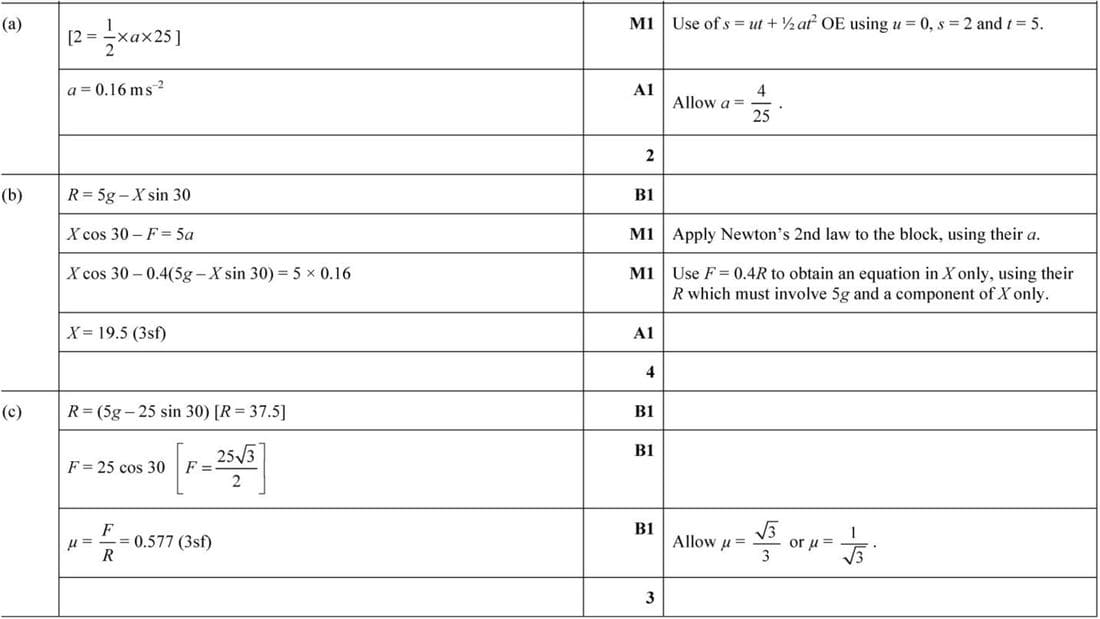
(a) Find the acceleration of the block. [2]
(b) Given that the coefficient of friction between the block and the floor is 0.4, find X. [4]
The block is now placed on a part of the floor where the coefficient of friction between the block and the floor has a different value. The value of X is changed to 25, and the block is now in limiting equilibrium.
(c) Find the value of the coefficient of friction between the block and this part of the floor. [3]
Feb/Mar 2020 p42 q2
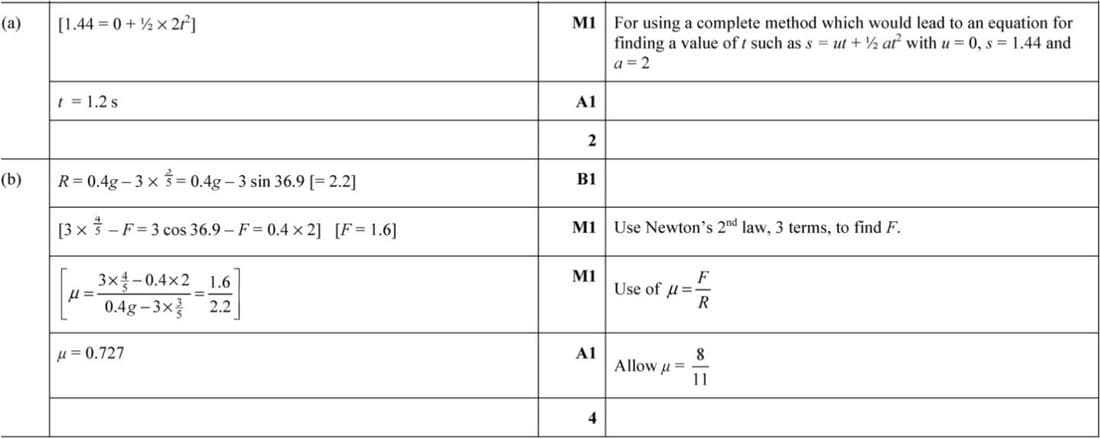
A particle P of mass 0.4 kg is on a rough horizontal floor. The coefficient of friction between P and the floor is \(\mu\). A force of magnitude 3 N is applied to P upwards at an angle \(\alpha\) above the horizontal, where \(\tan \alpha = \frac{3}{4}\). The particle is initially at rest and accelerates at 2 m/s\(^2\).
(a) Find the time it takes for P to travel a distance of 1.44 m from its starting point.
(b) Find \(\mu\).
Nov 2019 p43 q1
A crate of mass 500 kg is being pulled along rough horizontal ground by a horizontal rope attached to a winch. The winch produces a constant pulling force of 2500 N and the crate is moving at constant speed. Find the coefficient of friction between the crate and the ground.

Nov 2019 p42 q6
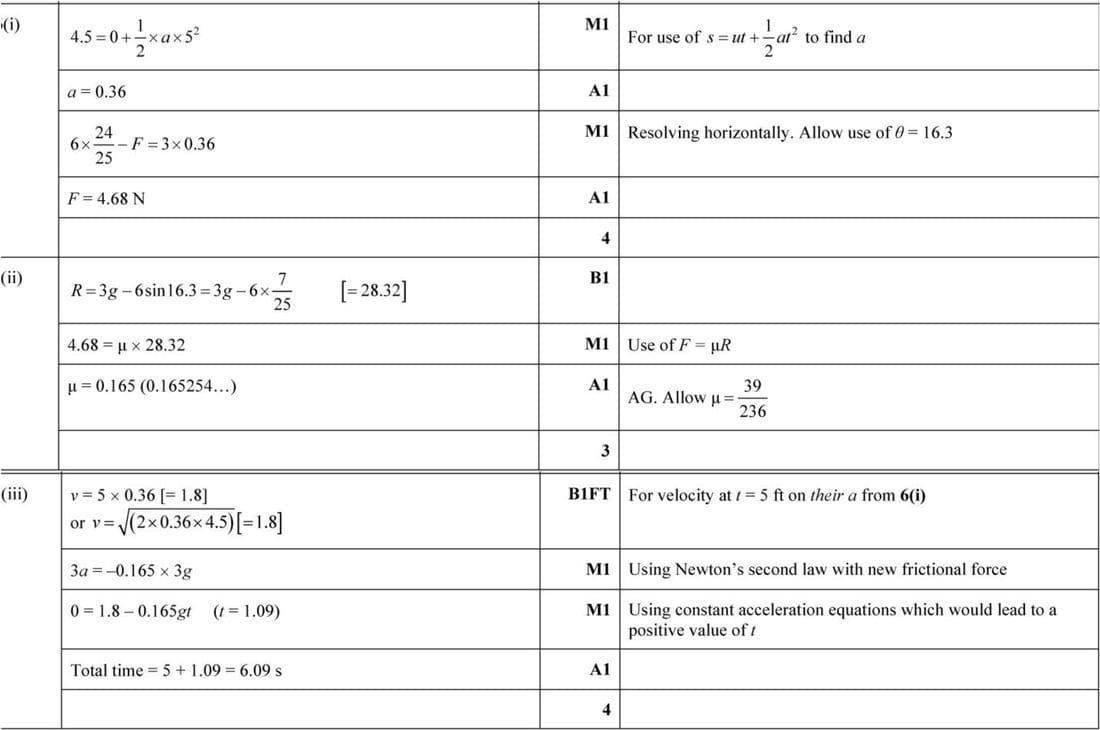
A block of mass 3 kg is initially at rest on a rough horizontal plane. A force of magnitude 6 N is applied to the block at an angle of \(\theta\) above the horizontal, where \(\cos \theta = \frac{24}{25}\). The force is applied for a period of 5 s, during which time the block moves a distance of 4.5 m.
- Find the magnitude of the frictional force on the block.
- Show that the coefficient of friction between the block and the plane is 0.165, correct to 3 significant figures.
- When the block has moved a distance of 4.5 m, the force of magnitude 6 N is removed and the block then decelerates to rest. Find the total time for which the block is in motion.
Nov 2018 p43 q2
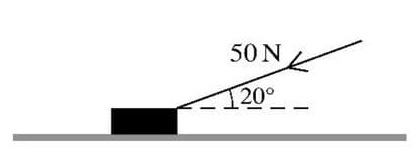
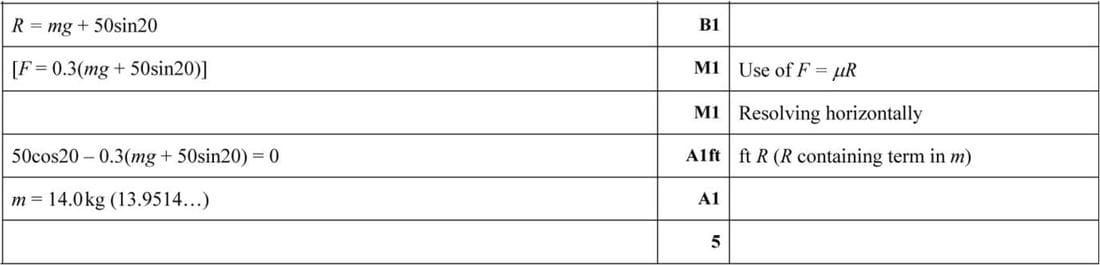
A block is pushed along a horizontal floor by a force of magnitude 50 N which acts at an angle of 20° to the horizontal (see diagram). The coefficient of friction between the block and the floor is 0.3. Given that the speed of the block is constant, find the mass of the block.