Exam-Style Problems
⬅ Back to SubchapterJune 2010 p41 q4
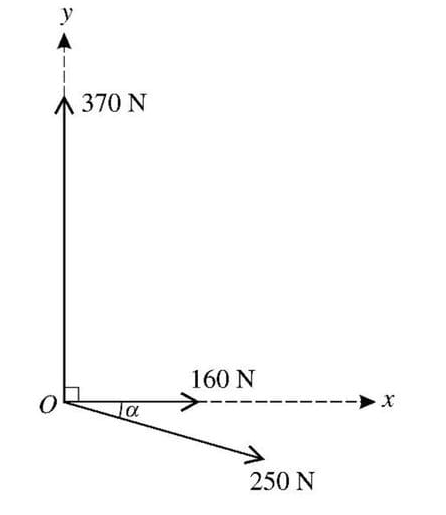
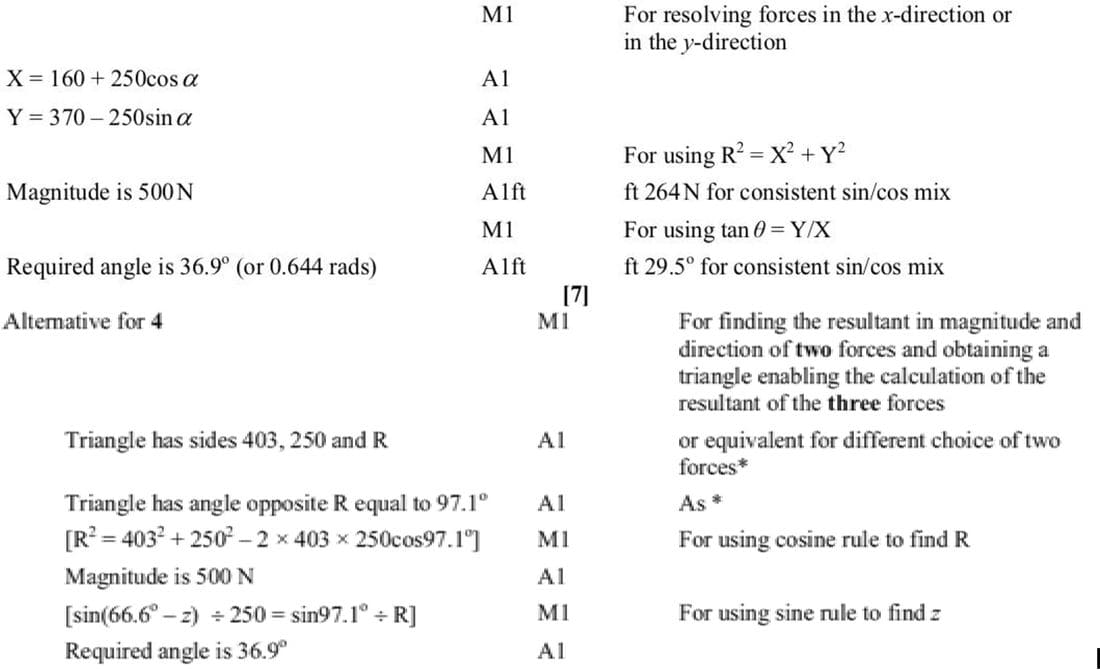
Coplanar forces of magnitudes 250 N, 160 N, and 370 N act at a point O in the directions shown in the diagram, where the angle \(\alpha\) is such that \(\sin \alpha = 0.28\) and \(\cos \alpha = 0.96\). Calculate the magnitude of the resultant of the three forces. Calculate also the angle that the resultant makes with the x-direction.
Nov 2009 p41 q3
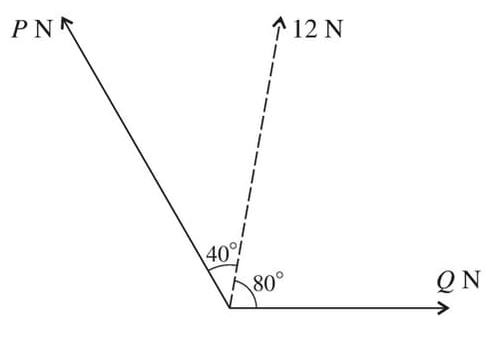
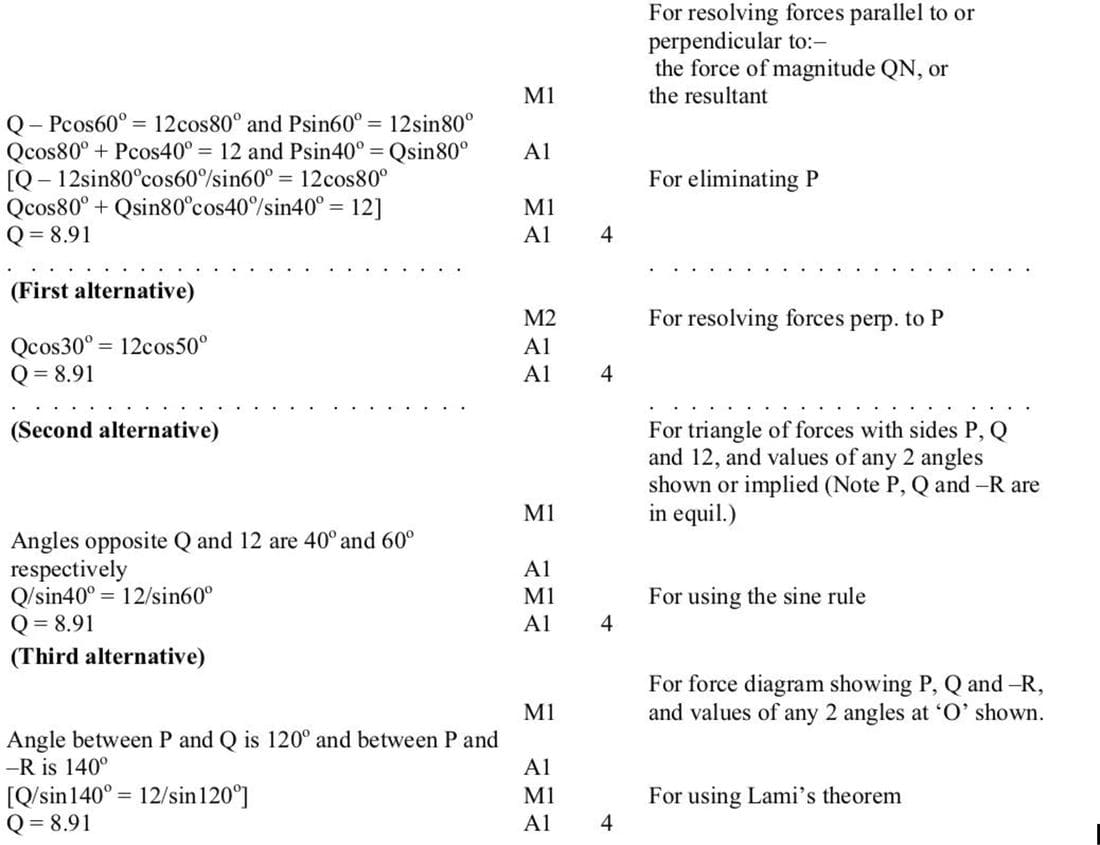
Two forces have magnitudes \(P\) N and \(Q\) N. The resultant of the two forces has magnitude 12 N and acts in a direction 40° clockwise from the force of magnitude \(P\) N and 80° anticlockwise from the force of magnitude \(Q\) N (see diagram). Find the value of \(Q\).
Feb/Mar 2022 p42 q5
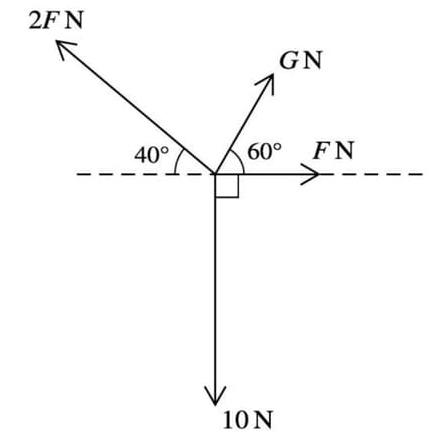
Four coplanar forces act at a point. The magnitudes of the forces are 10N, \(F\) N, \(G\) N, and \(2F\) N. The directions of the forces are as shown in the diagram.
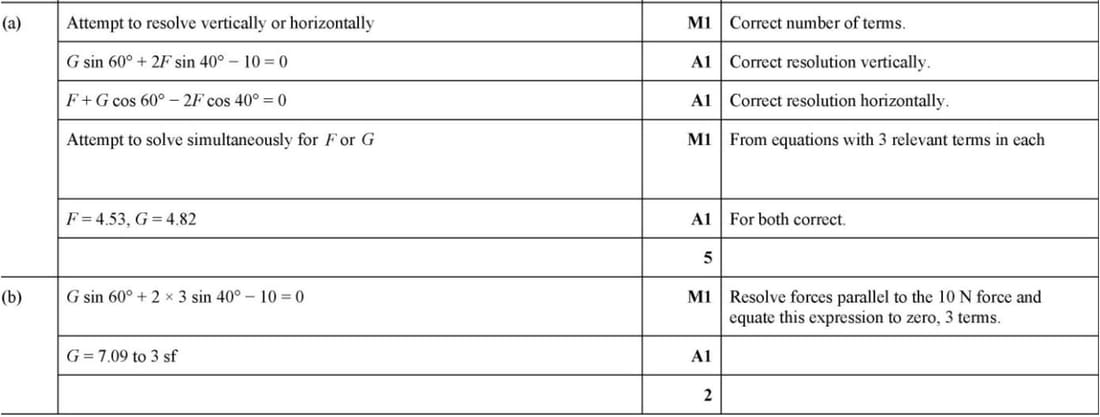
(a) Given that the forces are in equilibrium, find the values of \(F\) and \(G\).
(b) Given instead that \(F = 3\), find the value of \(G\) for which the resultant of the forces is perpendicular to the 10N force.
June 2009 p4 q3
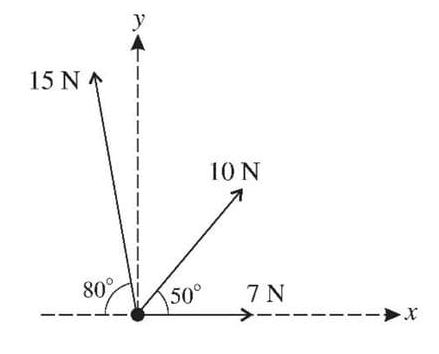
Forces of magnitudes 7 N, 10 N, and 15 N act on a particle in the directions shown in the diagram.
(i) Find the component of the resultant of the three forces
- in the x-direction,
- in the y-direction.
(ii) Hence find the direction of the resultant.

Nov 2008 p4 q1
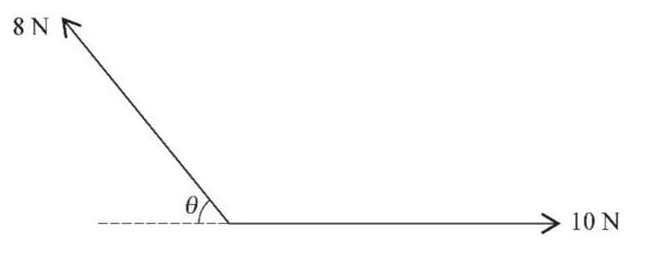
Forces of magnitudes 10 N and 8 N act in directions as shown in the diagram.
(i) Write down in terms of \(\theta\) the component of the resultant of the two forces
- parallel to the force of magnitude 10 N,
- perpendicular to the force of magnitude 10 N.
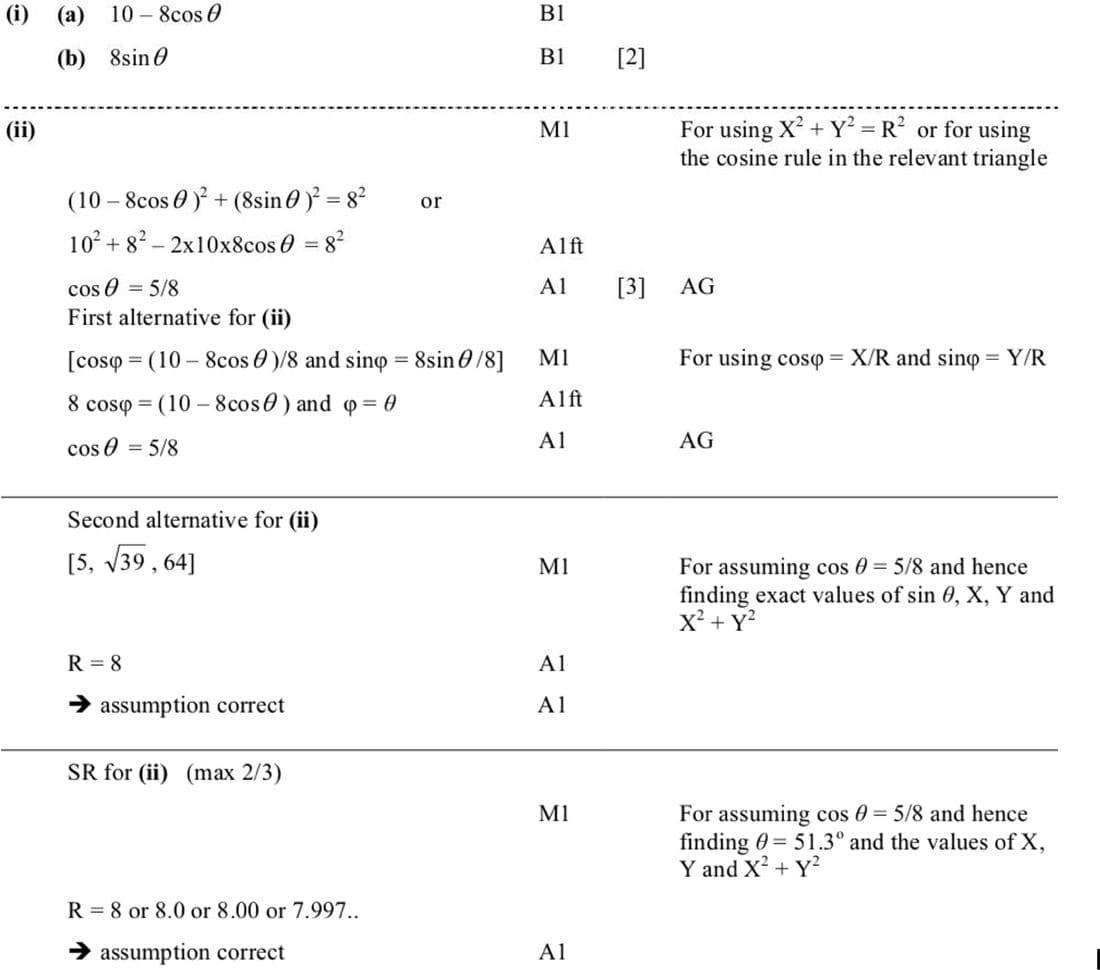
(ii) The resultant of the two forces has magnitude 8 N. Show that \(\cos \theta = \frac{5}{8}\).