Exam-Style Problems
⬅ Back to SubchapterJune 2011 p42 q5
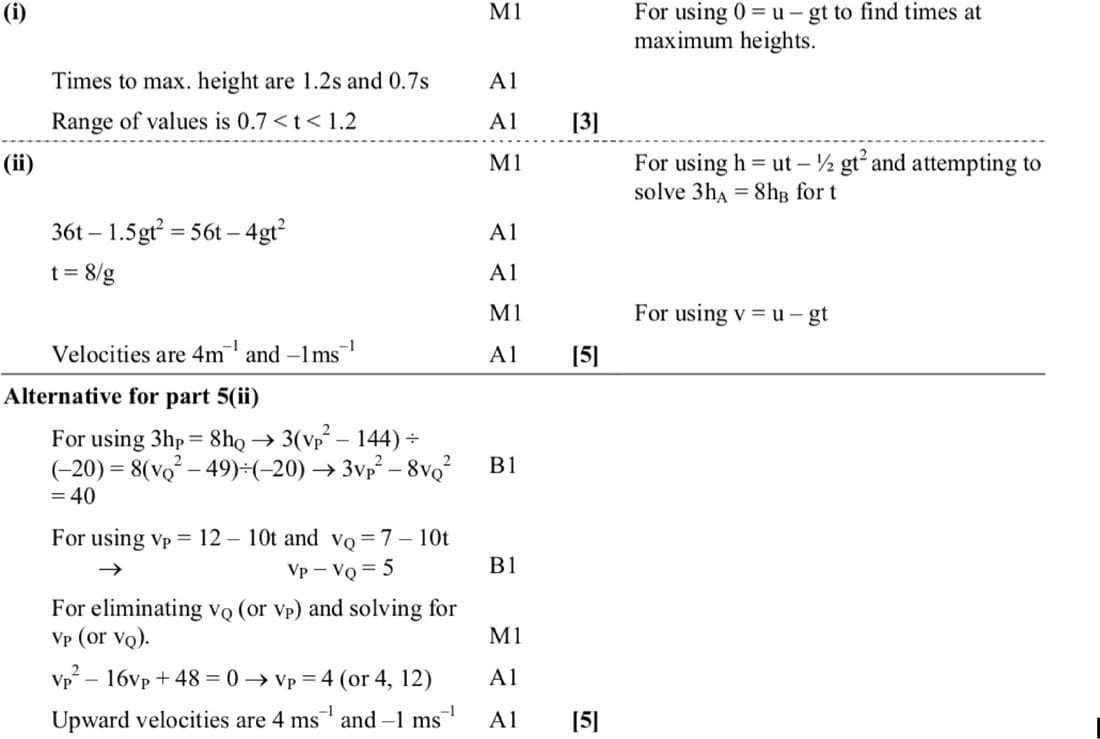
Two particles P and Q are projected vertically upwards from horizontal ground at the same instant. The speeds of projection of P and Q are 12 m s-1 and 7 m s-1 respectively and the heights of P and Q above the ground, t seconds after projection, are hP m and hQ m respectively. Each particle comes to rest on returning to the ground.
- Find the set of values of t for which the particles are travelling in opposite directions. [3]
- At a certain instant, P and Q are above the ground and 3hP = 8hQ. Find the velocities of P and Q at this instant. [5]
Nov 2010 p42 q5
Particles P and Q are projected vertically upwards, from different points on horizontal ground, with velocities of 20 m s-1 and 25 m s-1 respectively. Q is projected 0.4 s later than P. Find
- the time for which P's height above the ground is greater than 15 m,
- the velocities of P and Q at the instant when the particles are at the same height.

Nov 2022 p43 q1
A particle P is projected vertically upwards with speed u m s-1 from a point on the ground. P reaches its greatest height after 3 s.
(a) Find u.
(b) Find the greatest height of P above the ground.

Nov 2010 p41 q1
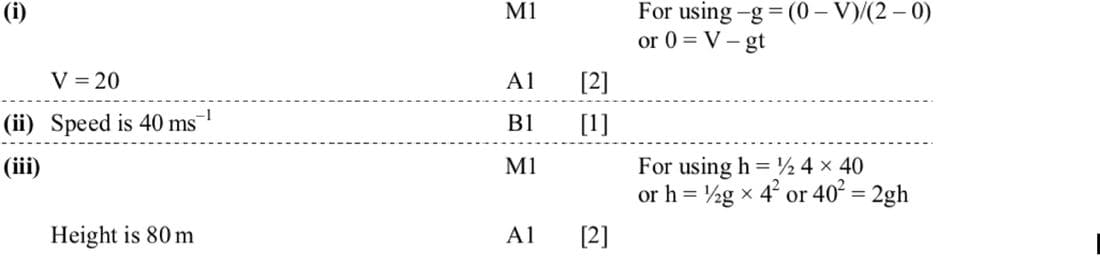
Two particles P and Q move vertically under gravity. The graphs show the upward velocity v m s-1 of the particles at time t s, for 0 ≤ t ≤ 4. P starts with velocity V m s-1 and Q starts from rest.
- Find the value of V.
\(Given that Q reaches the horizontal ground when t = 4, find\)
- the speed with which Q reaches the ground,
- the height of Q above the ground when t = 0.

Nov 2008 p4 q7
A particle P is held at rest at a fixed point O and then released. P falls freely under gravity until it reaches the point A which is 1.25 m below O.
- Find the speed of P at A and the time taken for P to reach A.
The particle continues to fall, but now its downward acceleration t seconds after passing through A is \((10 - 0.3t) \text{ m s}^{-2}\).
- Find the total distance P has fallen, 3 s after being released from O.
