Exam-Style Problems
⬅ Back to SubchapterJune 2016 p41 q1
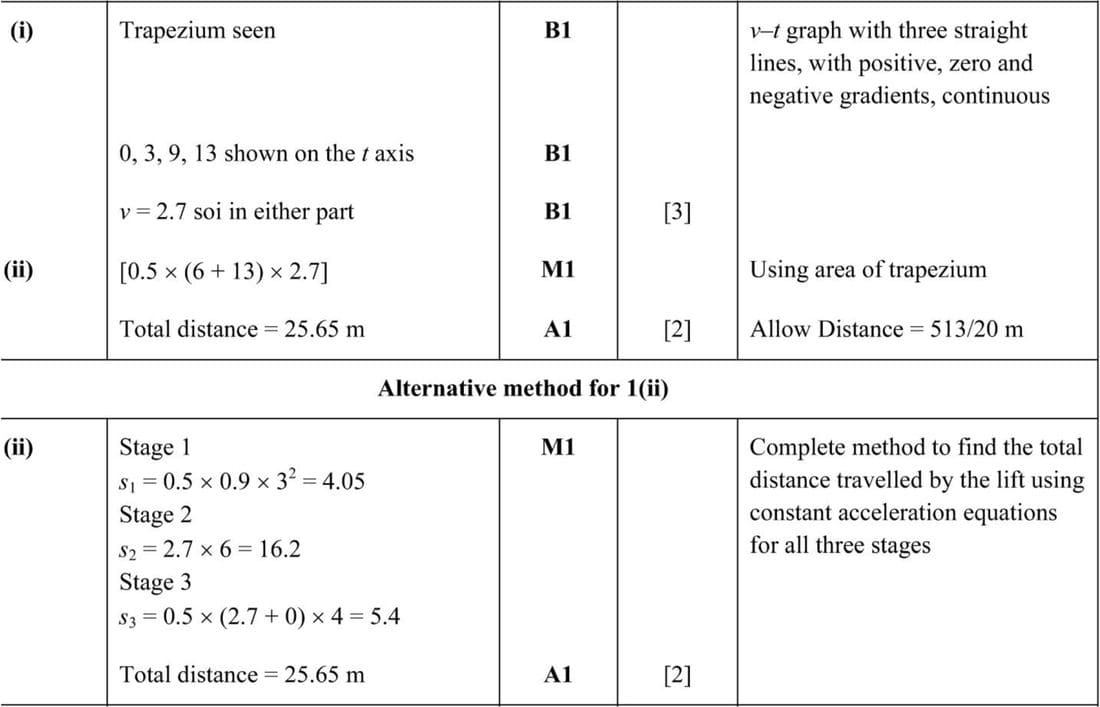
A lift moves upwards from rest and accelerates at 0.9 m/s2 for 3 s. The lift then travels for 6 s at constant speed and finally slows down, with a constant deceleration, stopping in a further 4 s.
- Sketch a velocity-time graph for the motion.
- Find the total distance travelled by the lift.

Nov 2013 p43 q5
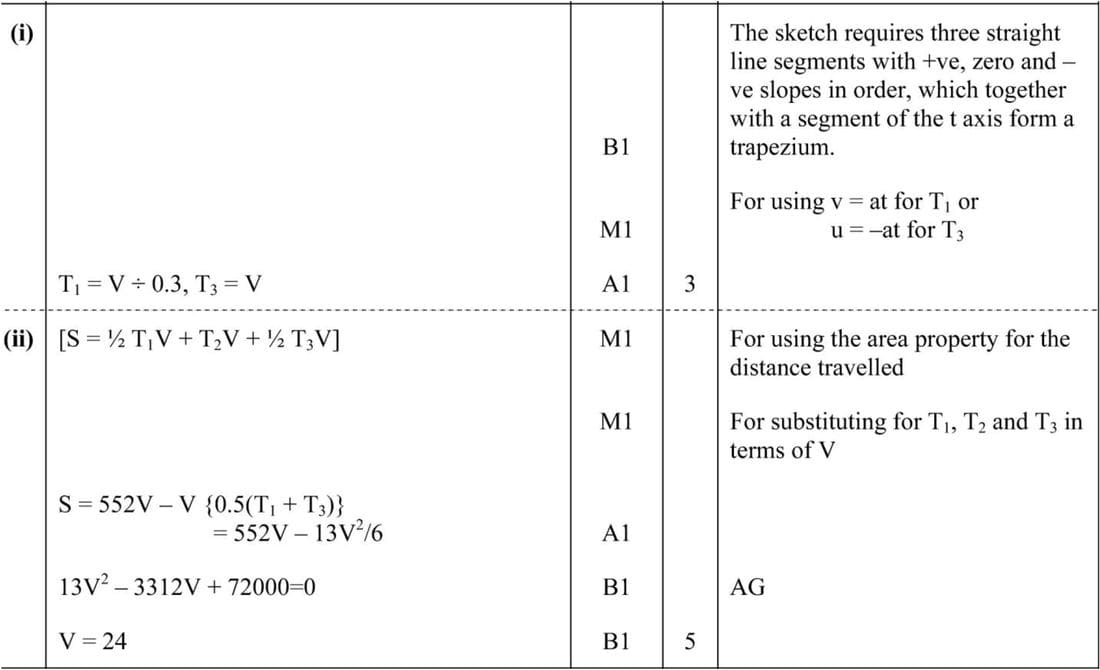
A car travels in a straight line from A to B, a distance of 12 km, taking 552 seconds. The car starts from rest at A and accelerates for T1 s at 0.3 m s-2, reaching a speed of V m s-1. The car then continues to move at V m s-1 for T2 s. It then decelerates for T3 s at 1 m s-2, coming to rest at B.
(i) Sketch the velocity-time graph for the motion and express T1 and T3 in terms of V.
(ii) Express the total distance travelled in terms of V and show that 13V2 - 3312V + 72000 = 0. Hence find the value of V.

June 2013 p42 q6
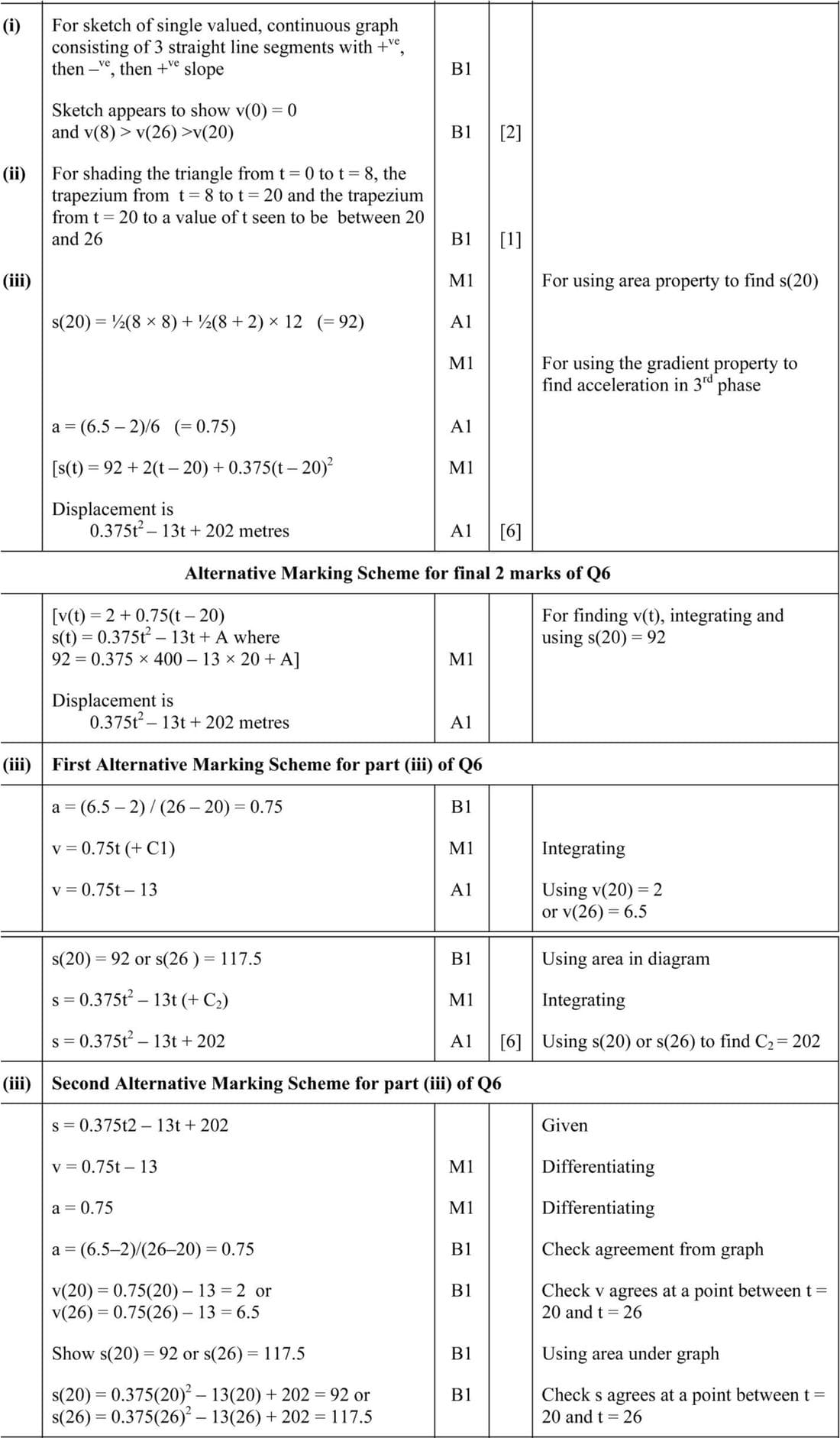
A particle P moves in a straight line. It starts from rest at a point O and moves towards a point A on the line. During the first 8 seconds P's speed increases to 8 m s-1 with constant acceleration. During the next 12 seconds P's speed decreases to 2 m s-1 with constant deceleration. P then moves with constant acceleration for 6 seconds, reaching A with speed 6.5 m s-1.
- Sketch the velocity-time graph for P's motion.
The displacement of P from O, at time t seconds after P leaves O, is s metres.
- Shade the region of the velocity-time graph representing s for a value of t where 20 ≤ t ≤ 26.
- Show that, for 20 ≤ t ≤ 26,
\(s = 0.375t^2 - 13t + 202.\)

June 2011 p41 q5
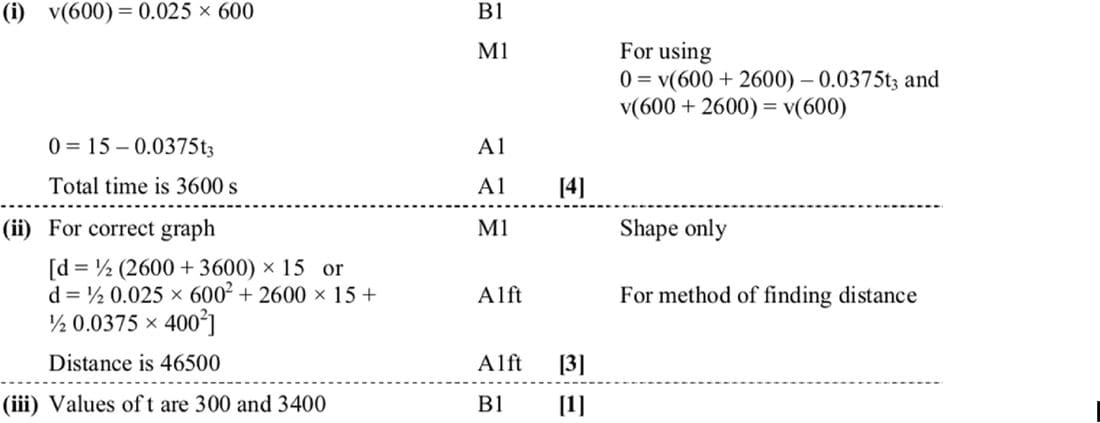
A train starts from rest at a station A and travels in a straight line to station B, where it comes to rest. The train moves with constant acceleration 0.025 m s-2 for the first 600 s, with constant speed for the next 2600 s, and finally with constant deceleration 0.0375 m s-2.
- Find the total time taken for the train to travel from A to B.
- Sketch the velocity-time graph for the journey and find the distance AB.
- The speed of the train t seconds after leaving A is 7.5 m s-1. State the possible values of t.
Nov 2010 p43 q4
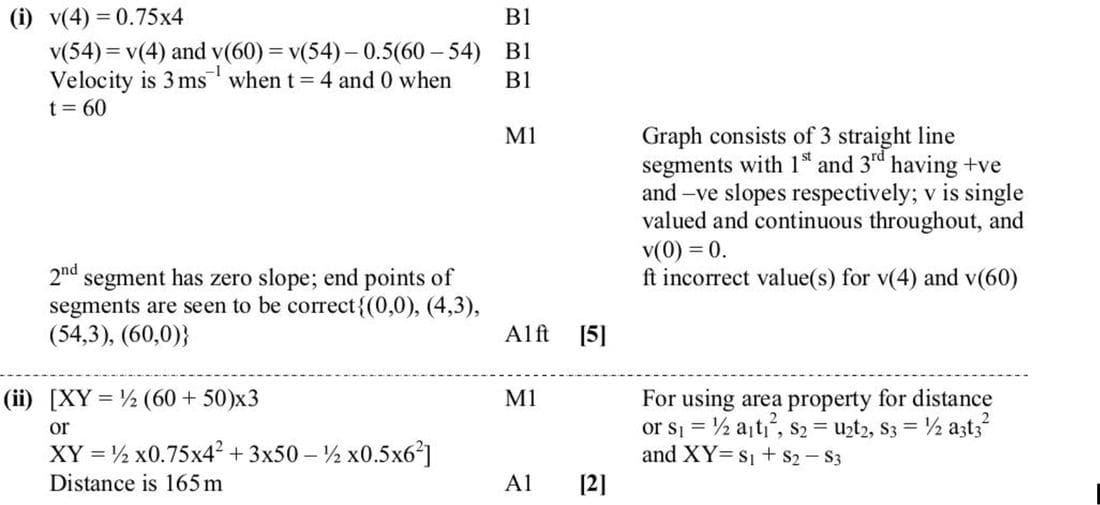
A particle starts from rest at a point X and moves in a straight line until, 60 seconds later, it reaches a point Y. At time t s after leaving X, the acceleration of the particle is
0.75 m s-2 for 0 < t < 4,
0 m s-2 for 4 < t < 54,
-0.5 m s-2 for 54 < t < 60.
\((i) Find the velocity of the particle when t = 4 and when t = 60, and sketch the velocity-time graph.\)
(ii) Find the distance XY.