Exam-Style Problems
⬅ Back to SubchapterNov 2013 p33 q10
2299
A particular solution of the differential equation
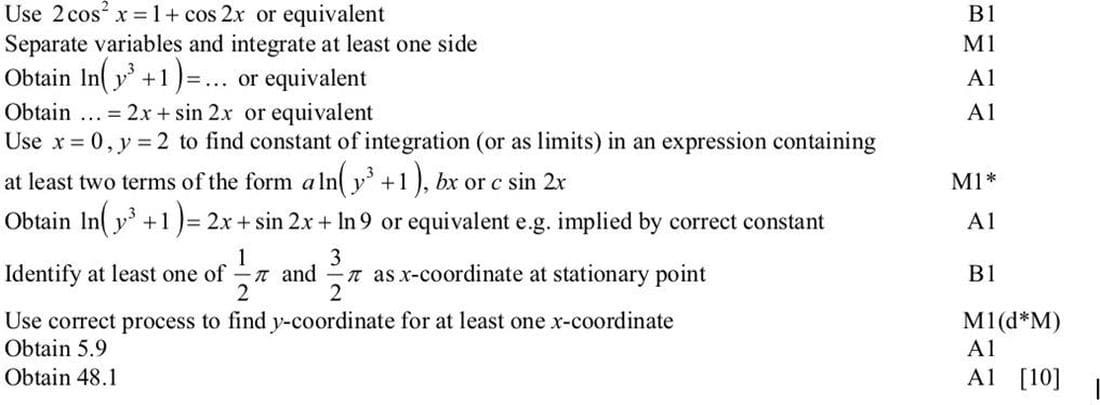
\(3y^2 \frac{dy}{dx} = 4(y^3 + 1) \cos^2 x\)
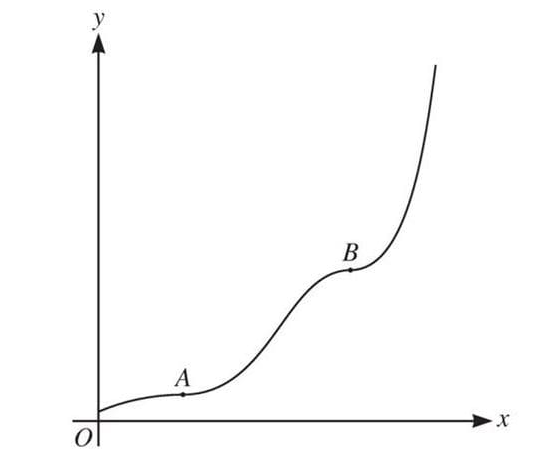
is such that \(y = 2\) when \(x = 0\). The diagram shows a sketch of the graph of this solution for \(0 \leq x \leq 2\pi\); the graph has stationary points at \(A\) and \(B\). Find the \(y\)-coordinates of \(A\) and \(B\), giving each coordinate correct to 1 decimal place.
Problem 2300
2300
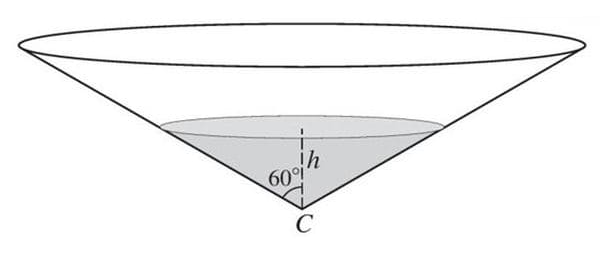
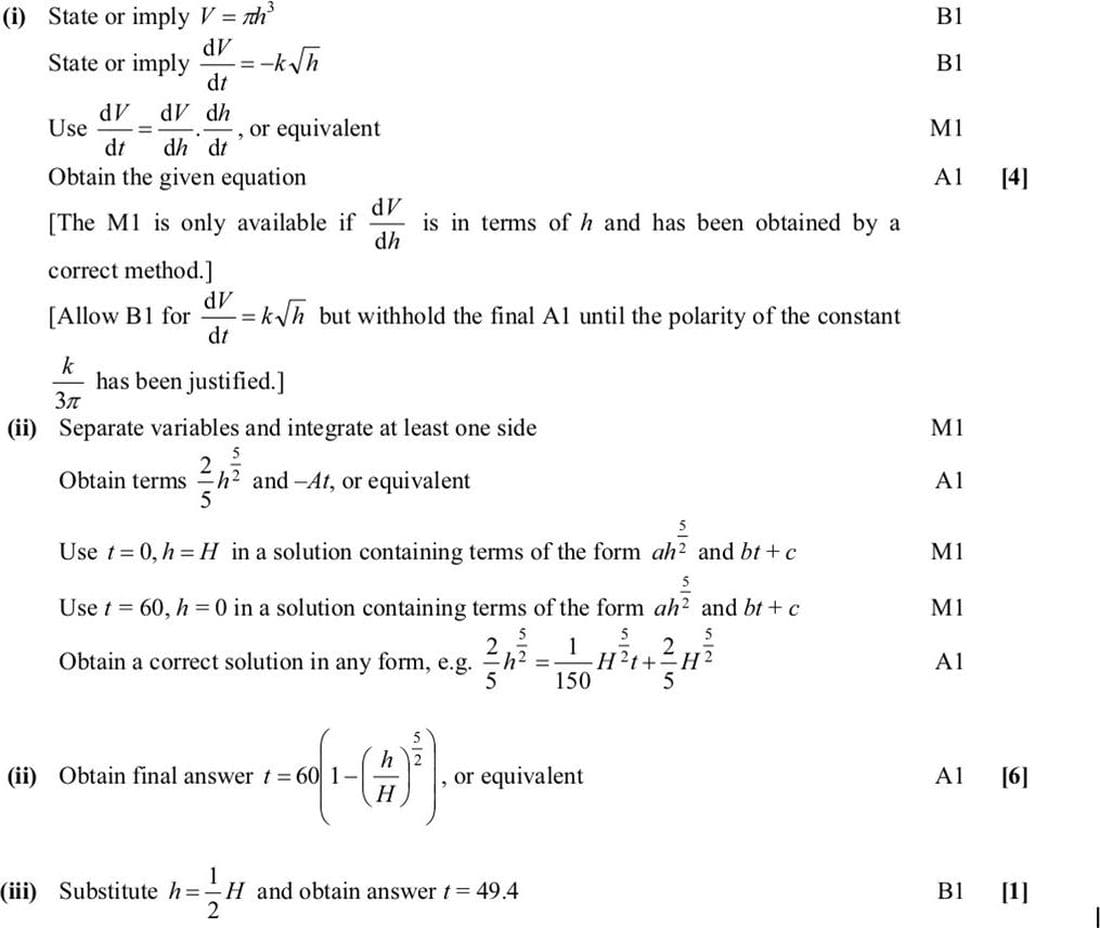
A tank containing water is in the form of a cone with vertex C. The axis is vertical and the semi-vertical angle is 60°, as shown in the diagram. At time t = 0, the tank is full and the depth of water is H. At this instant, a tap at C is opened and water begins to flow out. The volume of water in the tank decreases at a rate proportional to \(\sqrt{h}\), where h is the depth of water at time t. The tank becomes empty when \(t = 60\).
(i) Show that h and t satisfy a differential equation of the form \(\frac{dh}{dt} = -Ah^{-\frac{3}{2}}\), where A is a positive constant.
(ii) Solve the differential equation given in part (i) and obtain an expression for t in terms of h and H.
(iii) Find the time at which the depth reaches \(\frac{1}{2}H\).
[The volume V of a cone of vertical height h and base radius r is given by \(V = \frac{1}{3} \pi r^2 h\).]
June 2013 p31 q10
2301
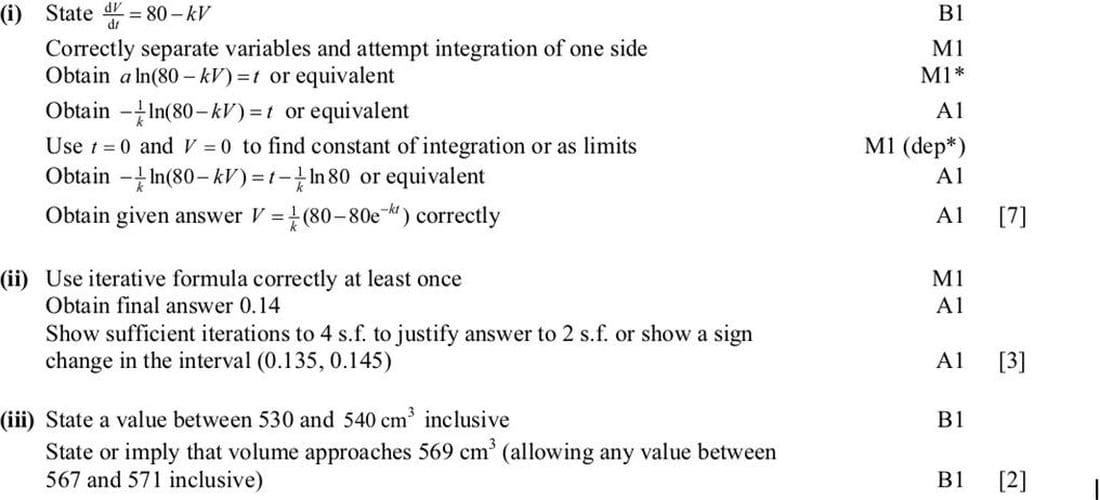
Liquid is flowing into a small tank which has a leak. Initially the tank is empty and, t minutes later, the volume of liquid in the tank is V cm3. The liquid is flowing into the tank at a constant rate of 80 cm3 per minute. Because of the leak, liquid is being lost from the tank at a rate which, at any instant, is equal to kV cm3 per minute where k is a positive constant.
(i) Write down a differential equation describing this situation and solve it to show that \(V = \frac{1}{k}(80 - 80e^{-kt})\).
(ii) It is observed that \(V = 500\) when \(t = 15\), so that \(k\) satisfies the equation \(k = \frac{4 - 4e^{-15k}}{25}\). Use an iterative formula, based on this equation, to find the value of \(k\) correct to 2 significant figures. Use an initial value of \(k = 0.1\) and show the result of each iteration to 4 significant figures.
(iii) Determine how much liquid there is in the tank 20 minutes after the liquid started flowing, and state what happens to the volume of liquid in the tank after a long time.
June 2012 p33 q5
2302
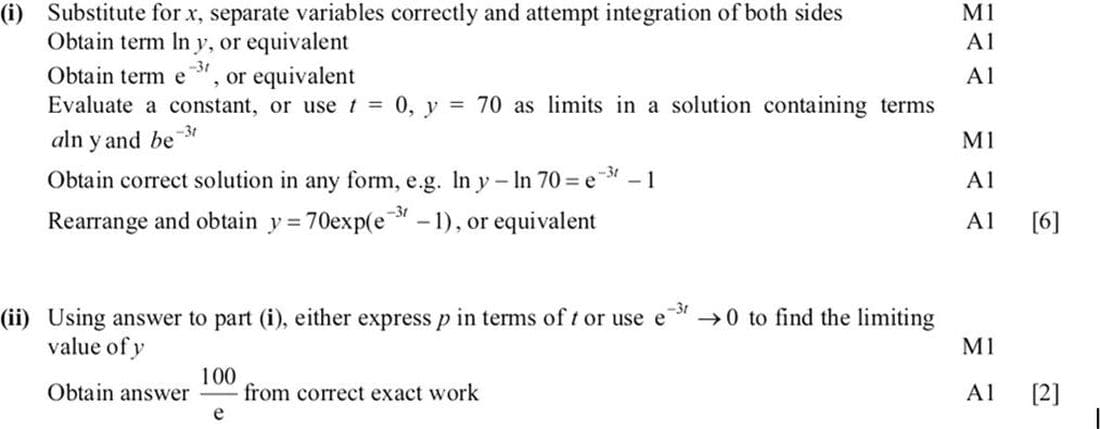
In a certain chemical process a substance A reacts with another substance B. The masses in grams of A and B present at time t seconds after the start of the process are x and y respectively. It is given that \(\frac{dy}{dt} = -0.6xy\) and \(x = 5e^{-3t}\). When \(t = 0\), \(y = 70\).
(i) Form a differential equation in y and t. Solve this differential equation and obtain an expression for y in terms of t.
(ii) The percentage of the initial mass of B remaining at time t is denoted by p. Find the exact value approached by p as t becomes large.
June 2011 p33 q9
2303
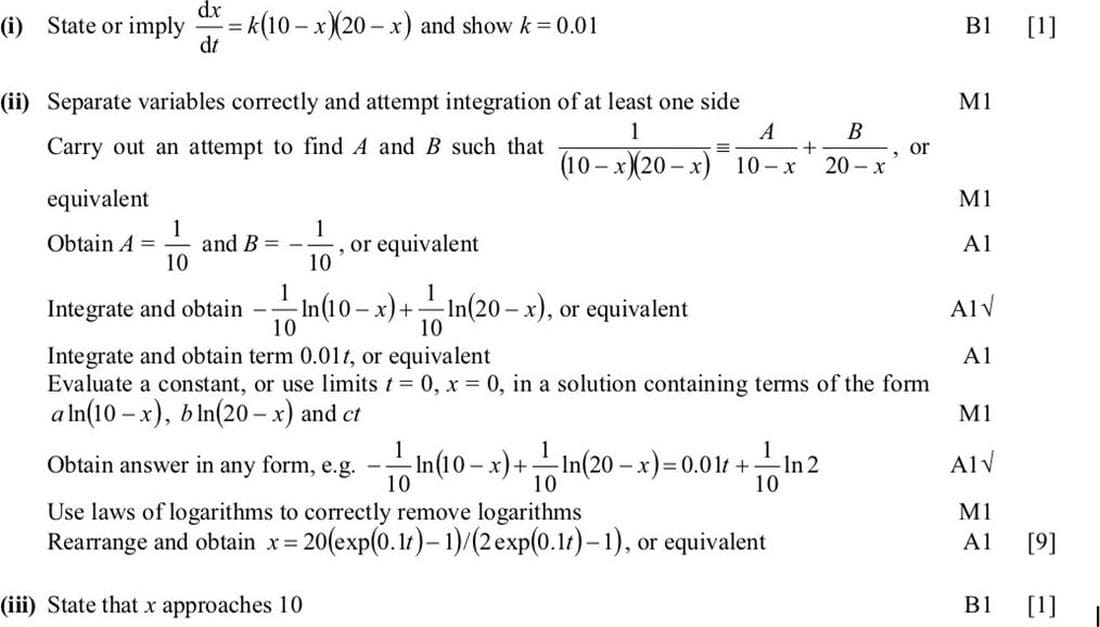
In a chemical reaction, a compound X is formed from two compounds Y and Z. The masses in grams of X, Y and Z present at time t seconds after the start of the reaction are x, 10 − x and 20 − x respectively. At any time the rate of formation of X is proportional to the product of the masses of Y and Z present at the time. When t = 0, x = 0 and \(\frac{dx}{dt} = 2\).
(i) Show that x and t satisfy the differential equation \(\frac{dx}{dt} = 0.01(10-x)(20-x)\).
(ii) Solve this differential equation and obtain an expression for x in terms of t.
(iii) State what happens to the value of x when t becomes large.