Exam-Style Problems
⬅ Back to SubchapterJune 2010 p11 q10
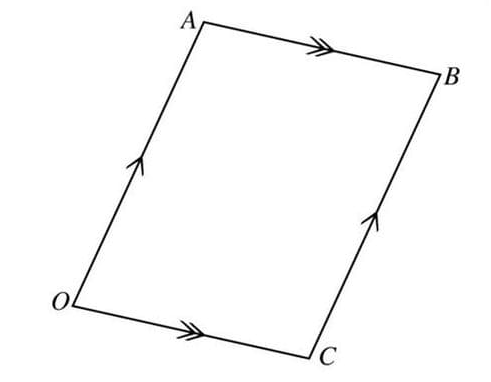
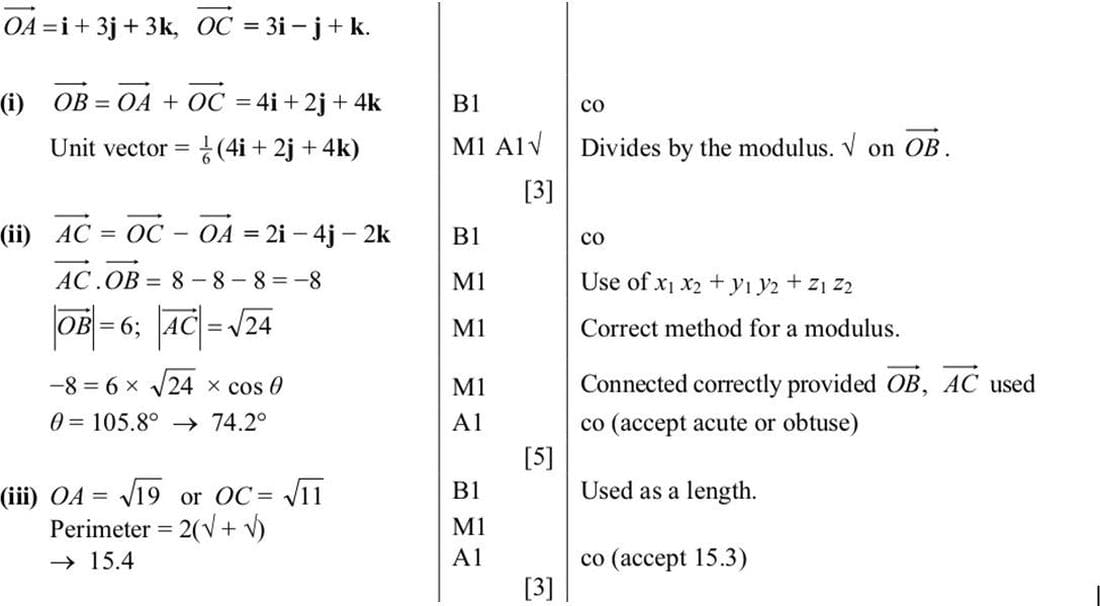
The diagram shows the parallelogram OABC. Given that \(\overrightarrow{OA} = \mathbf{i} + 3\mathbf{j} + 3\mathbf{k}\) and \(\overrightarrow{OC} = 3\mathbf{i} - \mathbf{j} + \mathbf{k}\), find
- the unit vector in the direction of \(\overrightarrow{OB}\),
- the acute angle between the diagonals of the parallelogram,
- the perimeter of the parallelogram, correct to 1 decimal place.
Nov 2009 p12 q6
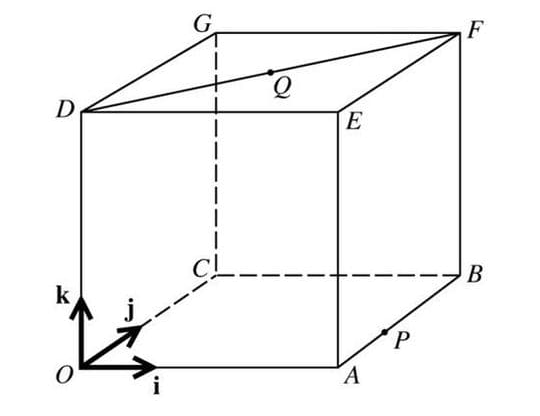
In the diagram, \(OABCDEFG\) is a cube in which each side has length 6. Unit vectors \(\mathbf{i}, \mathbf{j}\) and \(\mathbf{k}\) are parallel to \(\overrightarrow{OA}, \overrightarrow{OC}\) and \(\overrightarrow{OD}\) respectively. The point \(P\) is such that \(\overrightarrow{AP} = \frac{1}{3} \overrightarrow{AB}\) and the point \(Q\) is the mid-point of \(DF\).
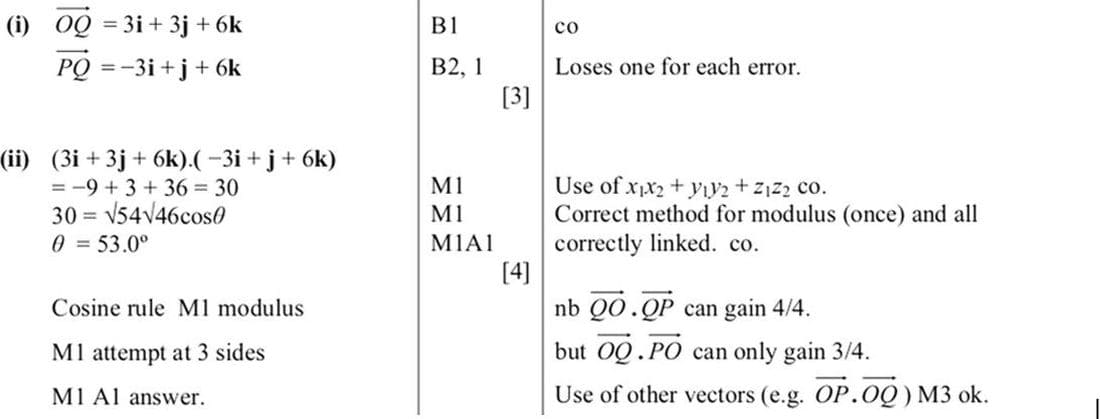
(i) Express each of the vectors \(\overrightarrow{OQ}\) and \(\overrightarrow{PQ}\) in terms of \(\mathbf{i}, \mathbf{j}\) and \(\mathbf{k}\).
(ii) Find the angle \(OQP\).
Nov 2019 p12 q7
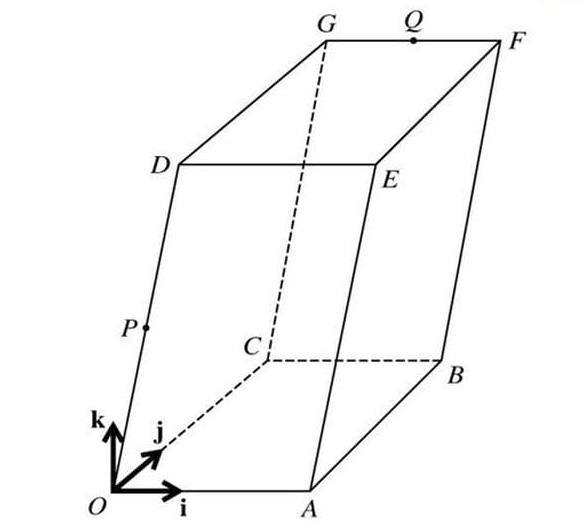
The diagram shows a three-dimensional shape OABCDEFG. The base OABC and the upper surface DEFG are identical horizontal rectangles. The parallelograms OAED and CBFG both lie in vertical planes. Points P and Q are the mid-points of OD and GF respectively. Unit vectors i and j are parallel to \(\overrightarrow{OA}\) and \(\overrightarrow{OC}\) respectively and the unit vector k is vertically upwards. The position vectors of A, C and D are given by \(\overrightarrow{OA} = 6\mathbf{i}\), \(\overrightarrow{OC} = 8\mathbf{j}\) and \(\overrightarrow{OD} = 2\mathbf{i} + 10\mathbf{k}\).
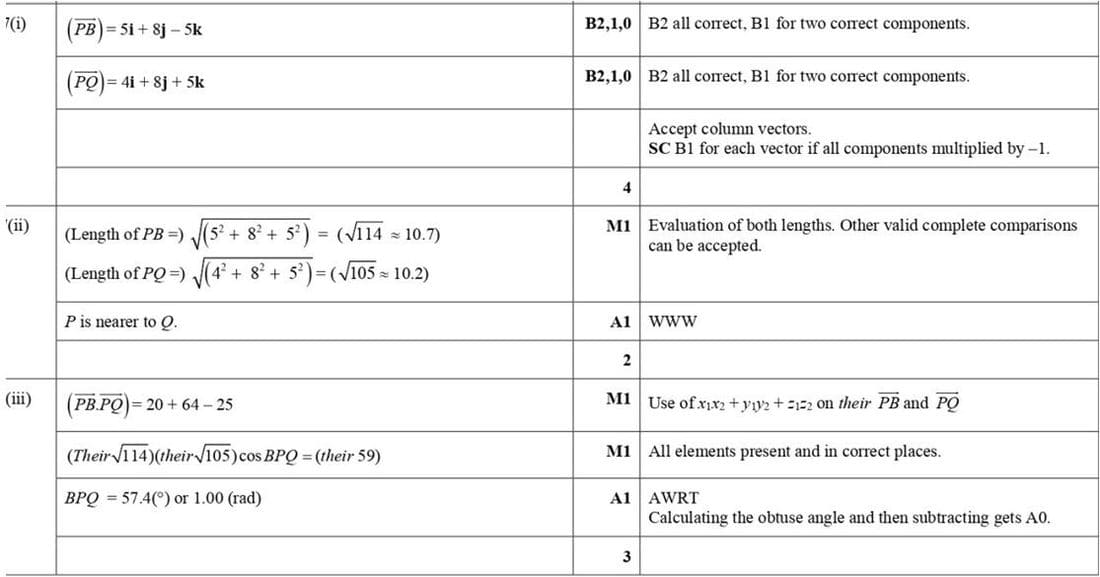
(i) Express each of the vectors \(\overrightarrow{PB}\) and \(\overrightarrow{PQ}\) in terms of i, j and k.
(ii) Determine whether P is nearer to Q or to B.
(iii) Use a scalar product to find angle BPQ.
Nov 2008 p1 q4
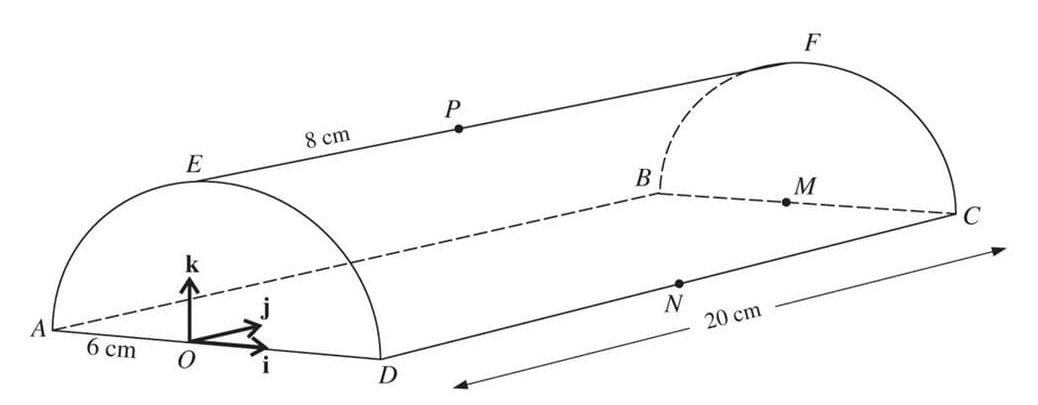
The diagram shows a semicircular prism with a horizontal rectangular base \(ABCD\). The vertical ends \(AED\) and \(BFC\) are semicircles of radius 6 cm. The length of the prism is 20 cm. The mid-point of \(AD\) is the origin \(O\), the mid-point of \(BC\) is \(M\) and the mid-point of \(DC\) is \(N\). The points \(E\) and \(F\) are the highest points of the semicircular ends of the prism. The point \(P\) lies on \(EF\) such that \(EP = 8\) cm.
Unit vectors \(\mathbf{i}, \mathbf{j}\) and \(\mathbf{k}\) are parallel to \(OD, OM\) and \(OE\) respectively.
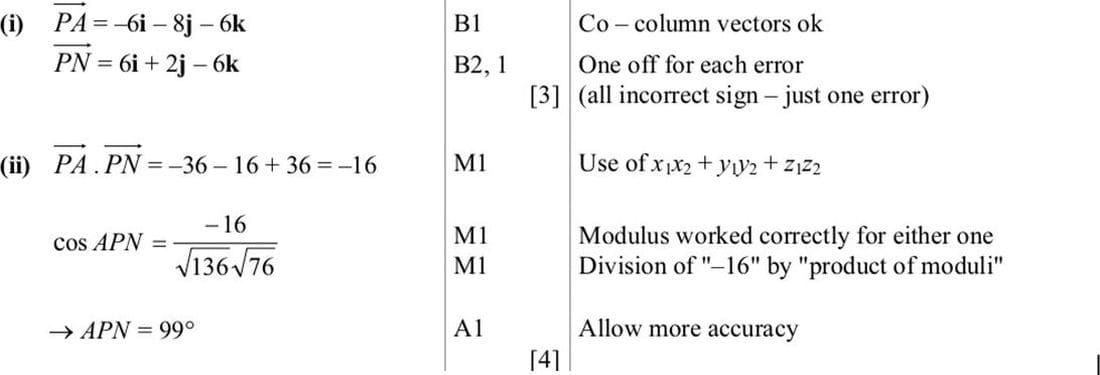
(i) Express each of the vectors \(\overrightarrow{PA}\) and \(\overrightarrow{PN}\) in terms of \(\mathbf{i}, \mathbf{j}\) and \(\mathbf{k}\).
(ii) Use a scalar product to calculate angle \(APN\).
Nov 2007 p1 q10
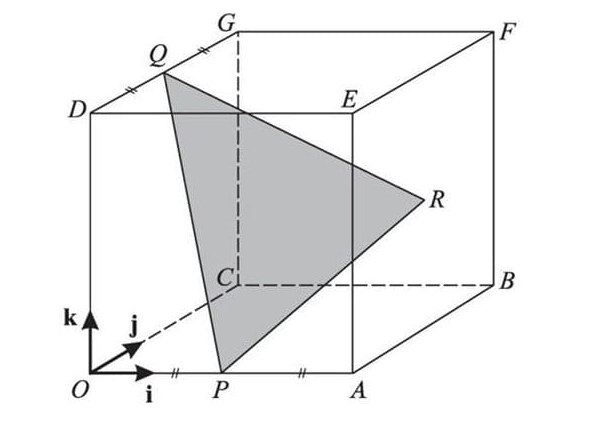
The diagram shows a cube OABCDEFG in which the length of each side is 4 units. The unit vectors i, j, and k are parallel to \(\overrightarrow{OA}\), \(\overrightarrow{OC}\), and \(\overrightarrow{OD}\) respectively. The mid-points of OA and DG are P and Q respectively and R is the centre of the square face ABFE.
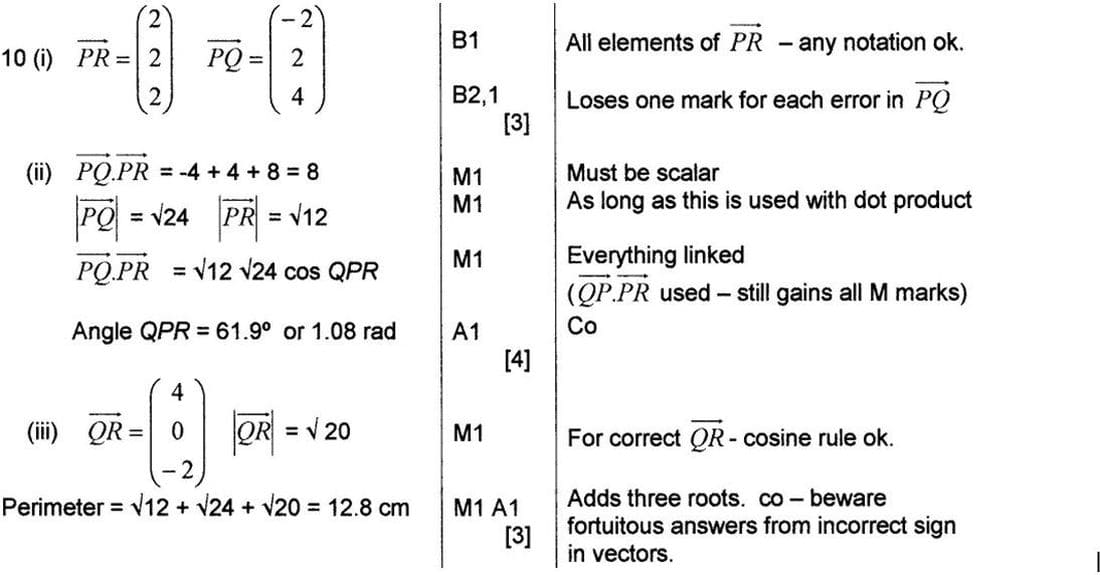
- Express each of the vectors \(\overrightarrow{PR}\) and \(\overrightarrow{PQ}\) in terms of i, j, and k.
- Use a scalar product to find angle QPR.
- Find the perimeter of triangle PQR, giving your answer correct to 1 decimal place.