Exam-Style Problems
⬅ Back to SubchapterJune 2007 p3 q1
2036
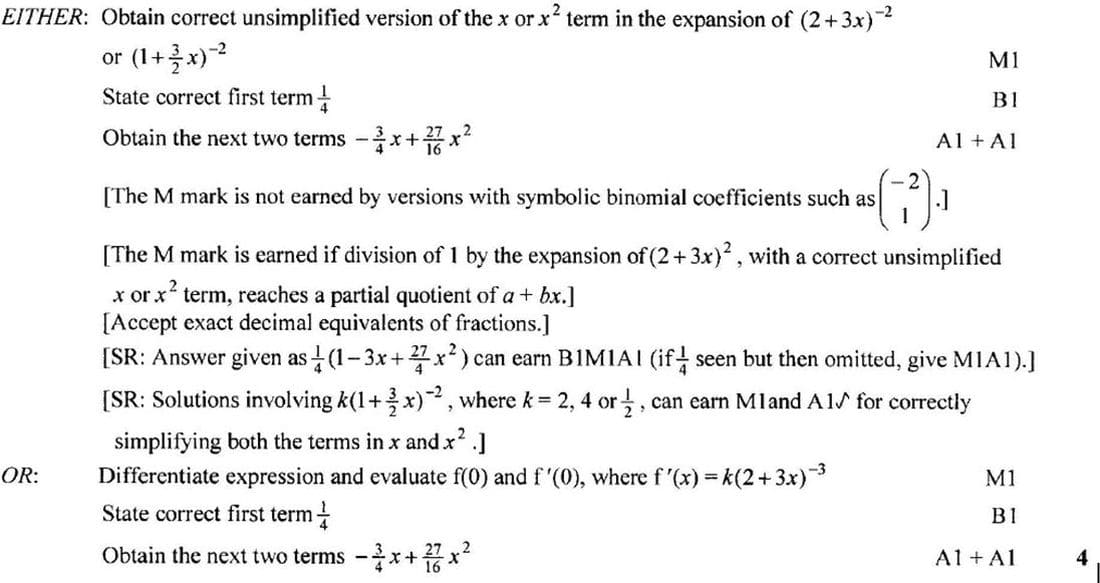
Expand \((2 + 3x)^{-2}\) in ascending powers of \(x\), up to and including the term in \(x^2\), simplifying the coefficients.
Nov 2006 p3 q5
2037
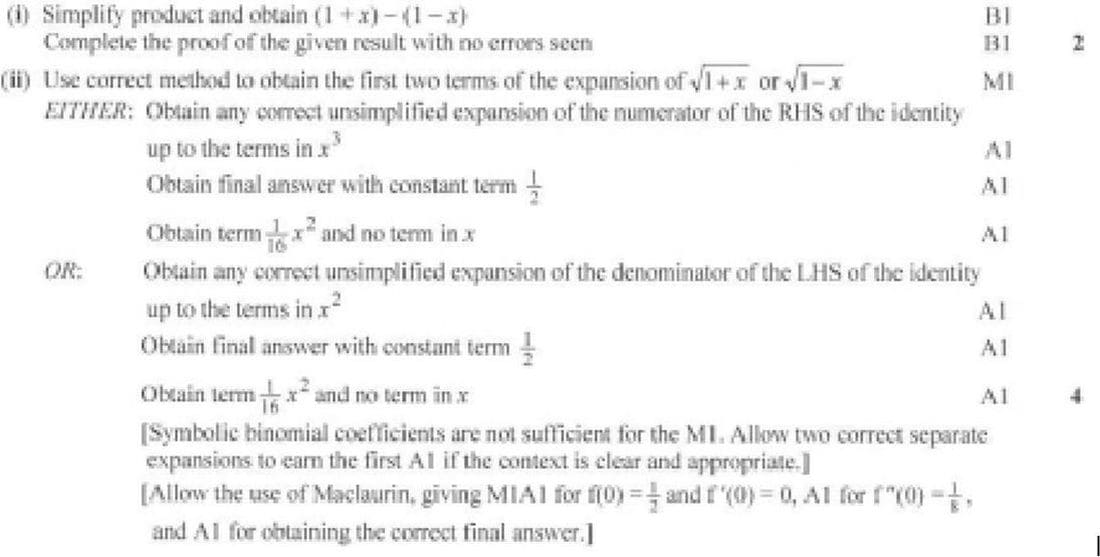
(i) Simplify \((\sqrt{1+x} + \sqrt{1-x})(\sqrt{1+x} - \sqrt{1-x})\), showing your working, and deduce that
\(\frac{1}{\sqrt{1+x} + \sqrt{1-x}} = \frac{\sqrt{1+x} - \sqrt{1-x}}{2x}.\)
(ii) Using this result, or otherwise, obtain the expansion of
\(\frac{1}{\sqrt{1+x} + \sqrt{1-x}}\)
in ascending powers of \(x\), up to and including the term in \(x^2\).
June 2022 p31 q2
2038
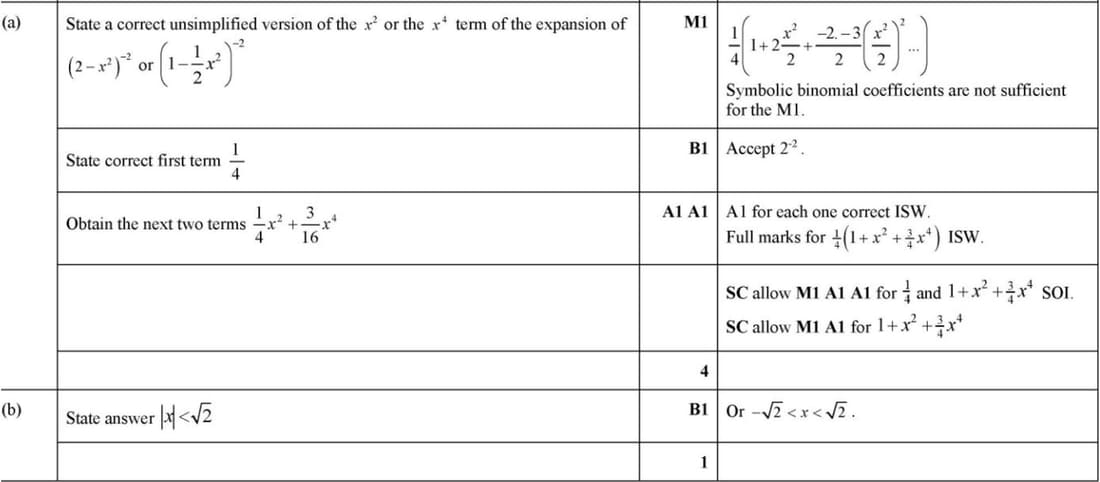
(a) Expand \((2 - x^2)^{-2}\) in ascending powers of \(x\), up to and including the term in \(x^4\), simplifying the coefficients.
(b) State the set of values of \(x\) for which the expansion is valid.
June 2005 p3 q1
2039
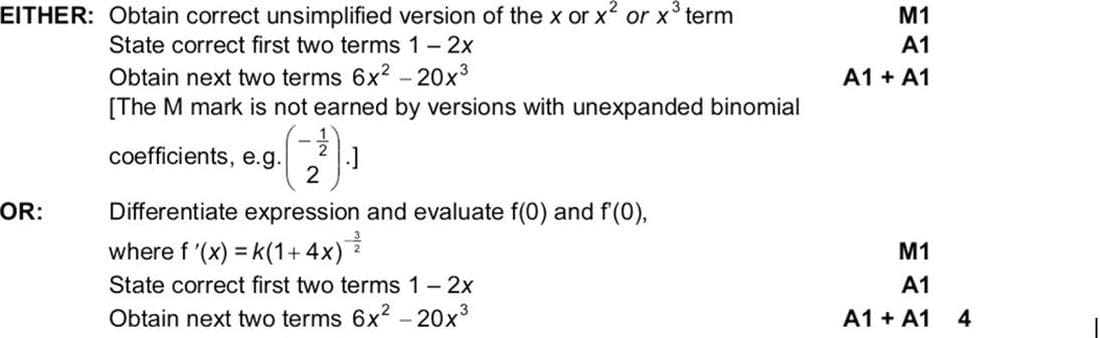
Expand \((1 + 4x)^{-\frac{1}{2}}\) in ascending powers of \(x\), up to and including the term in \(x^3\), simplifying the coefficients.
Nov 2004 p3 q1
2040
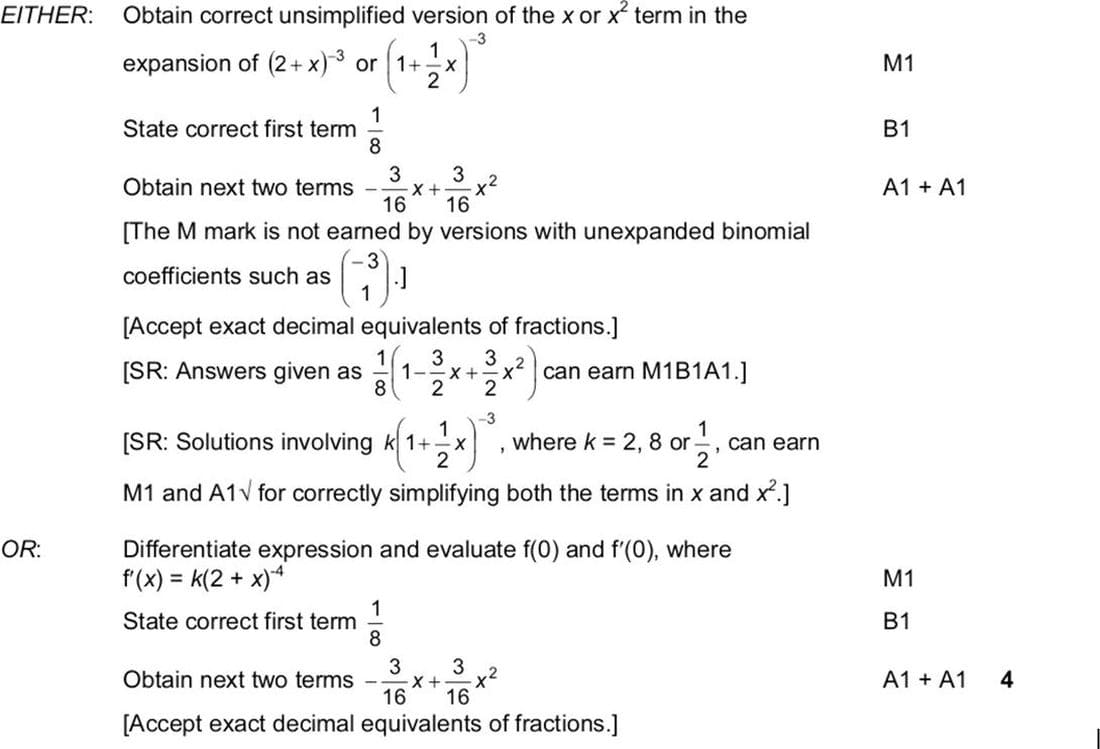
Expand \(\frac{1}{(2+x)^3}\) in ascending powers of \(x\), up to and including the term in \(x^2\), simplifying the coefficients.