Exam-Style Problems
⬅ Back to SubchapterNov 2018 p32 q5
The equation of a curve is \(y = x \ln(8 - x)\). The gradient of the curve is equal to 1 at only one point, when \(x = a\).
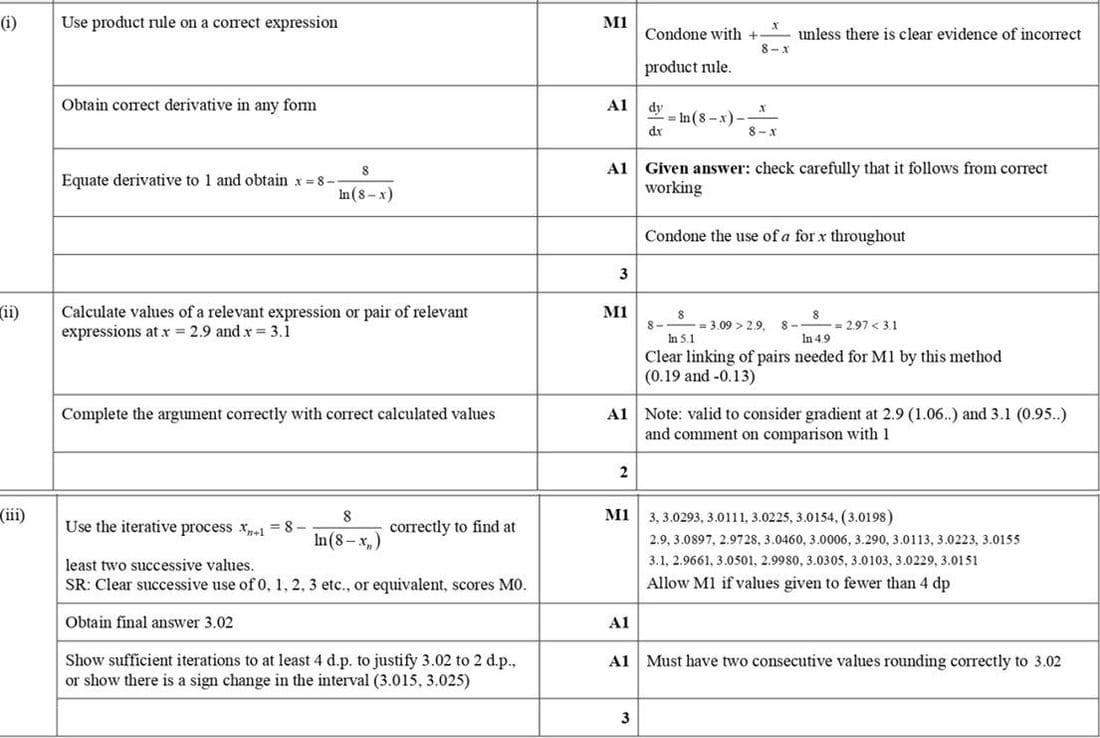
(i) Show that \(a\) satisfies the equation \(x = 8 - \frac{8}{\ln(8 - x)}\).
(ii) Verify by calculation that \(a\) lies between 2.9 and 3.1.
(iii) Use an iterative formula based on the equation in part (i) to determine \(a\) correct to 2 decimal places. Give the result of each iteration to 4 decimal places.
June 2016 p33 q6
The curve with equation \(y = x^2 \cos \frac{1}{2}x\) has a stationary point at \(x = p\) in the interval \(0 < x < \pi\).
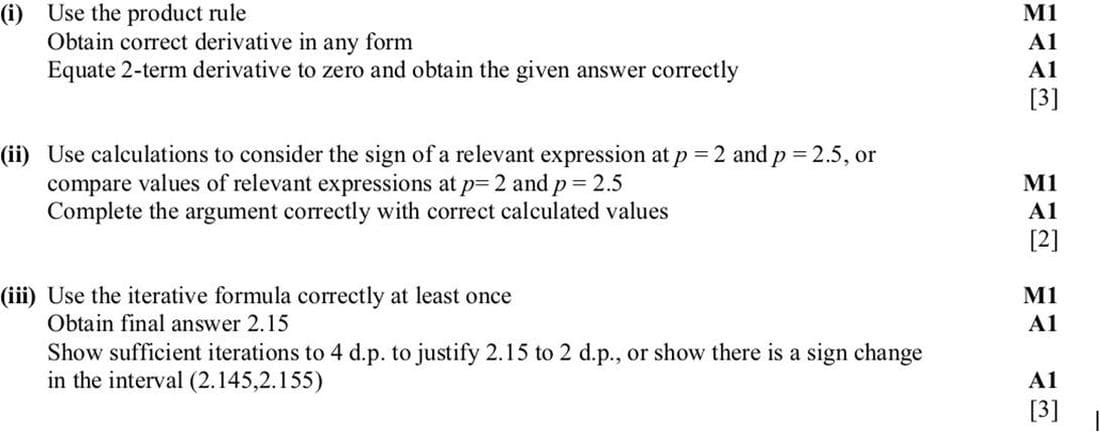
- Show that \(p\) satisfies the equation \(\tan \frac{1}{2}p = \frac{4}{p}\).
- Verify by calculation that \(p\) lies between 2 and 2.5.
- Use the iterative formula \(p_{n+1} = 2 \arctan \left( \frac{4}{p_n} \right)\) to determine the value of \(p\) correct to 2 decimal places. Give the result of each iteration to 4 decimal places.
June 2016 p32 q8
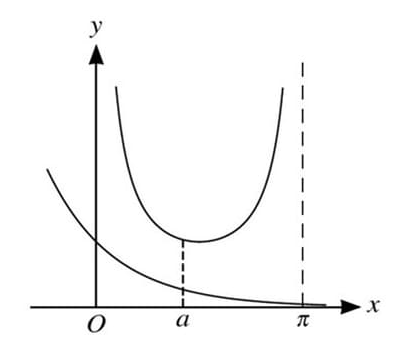
The diagram shows the curve \(y = \csc x\) for \(0 < x < \pi\) and part of the curve \(y = e^{-x}\). When \(x = a\), the tangents to the curves are parallel.
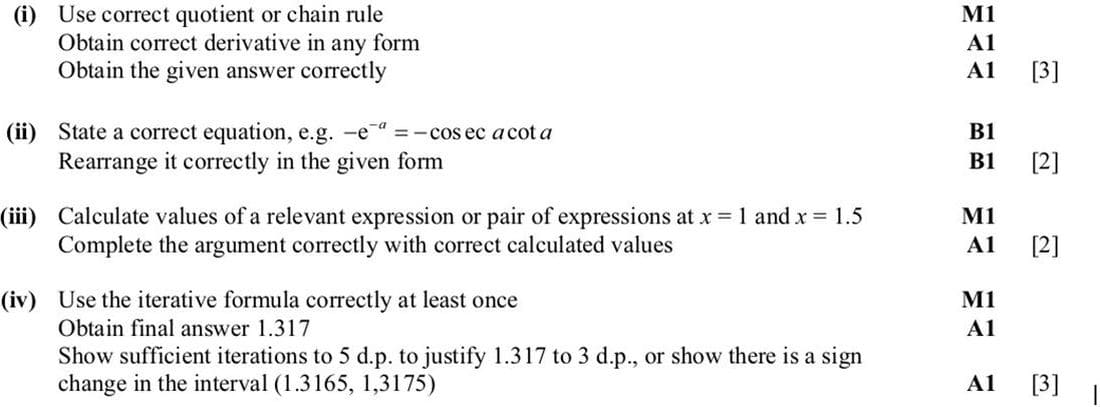
(i) By differentiating \(\frac{1}{\sin x}\), show that if \(y = \csc x\) then \(\frac{dy}{dx} = -\csc x \cot x\). [3]
(ii) By equating the gradients of the curves at \(x = a\), show that \(a = \arctan \left( \frac{e^a}{\sin a} \right)\). [2]
(iii) Verify by calculation that \(a\) lies between 1 and 1.5. [2]
(iv) Use an iterative formula based on the equation in part (ii) to determine \(a\) correct to 3 decimal places. Give the result of each iteration to 5 decimal places. [3]
Nov 2015 p33 q4
A curve has parametric equations
\(x = t^2 + 3t + 1, \quad y = t^4 + 1.\)
The point \(P\) on the curve has parameter \(p\). It is given that the gradient of the curve at \(P\) is 4.
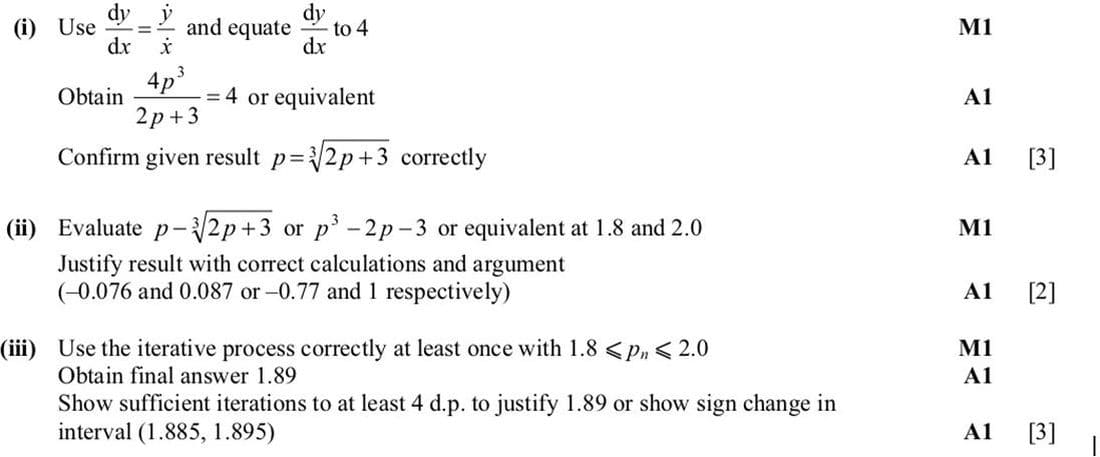
- Show that \(p = \sqrt[3]{2p + 3}\).
- Verify by calculation that the value of \(p\) lies between 1.8 and 2.0.
- Use an iterative formula based on the equation in part (i) to find the value of \(p\) correct to 2 decimal places. Give the result of each iteration to 4 decimal places.
June 2015 p31 q10
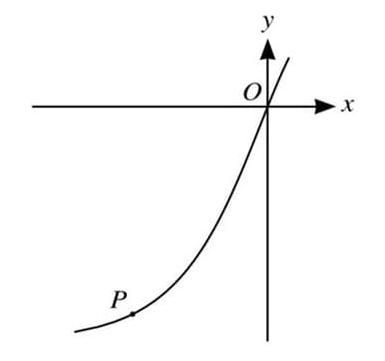
The diagram shows part of the curve with parametric equations
\(x = 2 \ln(t + 2)\), \(y = t^3 + 2t + 3\).
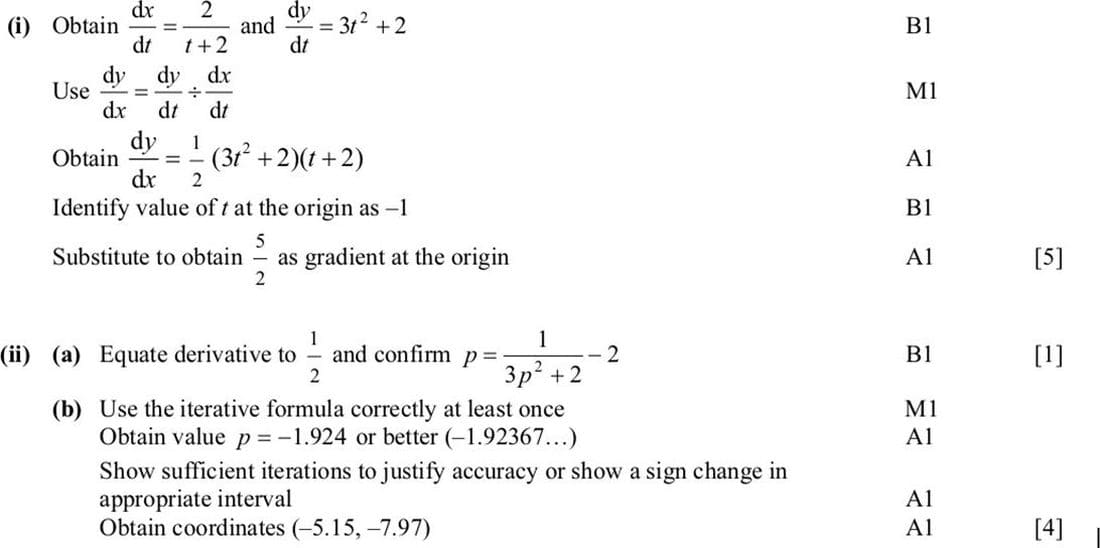
- Find the gradient of the curve at the origin. [5]
- At the point \(P\) on the curve, the value of the parameter is \(p\). It is given that the gradient of the curve at \(P\) is \(\frac{1}{2}\).
- Show that \(p = \frac{1}{3p^2 + 2} - 2\). [1]
- By first using an iterative formula based on the equation in part (a), determine the coordinates of the point \(P\). Give the result of each iteration to 5 decimal places and each coordinate of \(P\) correct to 2 decimal places. [4]