Exam-Style Problems
⬅ Back to SubchapterNov 2007 p3 q1
Find the exact value of the constant k for which \(\int_{1}^{k} \frac{1}{2x-1} \, dx = 1\).

June 2007 p3 q5
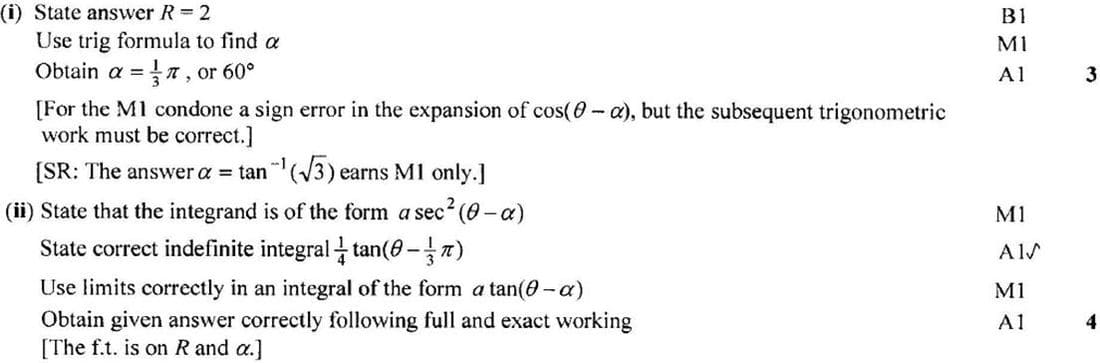
(i) Express \(\cos \theta + (\sqrt{3}) \sin \theta\) in the form \(R \cos(\theta - \alpha)\), where \(R > 0\) and \(0 < \alpha < \frac{1}{2} \pi\), giving the exact values of \(R\) and \(\alpha\).
(ii) Hence show that \(\int_{0}^{\frac{1}{2}\pi} \frac{1}{(\cos \theta + (\sqrt{3}) \sin \theta)^2} \, d\theta = \frac{1}{\sqrt{3}}\).
Nov 2019 p31 q9
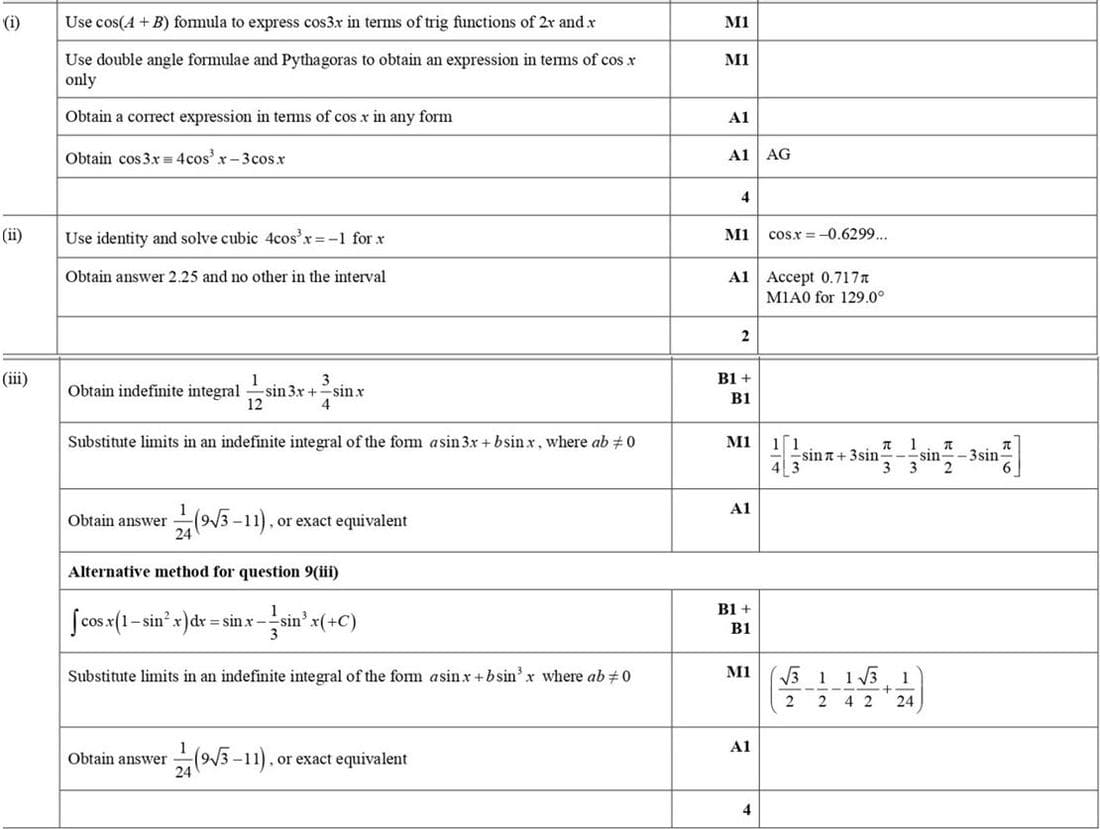
(i) By first expanding \(\cos(2x + x)\), show that \(\cos 3x \equiv 4 \cos^3 x - 3 \cos x\).
(ii) Hence solve the equation \(\cos 3x + 3 \cos x + 1 = 0\), for \(0 \leq x \leq \pi\).
(iii) Find the exact value of \(\int_{\frac{1}{6}\pi}^{\frac{1}{3}\pi} \cos^3 x \, dx\).
June 2018 p33 q7
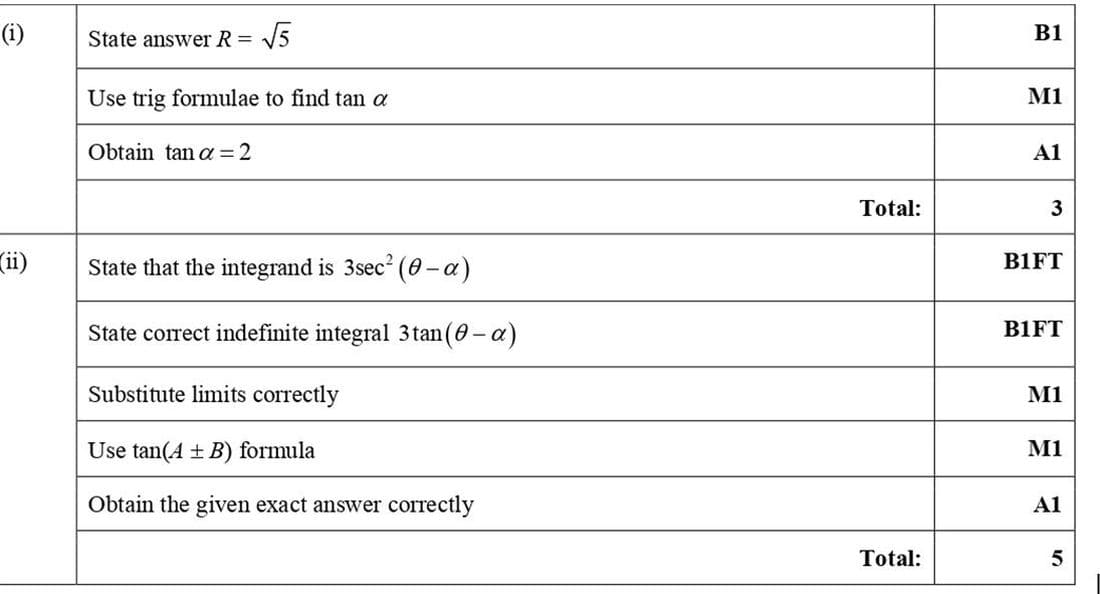
(i) Express \(\cos \theta + 2 \sin \theta\) in the form \(R \cos(\theta - \alpha)\), where \(R > 0\) and \(0 < \alpha < \frac{1}{2}\pi\). Give the exact values of \(R\) and \(\tan \alpha\).
(ii) Hence, showing all necessary working, show that \(\int_0^{\frac{1}{4}\pi} \frac{15}{(\cos \theta + 2 \sin \theta)^2} \, d\theta = 5.\)
June 2017 p32 q7
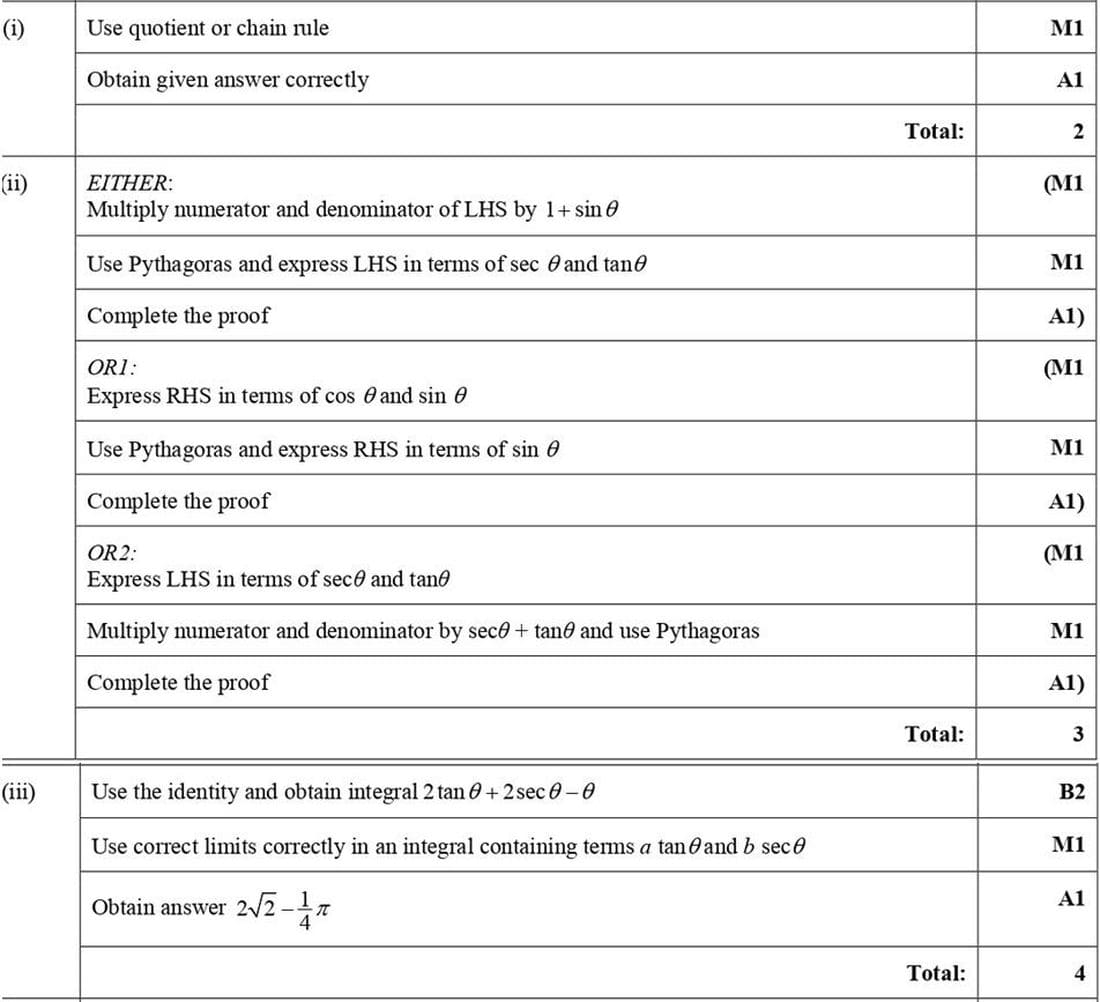
(i) Prove that if \(y = \frac{1}{\cos \theta}\) then \(\frac{dy}{d\theta} = \sec \theta \tan \theta\).
(ii) Prove the identity \(\frac{1 + \sin \theta}{1 - \sin \theta} \equiv 2 \sec^2 \theta + 2 \sec \theta \tan \theta - 1\).
(iii) Hence find the exact value of \(\int_{0}^{\frac{\pi}{4}} \frac{1 + \sin \theta}{1 - \sin \theta} \, d\theta\).