Exam-Style Problems
⬅ Back to SubchapterJune 2011 p32 q5
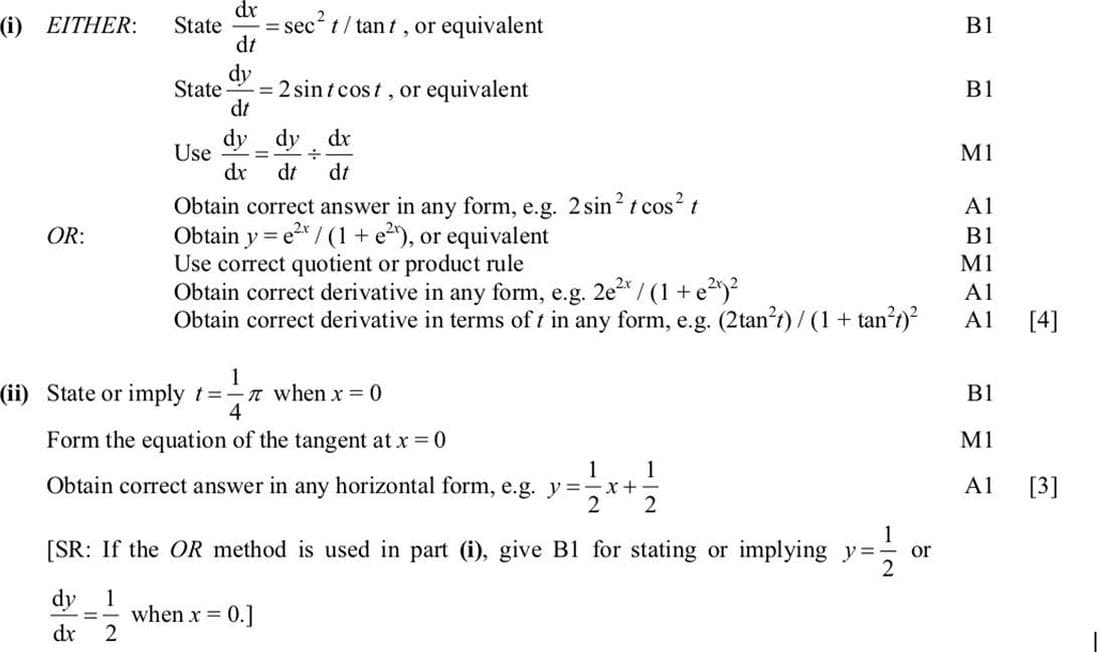
The parametric equations of a curve are
\(x = \ln(\tan t)\), \(y = \sin^2 t\),
where \(0 < t < \frac{1}{2}\pi\).
(i) Express \(\frac{dy}{dx}\) in terms of \(t\).
(ii) Find the equation of the tangent to the curve at the point where \(x = 0\).
Nov 2010 p33 q2
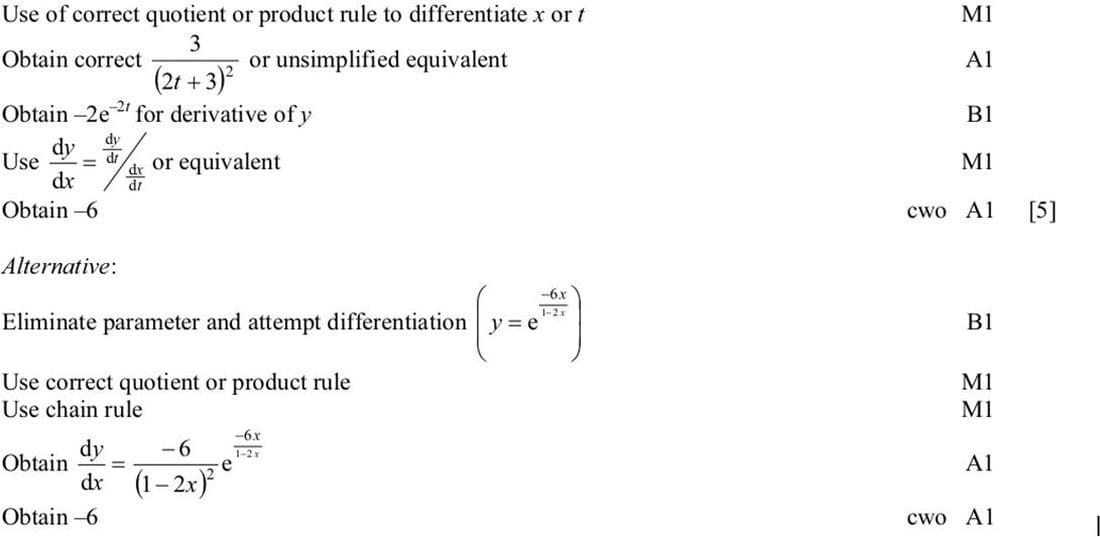
The parametric equations of a curve are
\(x = \frac{t}{2t + 3}\), \(y = e^{-2t}\).
Find the gradient of the curve at the point for which \(t = 0\).
June 2023 p33 q4
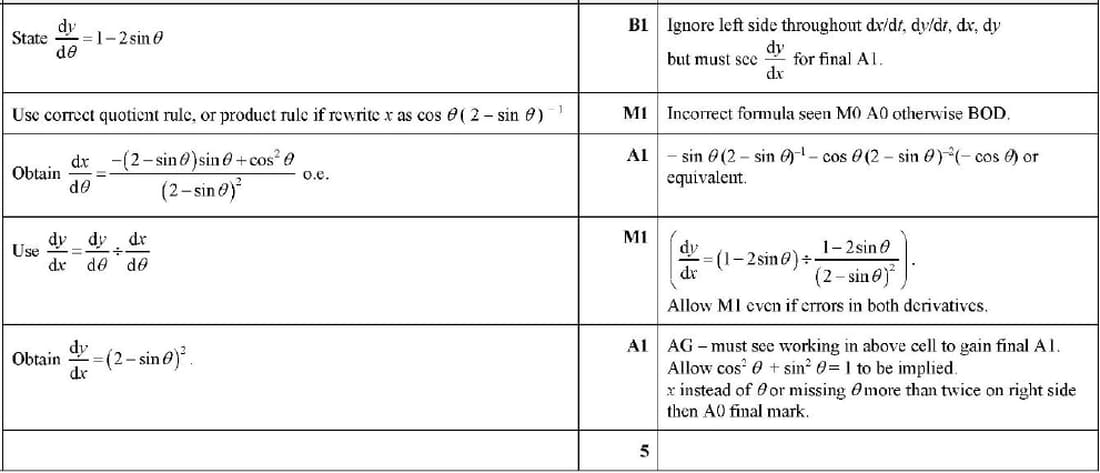
The parametric equations of a curve are
\(x = \frac{\cos \theta}{2 - \sin \theta}\), \(y = \theta + 2 \cos \theta\).
Show that \(\frac{dy}{dx} = (2 - \sin \theta)^2\).
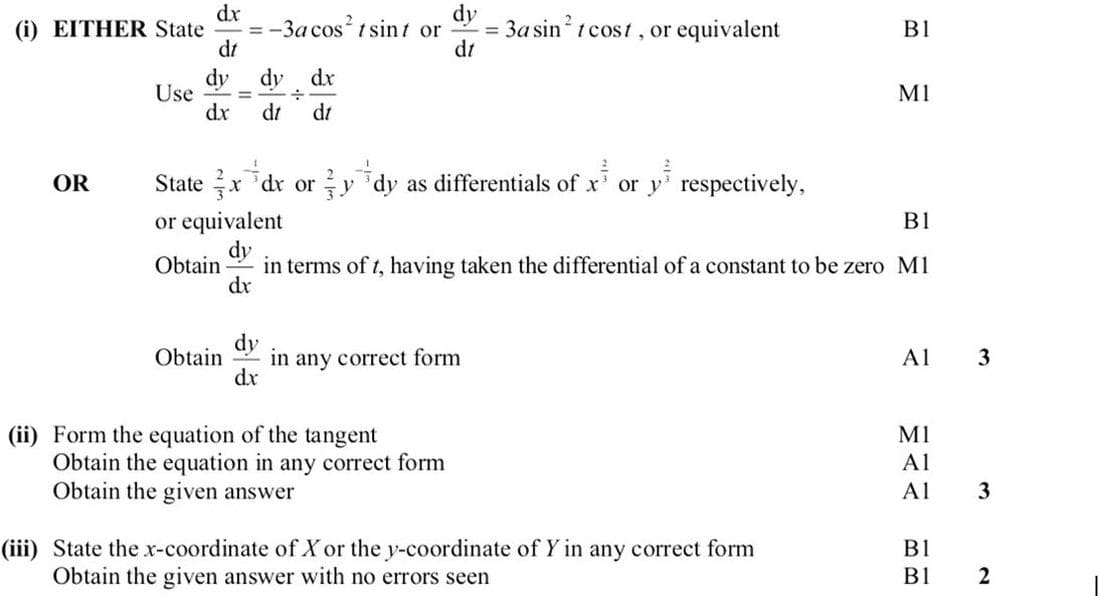
June 2009 p3 q6
The parametric equations of a curve are
\(x = a \cos^3 t, \quad y = a \sin^3 t,\)
where \(a\) is a positive constant and \(0 < t < \frac{1}{2} \pi\).
(i) Express \(\frac{dy}{dx}\) in terms of \(t\).
(ii) Show that the equation of the tangent to the curve at the point with parameter \(t\) is
\(x \sin t + y \cos t = a \sin t \cos t.\)
(iii) Hence show that, if this tangent meets the \(x\)-axis at \(X\) and the \(y\)-axis at \(Y\), then the length of \(XY\) is always equal to \(a\).
Nov 2008 p3 q4
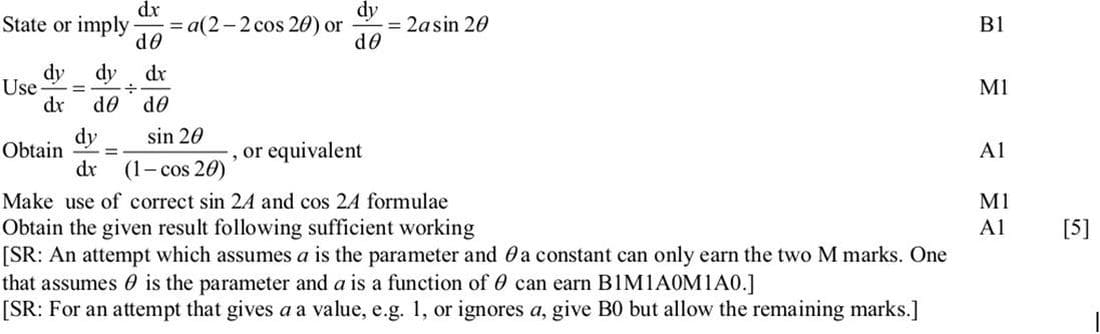
The parametric equations of a curve are
\(x = a(2\theta - \sin 2\theta)\), \(y = a(1 - \cos 2\theta)\).
Show that \(\frac{dy}{dx} = \cot \theta\).