Exam-Style Problems
⬅ Back to SubchapterJune 2013 p33 q5
1427
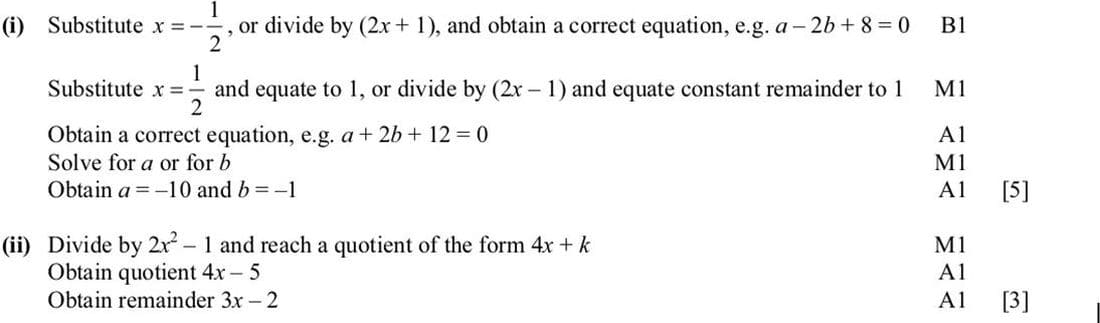
The polynomial \(8x^3 + ax^2 + bx + 3\), where \(a\) and \(b\) are constants, is denoted by \(p(x)\). It is given that \((2x + 1)\) is a factor of \(p(x)\) and that when \(p(x)\) is divided by \((2x - 1)\) the remainder is 1.
- Find the values of \(a\) and \(b\).
- When \(a\) and \(b\) have these values, find the remainder when \(p(x)\) is divided by \(2x^2 - 1\).
June 2013 p32 q4
1428
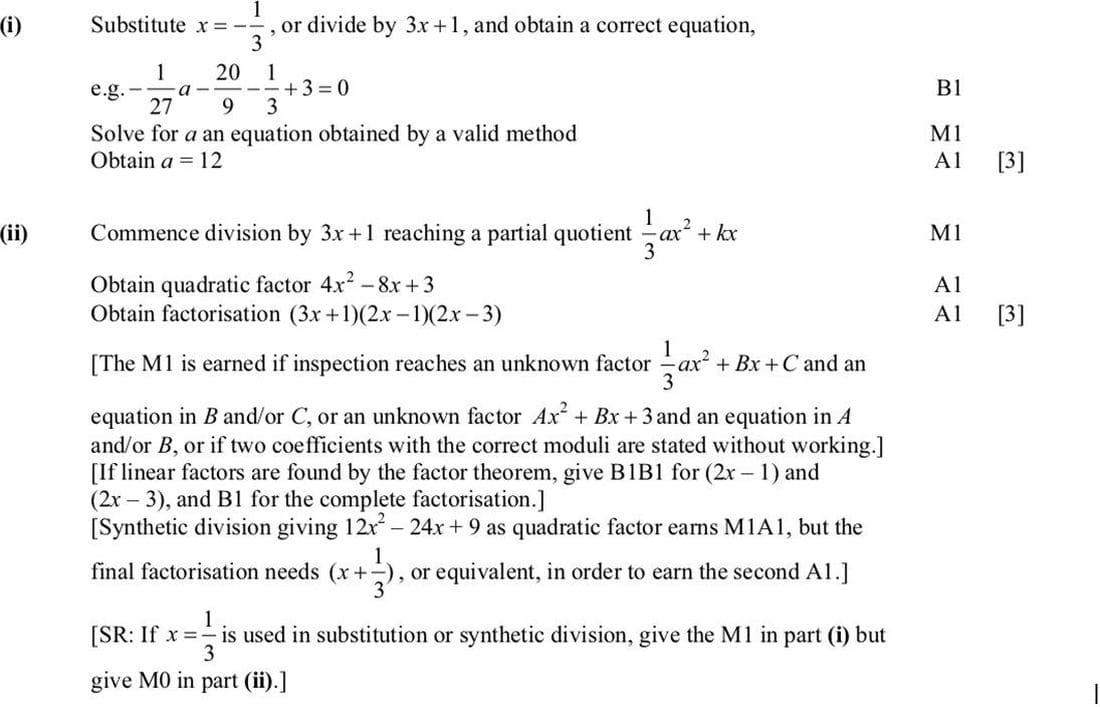
The polynomial \(ax^3 - 20x^2 + x + 3\), where \(a\) is a constant, is denoted by \(p(x)\). It is given that \((3x + 1)\) is a factor of \(p(x)\).
(i) Find the value of \(a\).
(ii) When \(a\) has this value, factorise \(p(x)\) completely.
June 2013 p31 q1
1429
Find the quotient and remainder when \(2x^2\) is divided by \(x + 2\).

June 2012 p31 q3
1430
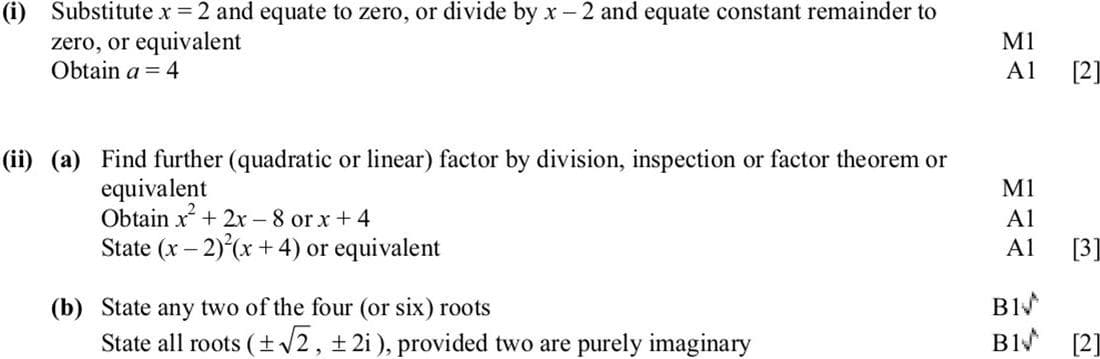
The polynomial \(p(x)\) is defined by
\(p(x) = x^3 - 3ax + 4a\),
where \(a\) is a constant.
(i) Given that \((x - 2)\) is a factor of \(p(x)\), find the value of \(a\).
(ii) When \(a\) has this value,
(a) factorise \(p(x)\) completely,
(b) find all the roots of the equation \(p(x^2) = 0\).
Nov 2011 p33 q7
1431
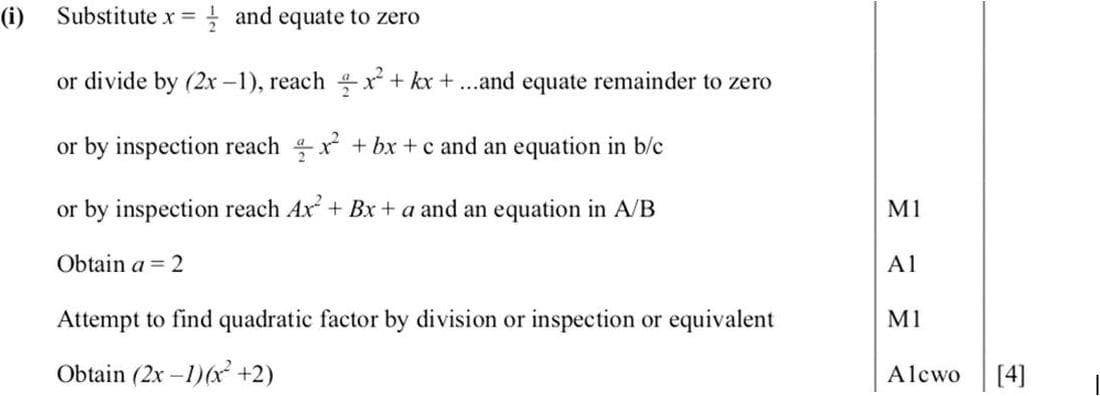
The polynomial \(p(x)\) is defined by
\(p(x) = ax^3 - x^2 + 4x - a\),
where \(a\) is a constant. It is given that \((2x - 1)\) is a factor of \(p(x)\).
Find the value of \(a\) and hence factorise \(p(x)\).