Exam-Style Problems
⬅ Back to SubchapterJune 2016 p11 q3
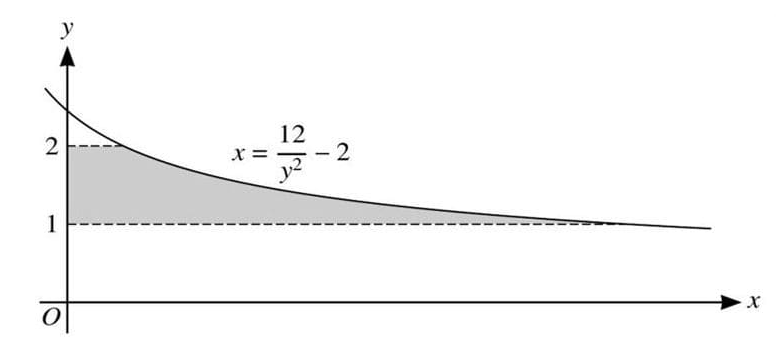
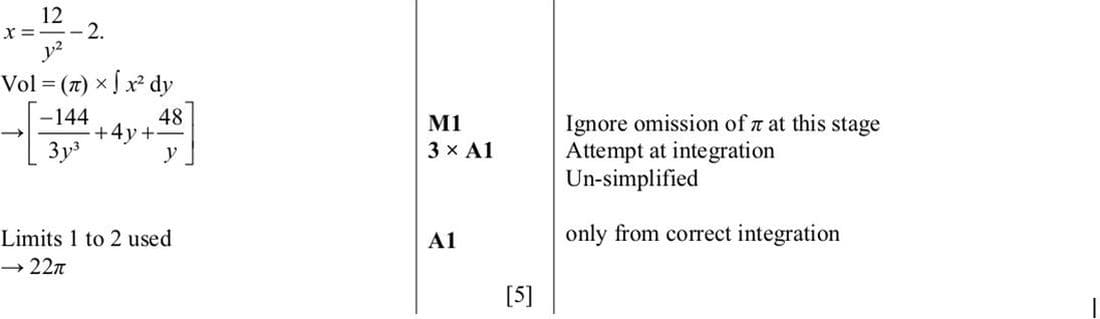
The diagram shows part of the curve \(x = \frac{12}{y^2} - 2\). The shaded region is bounded by the curve, the y-axis and the lines \(y = 1\) and \(y = 2\). Showing all necessary working, find the volume, in terms of \(\pi\), when this shaded region is rotated through 360° about the y-axis.
Nov 2015 p12 q10
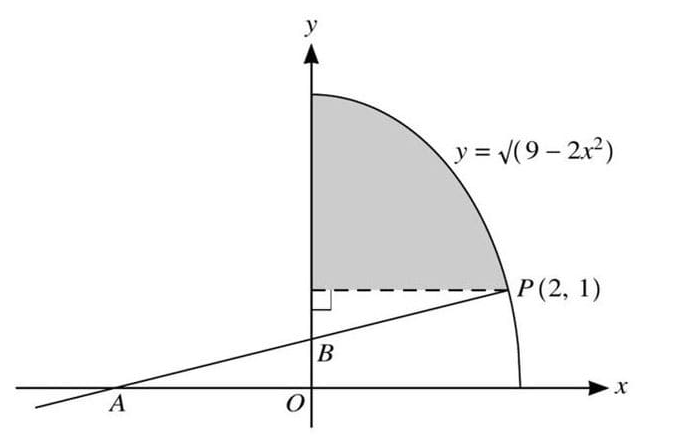
The diagram shows part of the curve \(y = \sqrt{9 - 2x^2}\). The point \(P(2, 1)\) lies on the curve and the normal to the curve at \(P\) intersects the \(x\)-axis at \(A\) and the \(y\)-axis at \(B\).
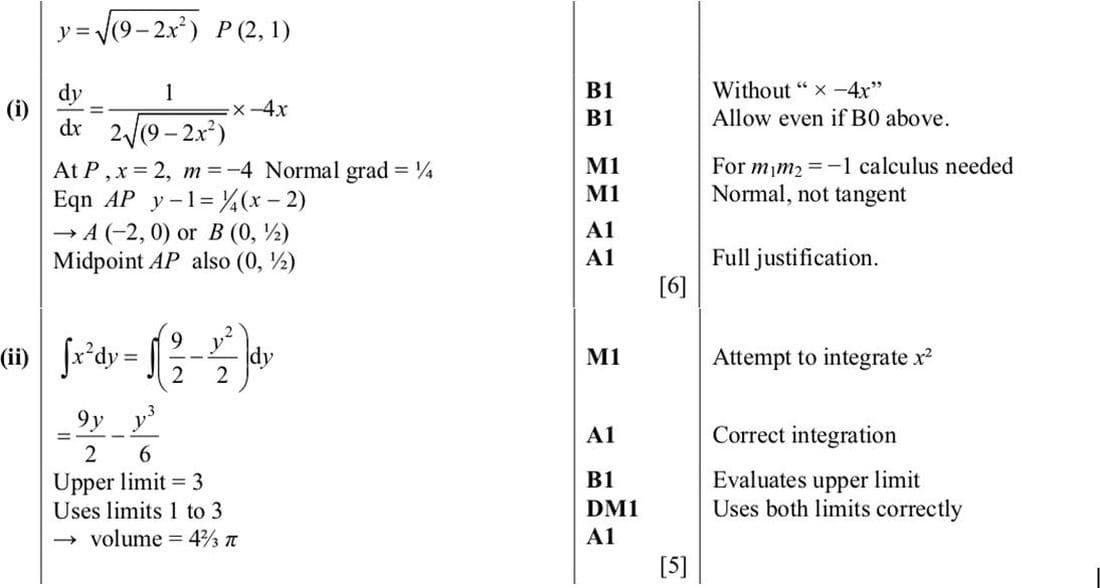
(i) Show that \(B\) is the mid-point of \(AP\).
The shaded region is bounded by the curve, the \(y\)-axis and the line \(y = 1\).
(ii) Find, showing all necessary working, the exact volume obtained when the shaded region is rotated through 360° about the \(y\)-axis.
Nov 2015 p11 q11
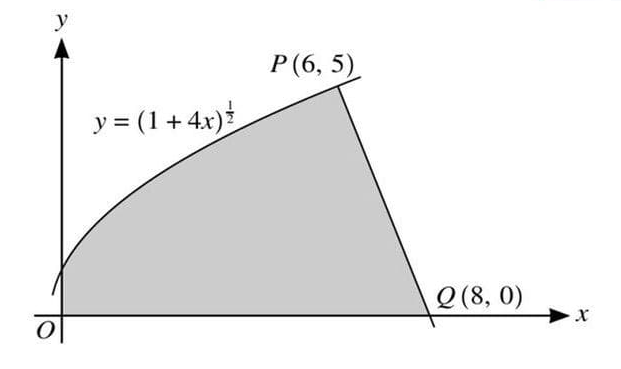
The diagram shows part of the curve \(y = (1 + 4x)^{\frac{1}{2}}\) and a point \(P(6, 5)\) lying on the curve. The line \(PQ\) intersects the \(x\)-axis at \(Q(8, 0)\).
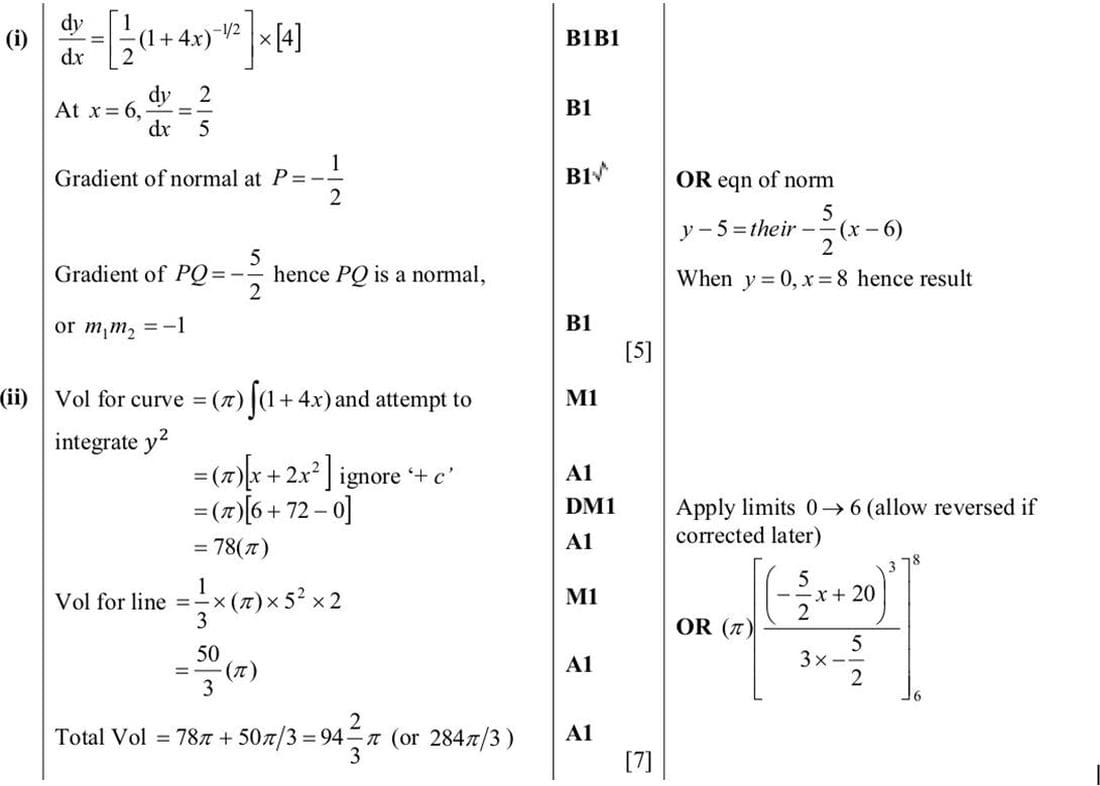
(i) Show that \(PQ\) is a normal to the curve. [5]
(ii) Find, showing all necessary working, the exact volume of revolution obtained when the shaded region is rotated through \(360^\circ\) about the \(x\)-axis. [7]
[In part (ii) you may find it useful to apply the fact that the volume, \(V\), of a cone of base radius \(r\) and vertical height \(h\), is given by \(V = \frac{1}{3} \pi r^2 h\).]
June 2015 p12 q10
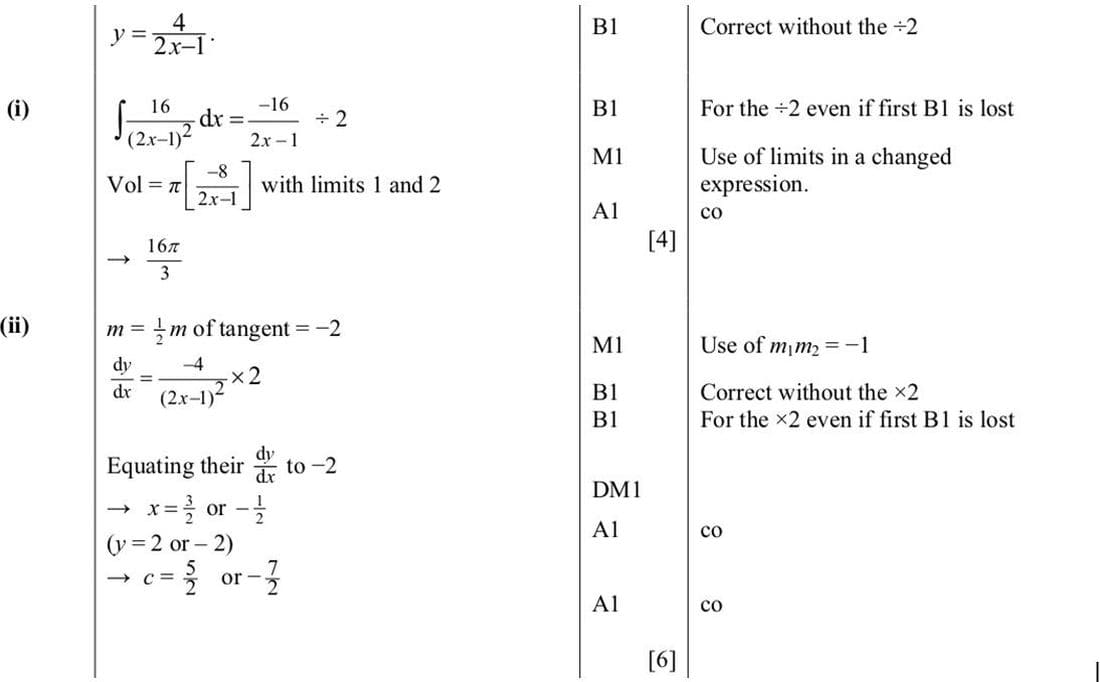
The equation of a curve is \(y = \frac{4}{2x-1}\).
(i) Find, showing all necessary working, the volume obtained when the region bounded by the curve, the \(x\)-axis and the lines \(x = 1\) and \(x = 2\) is rotated through 360° about the \(x\)-axis.
(ii) Given that the line \(2y = x + c\) is a normal to the curve, find the possible values of the constant \(c\).
Nov 2014 p12 q1
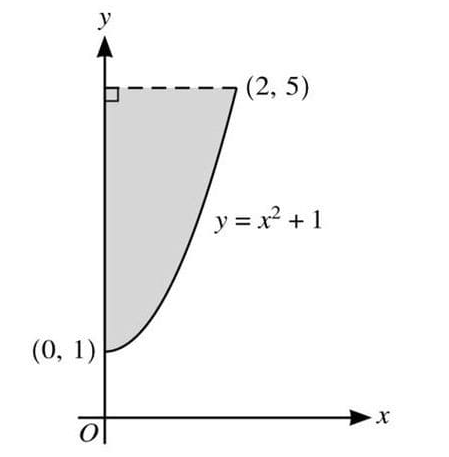
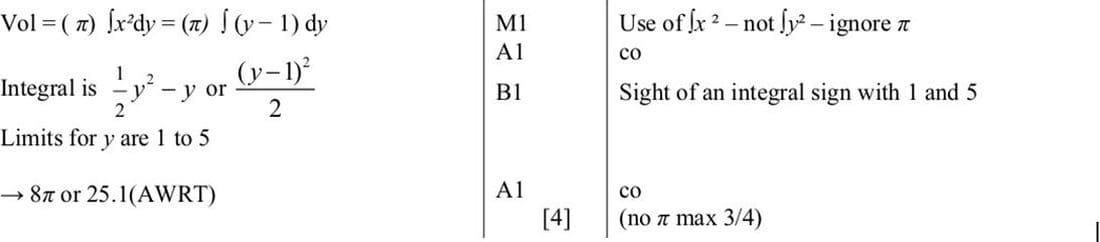
The diagram shows part of the curve \(y = x^2 + 1\). Find the volume obtained when the shaded region is rotated through 360° about the y-axis.