Exam-Style Problems
⬅ Back to SubchapterNov 2018 p12 q11
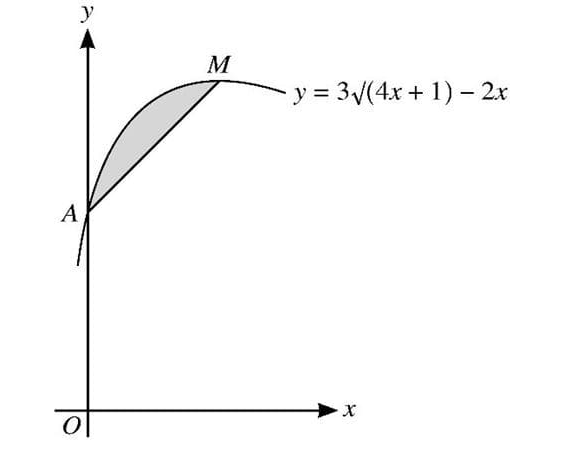
The diagram shows part of the curve \(y = 3\sqrt{4x + 1} - 2x\). The curve crosses the y-axis at \(A\) and the stationary point on the curve is \(M\).
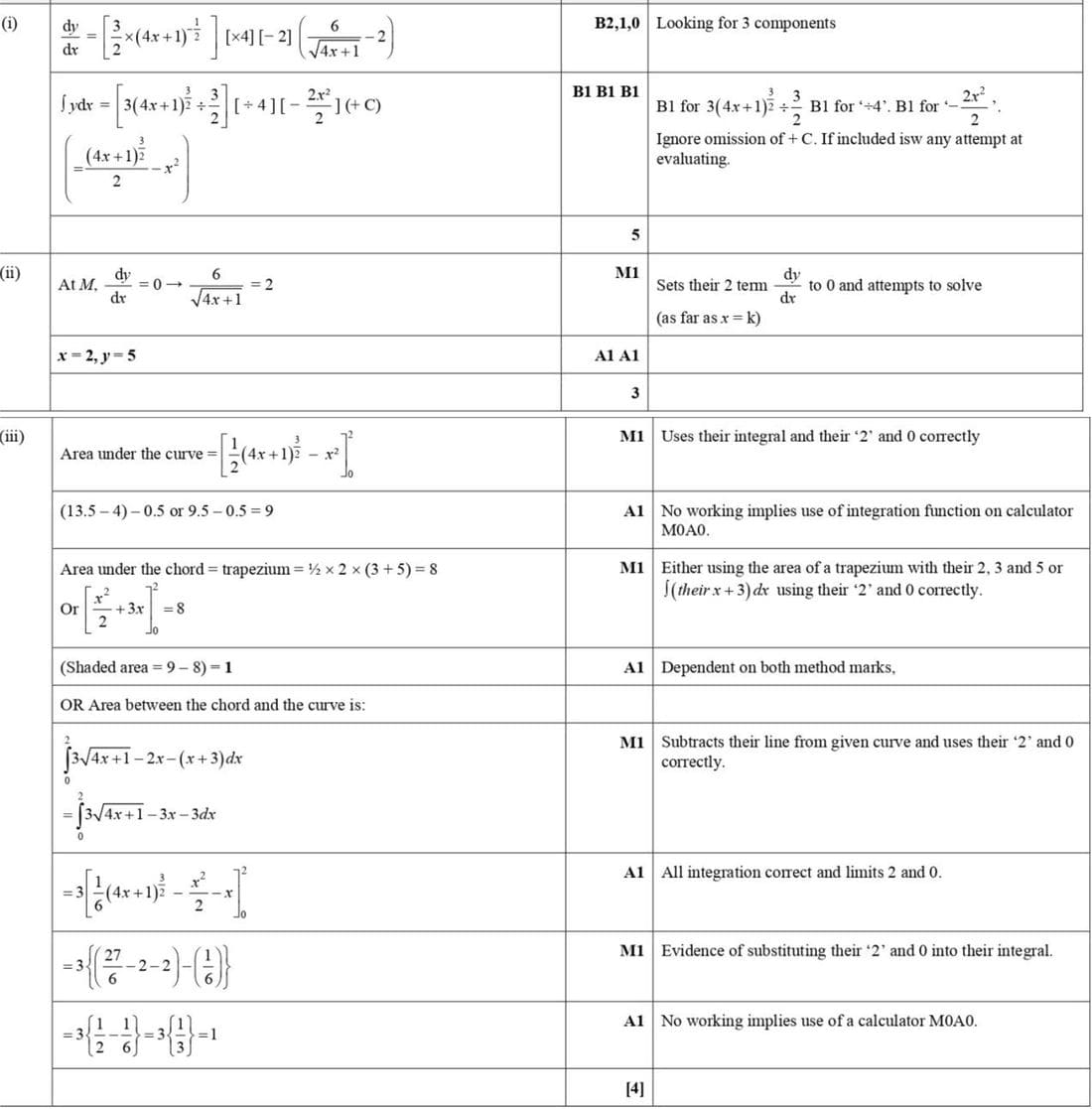
(i) Obtain expressions for \(\frac{dy}{dx}\) and \(\int y \, dx\).
(ii) Find the coordinates of \(M\).
(iii) Find, showing all necessary working, the area of the shaded region.
Nov 2018 p11 q7
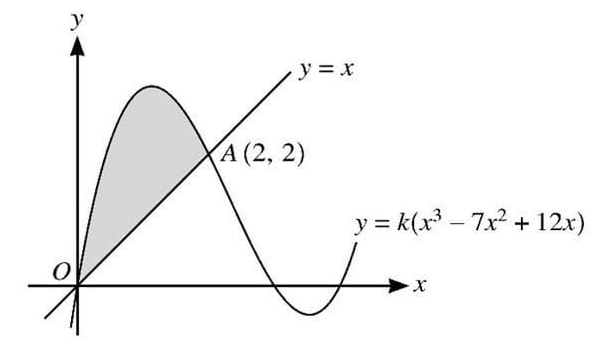
The diagram shows part of the curve with equation \(y = k(x^3 - 7x^2 + 12x)\) for some constant \(k\). The curve intersects the line \(y = x\) at the origin \(O\) and at the point \(A (2, 2)\).
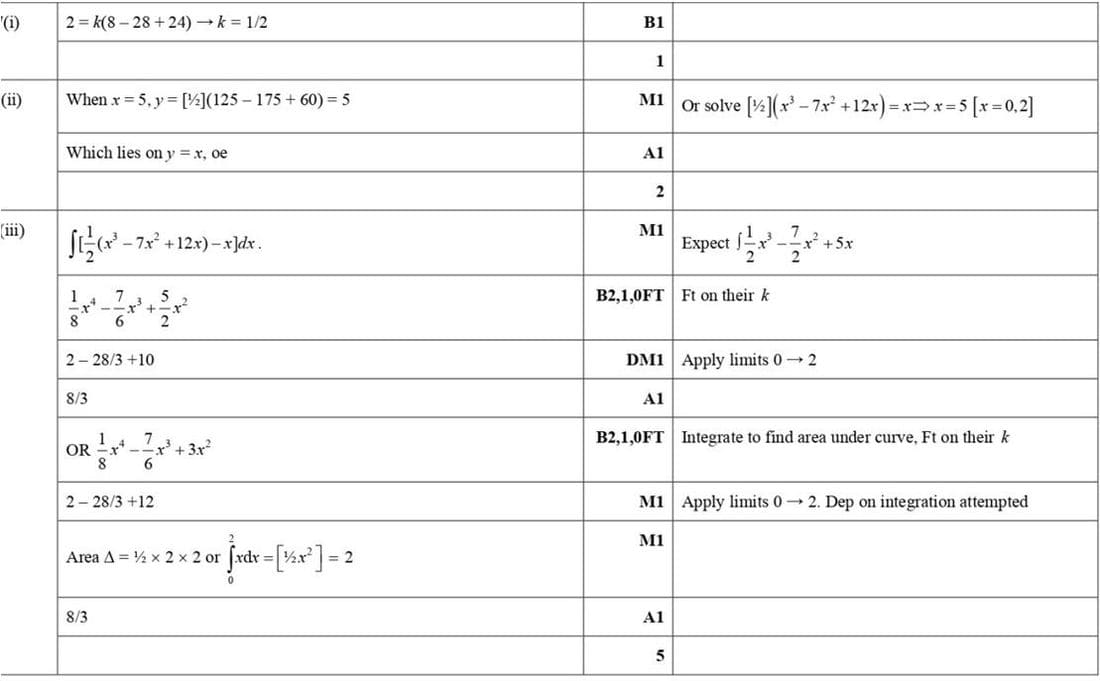
- Find the value of \(k\).
- Verify that the curve meets the line \(y = x\) again when \(x = 5\).
- Find, showing all necessary working, the area of the shaded region.
June 2018 p11 q10
The curve with equation \(y = x^3 - 2x^2 + 5x\) passes through the origin.
Showing all necessary working, find the area of the region enclosed by the curve, the \(x\)-axis and the line \(x = 6\).

Feb/Mar 2018 p12 q11
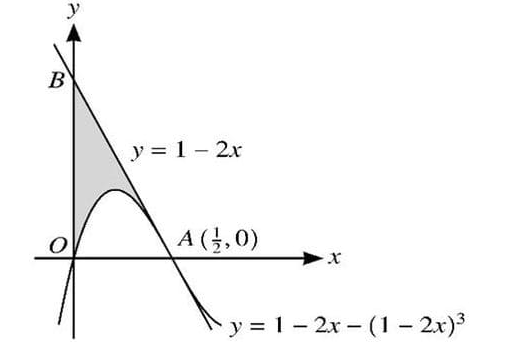
The diagram shows part of the curve \(y = 1 - 2x - (1 - 2x)^3\) intersecting the x-axis at the origin \(O\) and at \(A \left( \frac{1}{2}, 0 \right)\). The line \(AB\) intersects the y-axis at \(B\) and has equation \(y = 1 - 2x\).
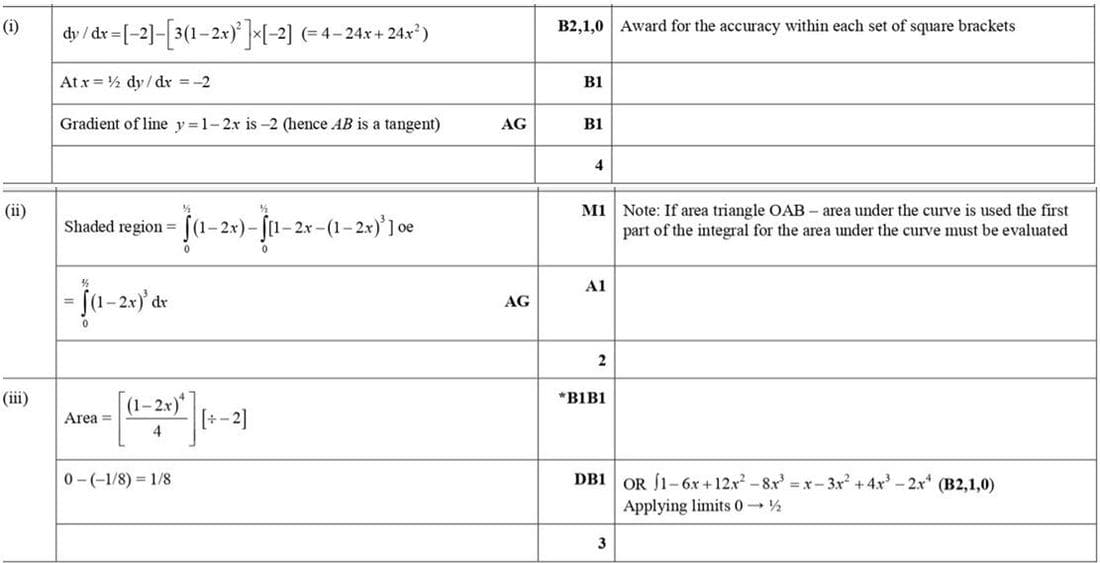
(i) Show that \(AB\) is the tangent to the curve at \(A\).
(ii) Show that the area of the shaded region can be expressed as \(\int_0^{\frac{1}{2}} (1 - 2x)^3 \, dx\).
(iii) Hence, showing all necessary working, find the area of the shaded region.
Nov 2017 p13 q8
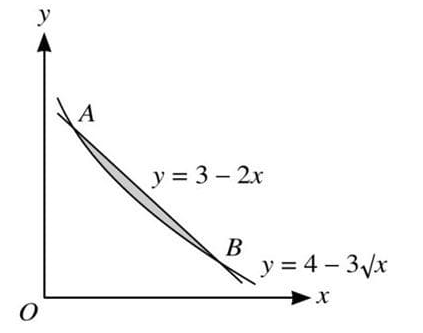
The diagram shows parts of the graphs of \(y = 3 - 2x\) and \(y = 4 - \frac{3}{\sqrt{x}}\) intersecting at points \(A\) and \(B\).
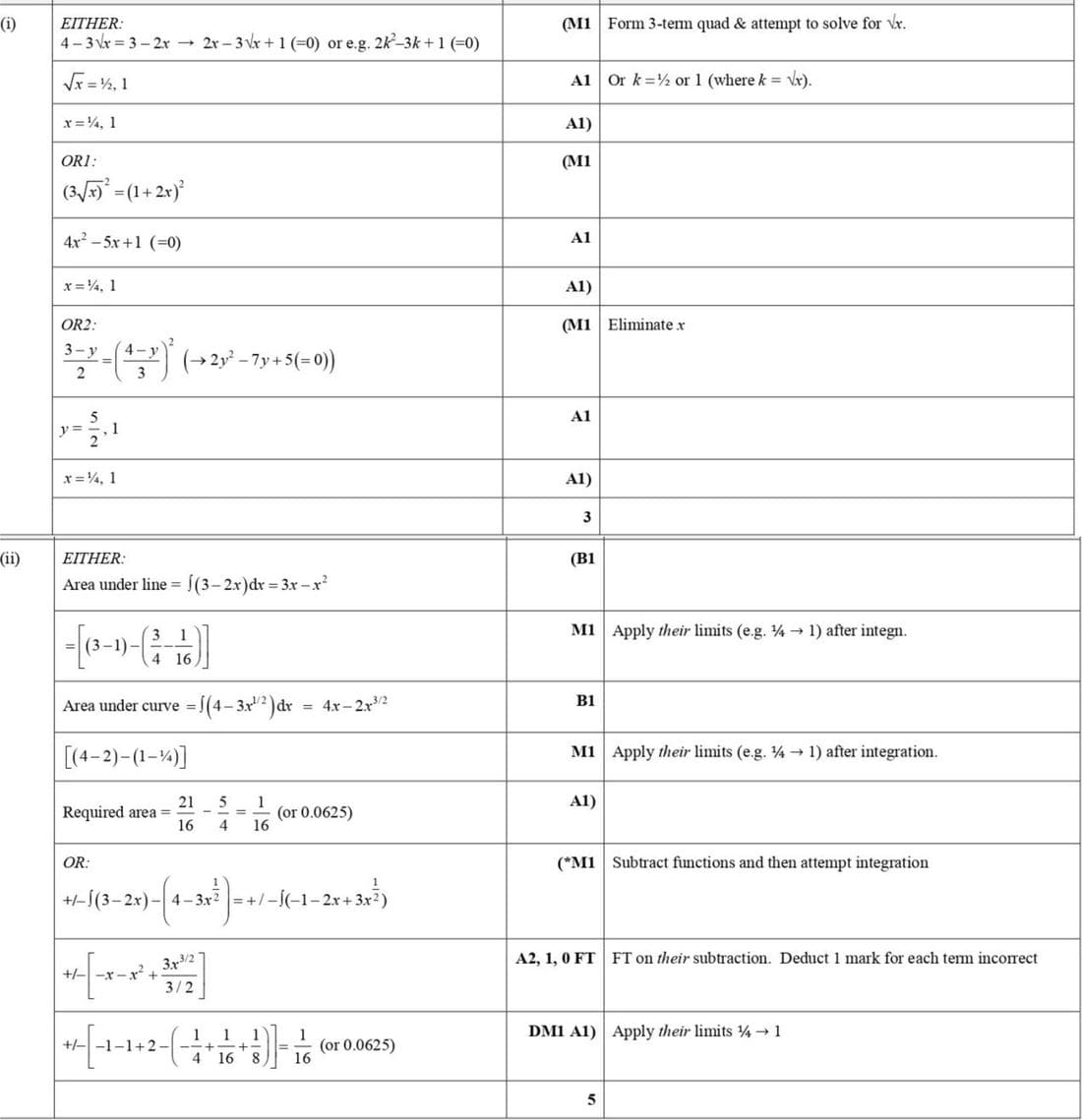
(i) Find by calculation the \(x\)-coordinates of \(A\) and \(B\).
(ii) Find, showing all necessary working, the area of the shaded region.