Exam-Style Problems
⬅ Back to Subchapter
Browsing as Guest. Progress, bookmarks and attempts are disabled.
Log in to track your work.
June 2019 p12 q3
1232
A curve is such that \(\frac{dy}{dx} = x^3 - \frac{4}{x^2}\). The point \(P(2, 9)\) lies on the curve.
Find the equation of the curve.

Log in to record attempts.
June 2018 p11 q3
1233
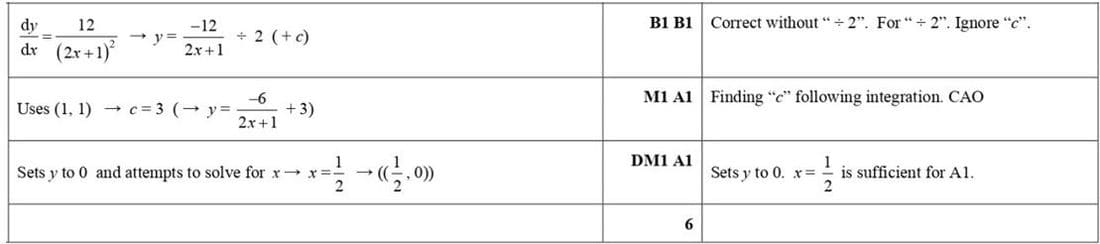
A curve is such that \(\frac{dy}{dx} = \frac{12}{(2x+1)^2}\). The point (1, 1) lies on the curve. Find the coordinates of the point at which the curve intersects the x-axis.
Log in to record attempts.
Feb/Mar 2018 p12 q1
1234
A curve passes through the point (4, -6) and has an equation for which \(\frac{dy}{dx} = x^{-\frac{1}{2}} - 3\). Find the equation of the curve.

Log in to record attempts.
Nov 2017 p12 q8
1235
A curve is such that \(\frac{dy}{dx} = -x^2 + 5x - 4\).
Given that the curve passes through the point (6, 2), find the equation of the curve.

Log in to record attempts.
Nov 2016 p12 q1
1236
A curve is such that \(\frac{dy}{dx} = \frac{8}{\sqrt{4x + 1}}\). The point \((2, 5)\) lies on the curve. Find the equation of the curve.

Log in to record attempts.