Exam-Style Problems
⬅ Back to SubchapterJune 2017 p11 q6
1200
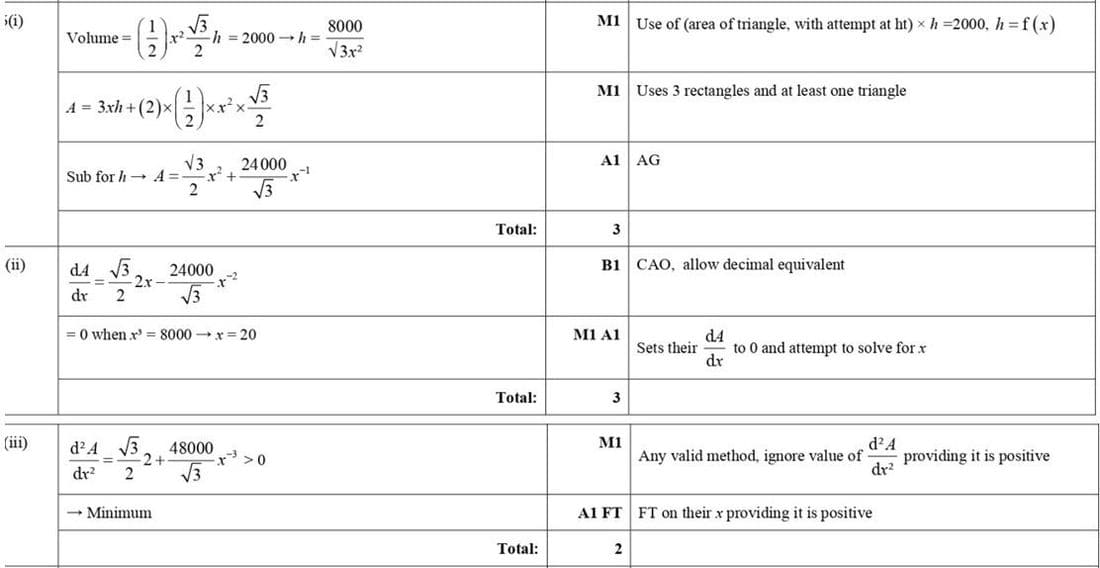
The horizontal base of a solid prism is an equilateral triangle of side \(x\) cm. The sides of the prism are vertical. The height of the prism is \(h\) cm and the volume of the prism is 2000 cm\(^3\).
(i) Express \(h\) in terms of \(x\) and show that the total surface area of the prism, \(A\) cm\(^2\), is given by
\(A = \frac{\sqrt{3}}{2}x^2 + \frac{24000}{\sqrt{3}}x^{-1}.\)
[3]
(ii) Given that \(x\) can vary, find the value of \(x\) for which \(A\) has a stationary value. [3]
(iii) Determine, showing all necessary working, the nature of this stationary value. [2]
June 2016 p11 q5
1201
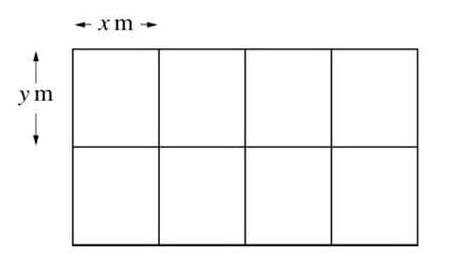
A farmer divides a rectangular piece of land into 8 equal-sized rectangular sheep pens as shown in the diagram. Each sheep pen measures \(x\) m by \(y\) m and is fully enclosed by metal fencing. The farmer uses 480 m of fencing.
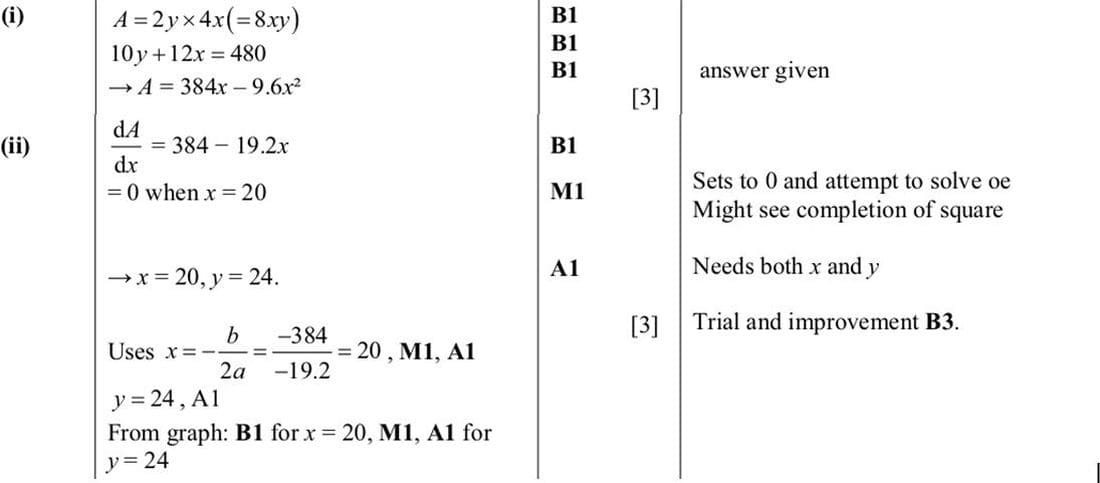
(i) Show that the total area of land used for the sheep pens, \(A\) m\(^2\), is given by \(A = 384x - 9.6x^2\).
(ii) Given that \(x\) and \(y\) can vary, find the dimensions of each sheep pen for which the value of \(A\) is a maximum. (There is no need to verify that the value of \(A\) is a maximum.)
Feb/Mar 2016 p12 q6
1202
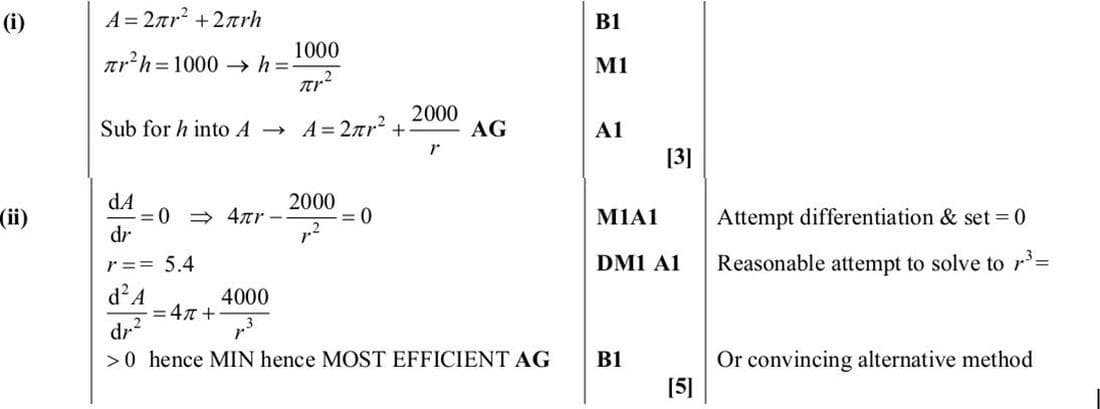
A vacuum flask (for keeping drinks hot) is modelled as a closed cylinder in which the internal radius is \(r\) cm and the internal height is \(h\) cm. The volume of the flask is 1000 cm\(^3\). A flask is most efficient when the total internal surface area, \(A\) cm\(^2\), is a minimum.
(i) Show that \(A = 2\pi r^2 + \frac{2000}{r}\).
(ii) Given that \(r\) can vary, find the value of \(r\), correct to 1 decimal place, for which \(A\) has a stationary value and verify that the flask is most efficient when \(r\) takes this value.
June 2015 p11 q5
1203
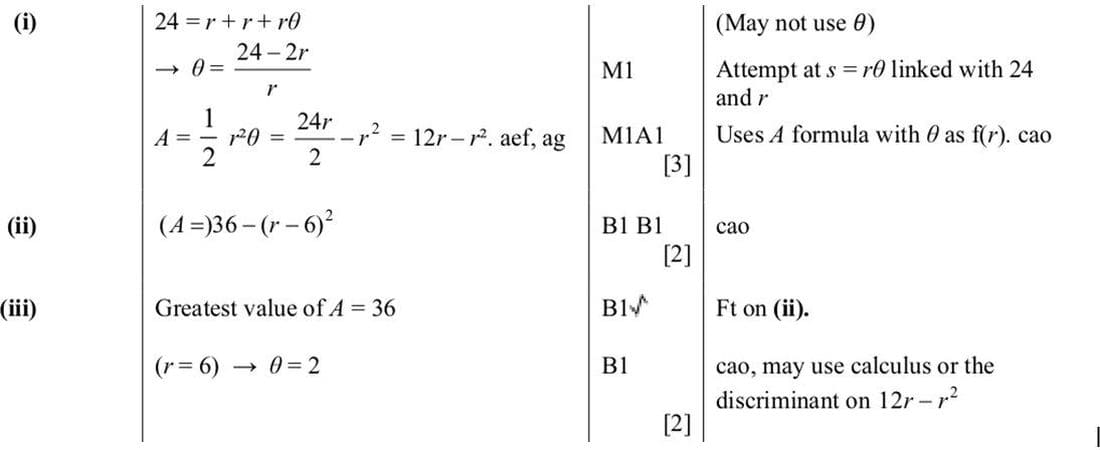
A piece of wire of length 24 cm is bent to form the perimeter of a sector of a circle of radius \(r\) cm.
(i) Show that the area of the sector, \(A\) cm\(^2\), is given by \(A = 12r - r^2\).
(ii) Express \(A\) in the form \(a - (r - b)^2\), where \(a\) and \(b\) are constants.
(iii) Given that \(r\) can vary, state the greatest value of \(A\) and find the corresponding angle of the sector.
June 2014 p13 q9
1204
The base of a cuboid has sides of length \(x\) cm and \(3x\) cm. The volume of the cuboid is \(288 \text{ cm}^3\).
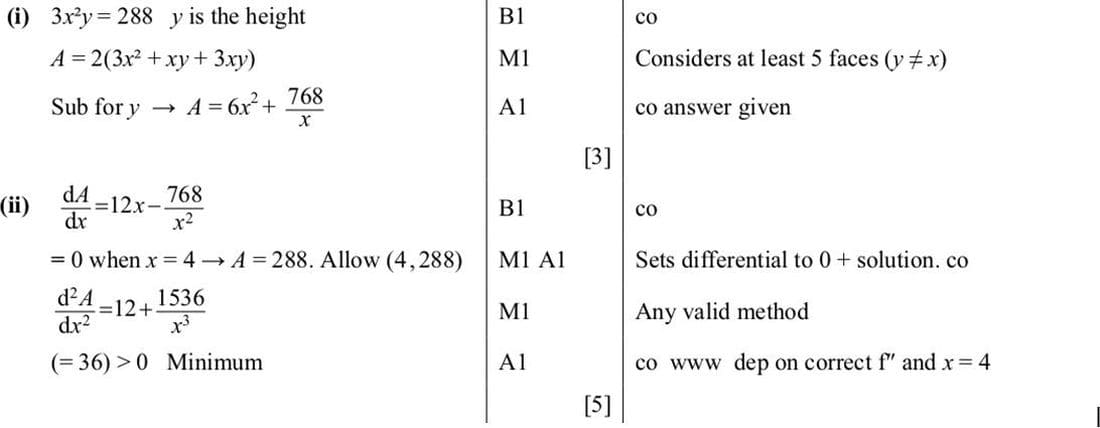
(i) Show that the total surface area of the cuboid, \(A \text{ cm}^2\), is given by
\(A = 6x^2 + \frac{768}{x}.\)
(ii) Given that \(x\) can vary, find the stationary value of \(A\) and determine its nature.