Exam-Style Problems
⬅ Back to SubchapterJune 2016 p13 q7
1114
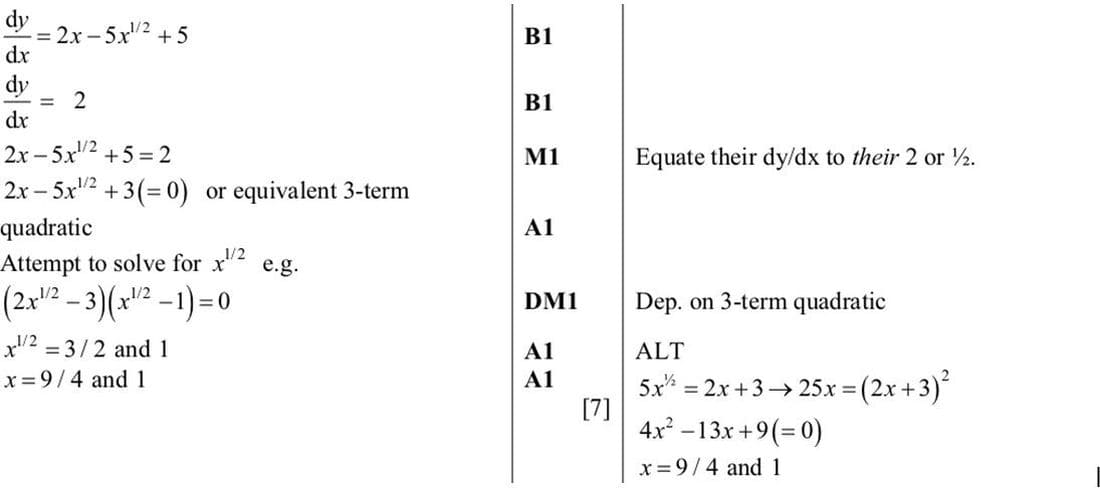
The point \(P(x, y)\) is moving along the curve \(y = x^2 - \frac{10}{3}x^{3/2} + 5x\) in such a way that the rate of change of \(y\) is constant. Find the values of \(x\) at the points at which the rate of change of \(x\) is equal to half the rate of change of \(y\).
June 2016 p11 q4
1115
A curve is such that \(\frac{dy}{dx} = 2 - 8(3x + 4)^{-\frac{1}{2}}\).
A point \(P\) moves along the curve in such a way that the \(x\)-coordinate is increasing at a constant rate of 0.3 units per second. Find the rate of change of the \(y\)-coordinate as \(P\) crosses the \(y\)-axis.

Nov 2015 p12 q3
1116
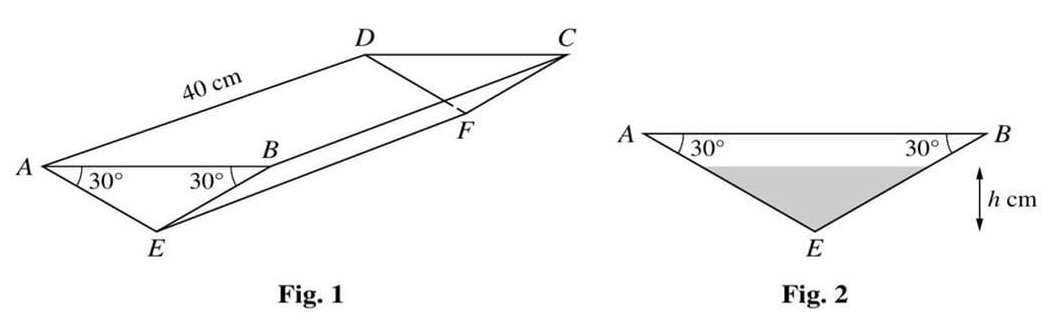
Fig. 1 shows an open tank in the shape of a triangular prism. The vertical ends ABE and DCF are identical isosceles triangles. Angle \(ABE =\) angle \(BAE = 30^\circ\). The length of \(AD\) is 40 cm. The tank is fixed in position with the open top \(ABCD\) horizontal. Water is poured into the tank at a constant rate of 200 cm\(^3\) s\(^{-1}\). The depth of water, \(t\) seconds after filling starts, is \(h\) cm (see Fig. 2).
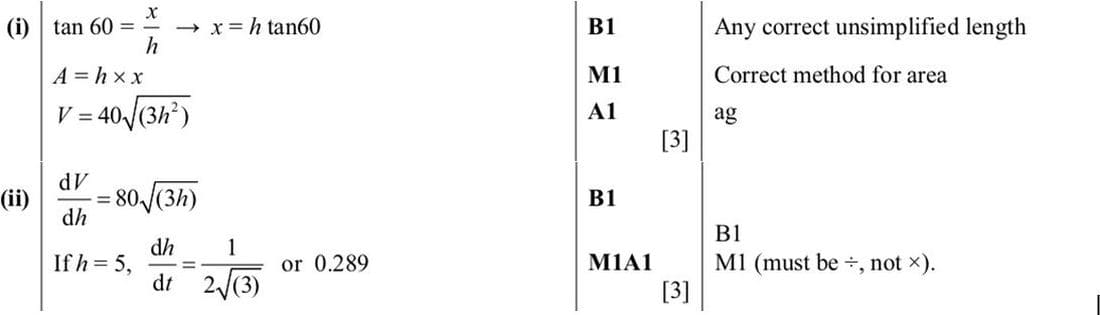
(i) Show that, when the depth of water in the tank is \(h\) cm, the volume, \(V\) cm\(^3\), of water in the tank is given by \(V = (40\sqrt{3})h^2\).
(ii) Find the rate at which \(h\) is increasing when \(h = 5\).
June 2015 p11 q2
1117
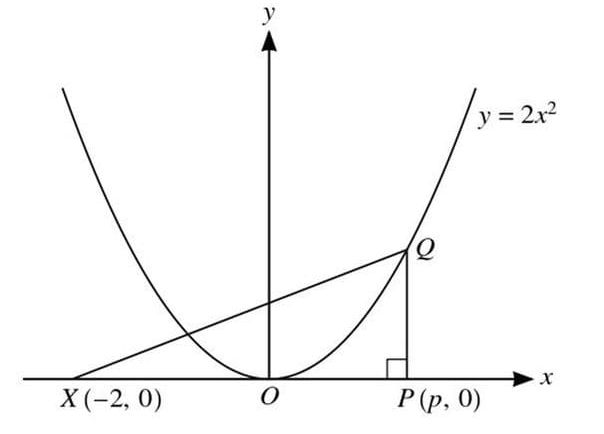
The diagram shows the curve \(y = 2x^2\) and the points \(X(-2, 0)\) and \(P(p, 0)\). The point \(Q\) lies on the curve and \(PQ\) is parallel to the \(y\)-axis.
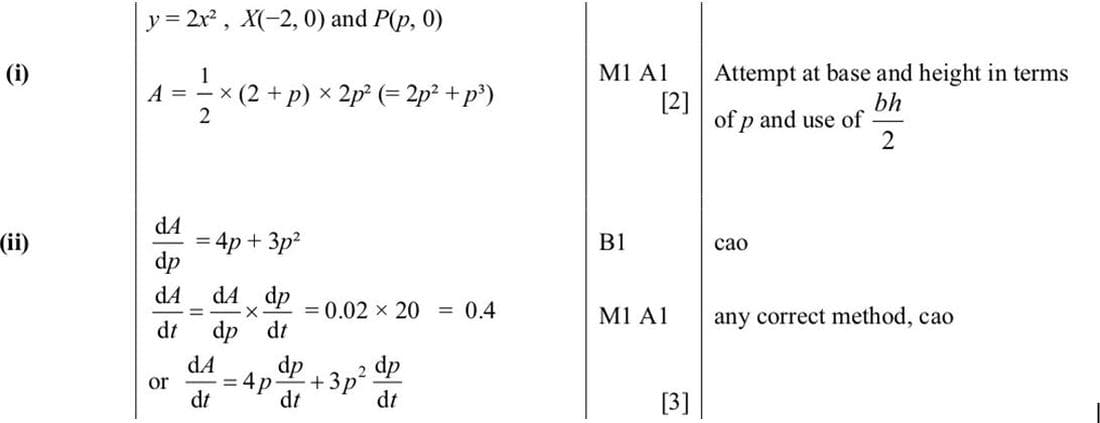
(i) Express the area, \(A\), of triangle \(XPQ\) in terms of \(p\).
(ii) The point \(P\) moves along the \(x\)-axis at a constant rate of 0.02 units per second and \(Q\) moves along the curve so that \(PQ\) remains parallel to the \(y\)-axis. Find the rate at which \(A\) is increasing when \(p = 2\).
Nov 2014 p13 q10
1118
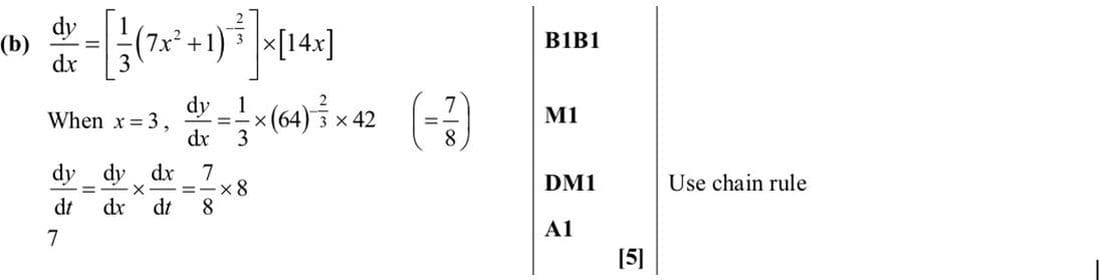
A point P travels along the curve \(y = (7x^2 + 1)^{\frac{1}{3}}\) in such a way that the x-coordinate of P at time t minutes is increasing at a constant rate of 8 units per minute. Find the rate of increase of the y-coordinate of P at the instant when P is at the point (3, 4).