Exam-Style Problems
⬅ Back to SubchapterNov 2015 p13 q10
The function f is defined by \(f(x) = 2x + (x + 1)^{-2}\) for \(x > -1\).
Find \(f'(x)\) and \(f''(x)\) and hence verify that the function f has a minimum value at \(x = 0\).

Nov 2015 p11 q5
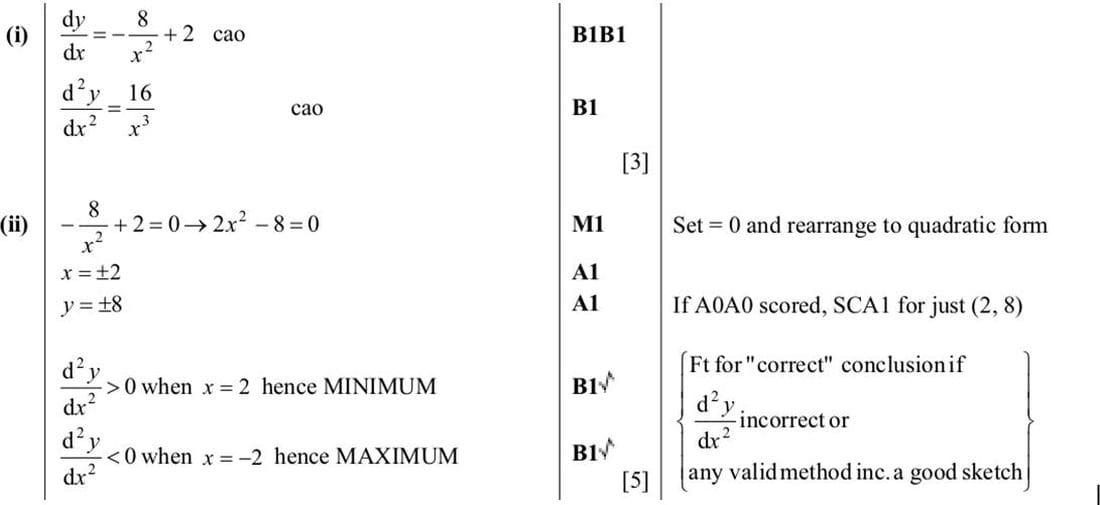
A curve has equation \(y = \frac{8}{x} + 2x\).
(i) Find \(\frac{dy}{dx}\) and \(\frac{d^2y}{dx^2}\).
(ii) Find the coordinates of the stationary points and state, with a reason, the nature of each stationary point.
June 2015 p12 q4
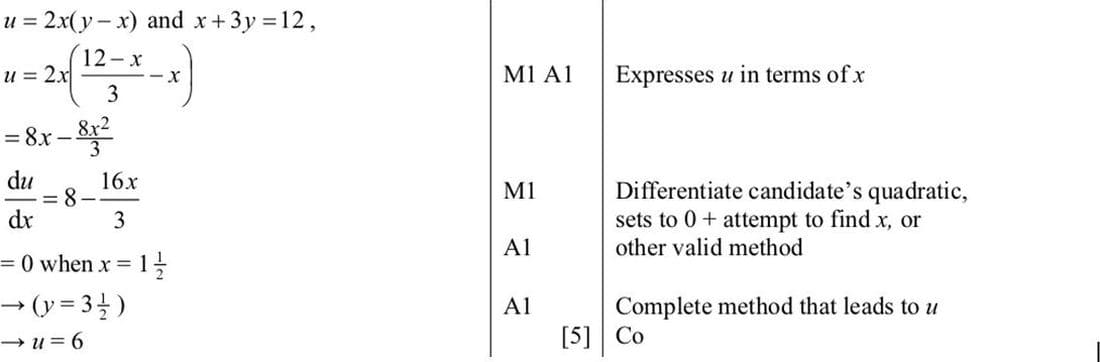
Variables u, x and y are such that \(u = 2x(y - x)\) and \(x + 3y = 12\). Express u in terms of x and hence find the stationary value of u.
June 2015 p11 q9
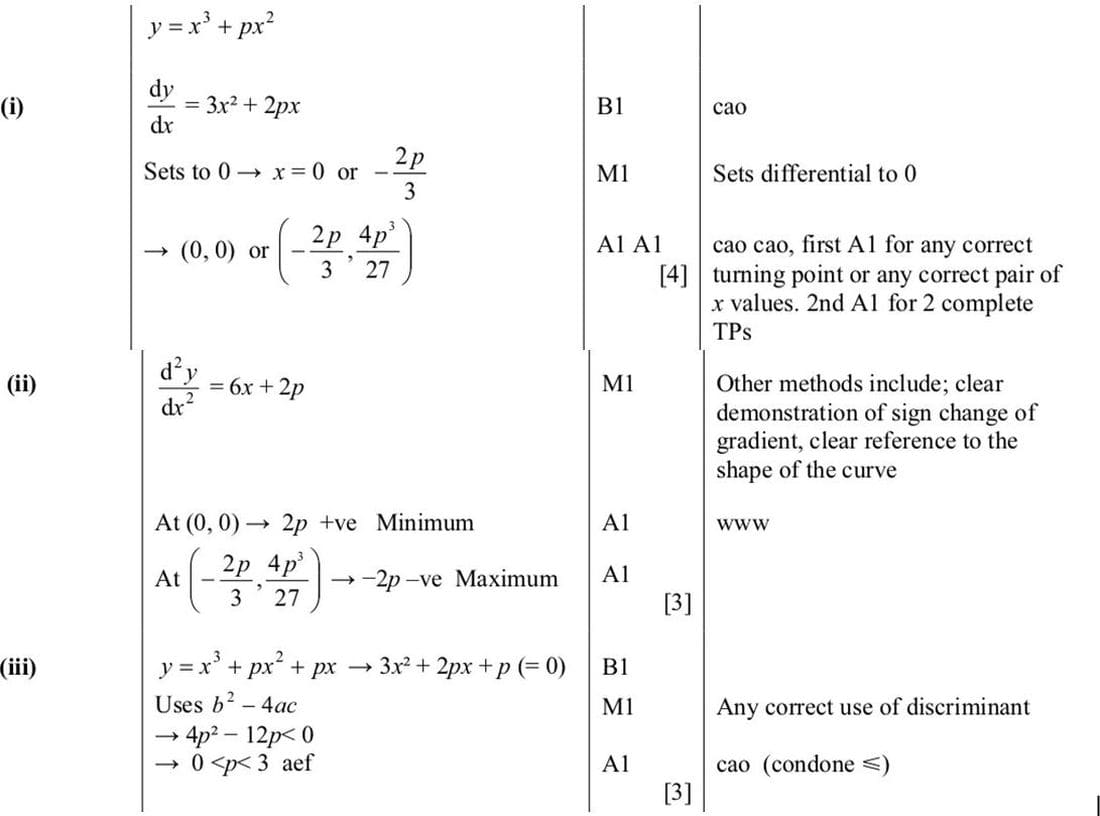
The equation of a curve is \(y = x^3 + px^2\), where \(p\) is a positive constant.
(i) Show that the origin is a stationary point on the curve and find the coordinates of the other stationary point in terms of \(p\).
(ii) Find the nature of each of the stationary points.
Another curve has equation \(y = x^3 + px^2 + px\).
(iii) Find the set of values of \(p\) for which this curve has no stationary points.
June 2014 p13 q5
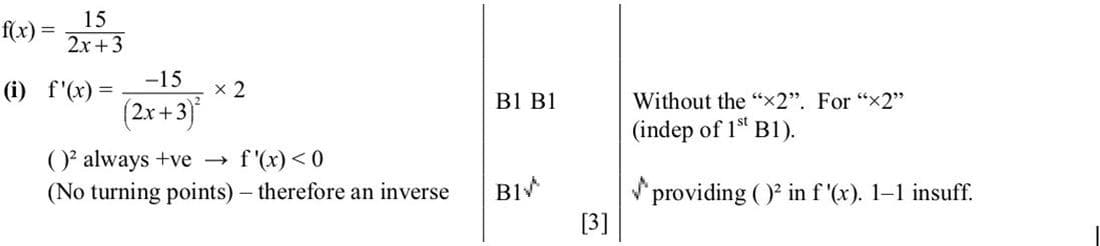
A function \(f\) is such that \(f(x) = \frac{15}{2x+3}\) for \(0 \leq x \leq 6\).
Find an expression for \(f'(x)\) and use your result to explain why \(f\) has an inverse.