Exam-Style Problems
⬅ Back to SubchapterJune 2021 p11 q11
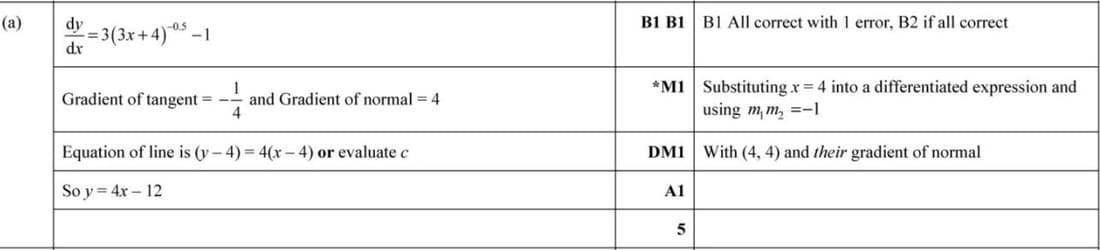
The equation of a curve is \(y = 2\sqrt{3x+4} - x\).
Find the equation of the normal to the curve at the point (4, 4), giving your answer in the form \(y = mx + c\).
Feb/Mar 2019 p12 q10
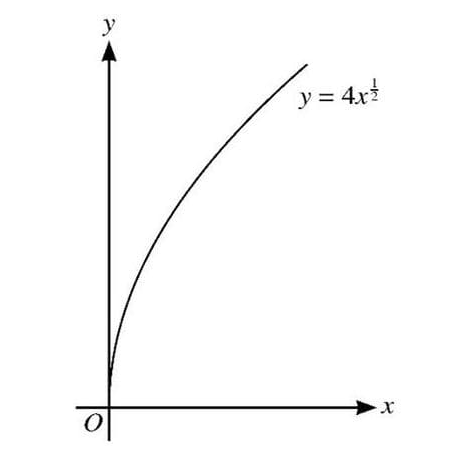
The diagram shows the curve with equation \(y = 4x^{\frac{1}{2}}\).
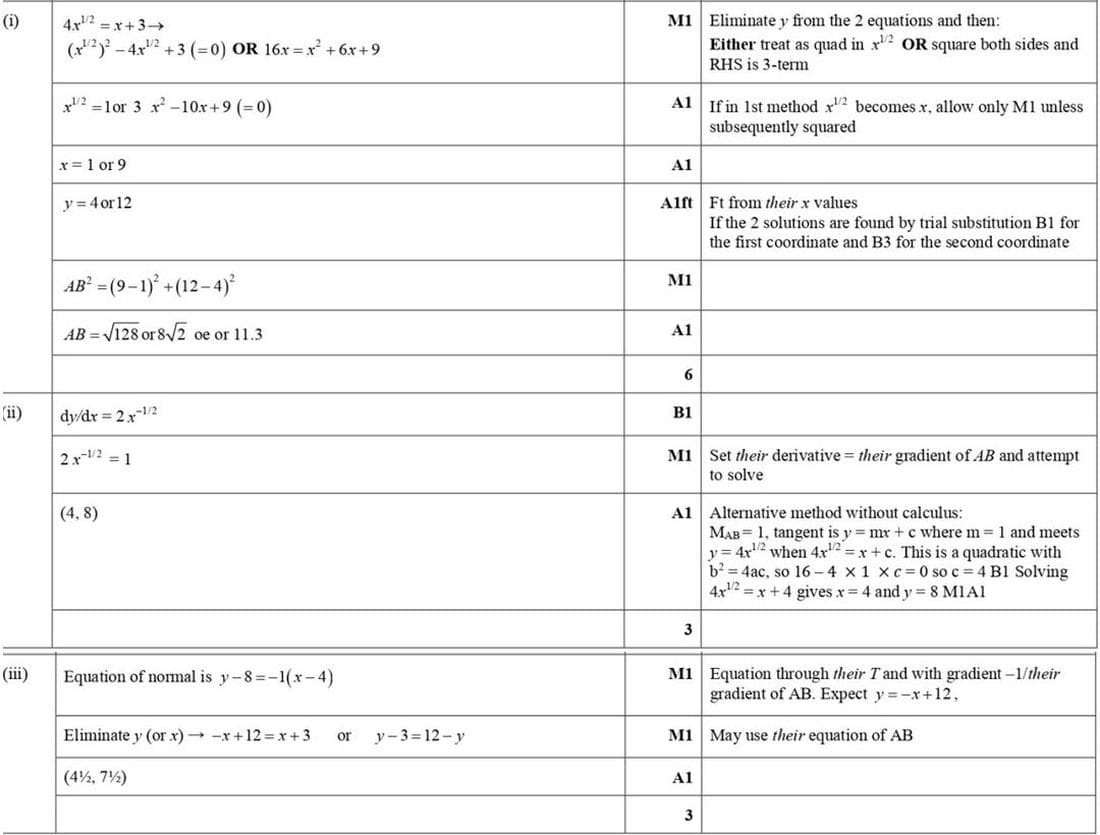
(i) The straight line with equation \(y = x + 3\) intersects the curve at points \(A\) and \(B\). Find the length of \(AB\).
(ii) The tangent to the curve at a point \(T\) is parallel to \(AB\). Find the coordinates of \(T\).
(iii) Find the coordinates of the point of intersection of the normal to the curve at \(T\) with the line \(AB\).
Nov 2017 p13 q11
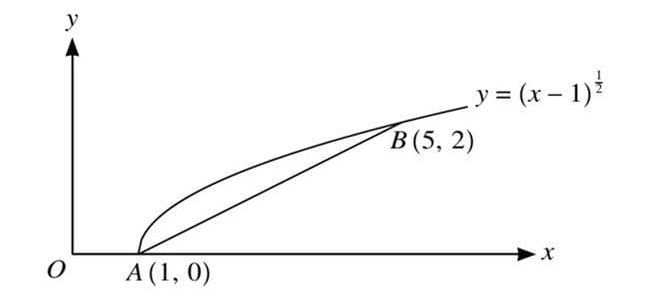
The diagram shows the curve \(y = (x - 1)^{\frac{1}{2}}\) and points \(A(1, 0)\) and \(B(5, 2)\) lying on the curve.
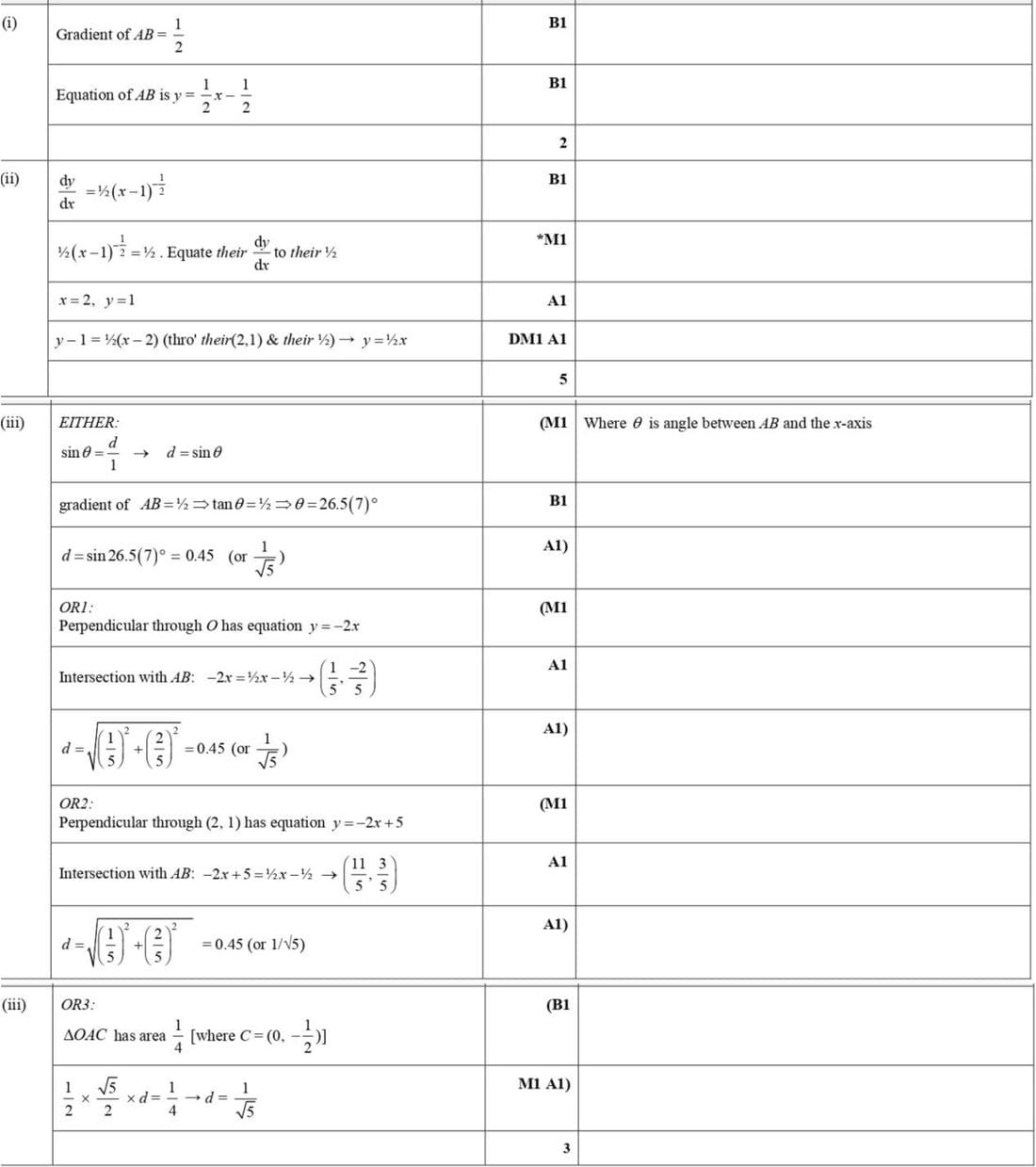
(i) Find the equation of the line \(AB\), giving your answer in the form \(y = mx + c\).
(ii) Find, showing all necessary working, the equation of the tangent to the curve which is parallel to \(AB\).
(iii) Find the perpendicular distance between the line \(AB\) and the tangent parallel to \(AB\). Give your answer correct to 2 decimal places.
Nov 2017 p11 q1
A curve has equation \(y = 2x^{\frac{3}{2}} - 3x - 4x^{\frac{1}{2}} + 4\). Find the equation of the tangent to the curve at the point (4, 0).

June 2017 p13 q6
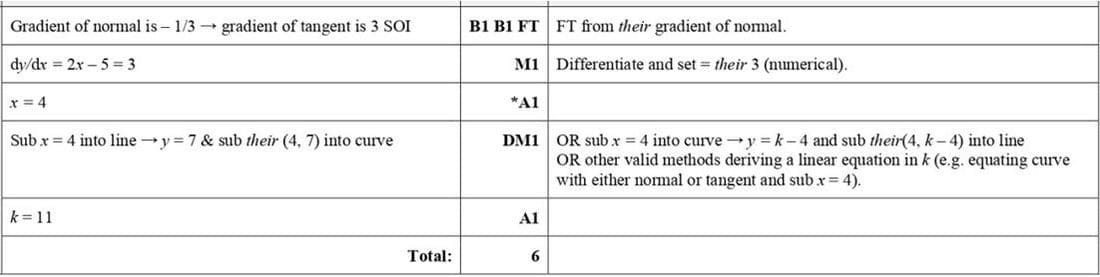
\(The line 3y + x = 25 is a normal to the curve y = x^2 - 5x + k. Find the value of the constant k.\)