Exam-Style Problems
⬅ Back to SubchapterJune 2007 p1 q7
811
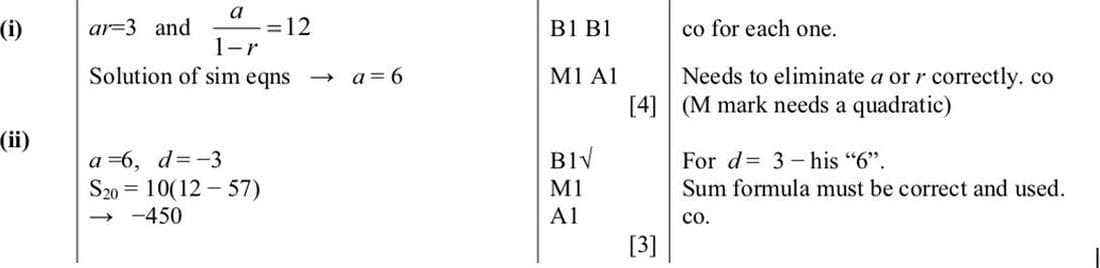
The second term of a geometric progression is 3 and the sum to infinity is 12.
(i) Find the first term of the progression.
An arithmetic progression has the same first and second terms as the geometric progression.
(ii) Find the sum of the first 20 terms of the arithmetic progression.
Nov 2005 p1 q6
812
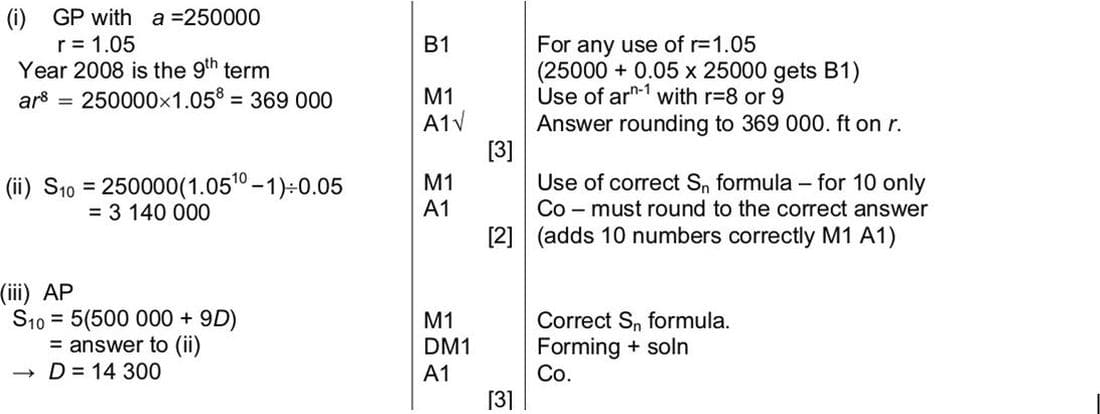
A small trading company made a profit of $250,000 in the year 2000. The company considered two different plans, plan A and plan B, for increasing its profits.
Under plan A, the annual profit would increase each year by 5% of its value in the preceding year. Find, for plan A,
(i) the profit for the year 2008,
(ii) the total profit for the 10 years 2000 to 2009 inclusive.
Under plan B, the annual profit would increase each year by a constant amount $D$.
(iii) Find the value of $D$ for which the total profit for the 10 years 2000 to 2009 inclusive would be the same for both plans.
June 2005 p1 q6
813
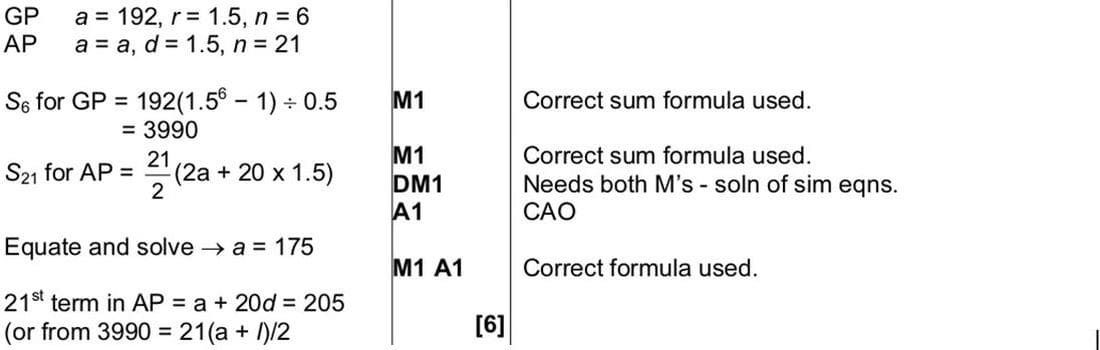
A geometric progression has 6 terms. The first term is 192 and the common ratio is 1.5. An arithmetic progression has 21 terms and common difference 1.5. Given that the sum of all the terms in the geometric progression is equal to the sum of all the terms in the arithmetic progression, find the first term and the last term of the arithmetic progression.
June 2002 p1 q4
814
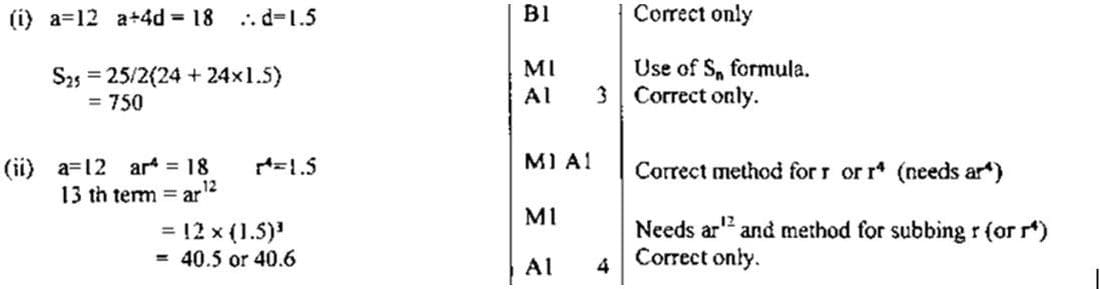
A progression has a first term of 12 and a fifth term of 18.
(i) Find the sum of the first 25 terms if the progression is arithmetic.
(ii) Find the 13th term if the progression is geometric.
Feb/Mar 2022 p12 q4
815
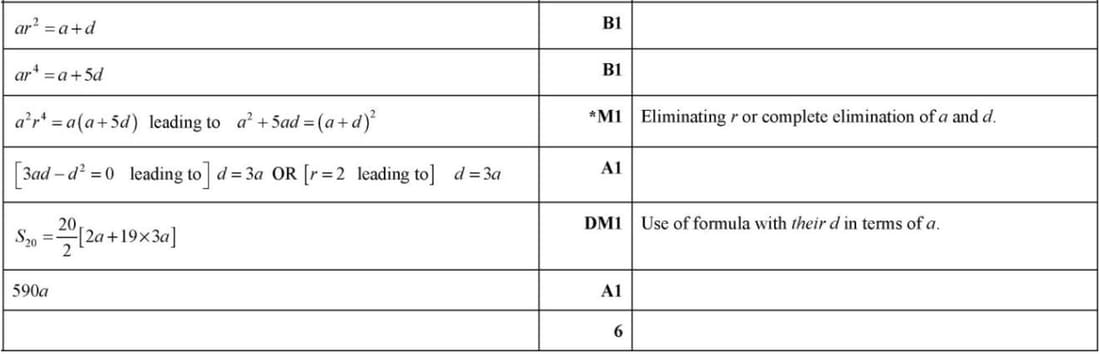
The first term of a geometric progression and the first term of an arithmetic progression are both equal to \(a\).
The third term of the geometric progression is equal to the second term of the arithmetic progression.
The fifth term of the geometric progression is equal to the sixth term of the arithmetic progression.
Given that the terms are all positive and not all equal, find the sum of the first twenty terms of the arithmetic progression in terms of \(a\).