Exam-Style Problems
⬅ Back to SubchapterJune 2014 p12 q3
581
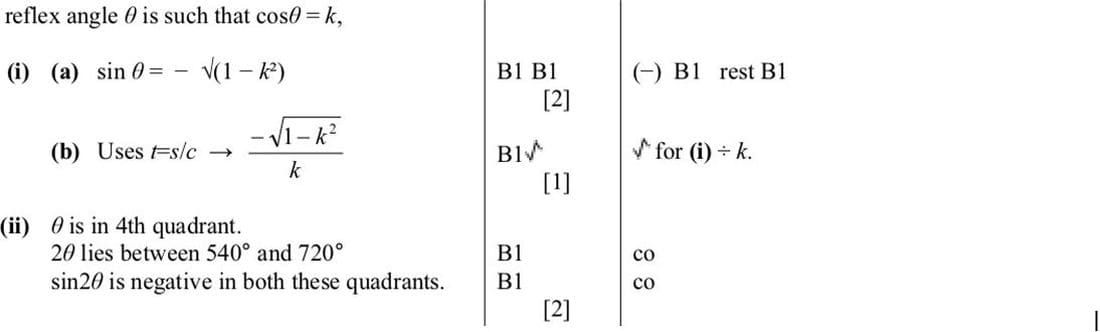
The reflex angle \(\theta\) is such that \(\cos \theta = k\), where \(0 < k < 1\).
(i) Find an expression, in terms of \(k\), for
(a) \(\sin \theta\),
(b) \(\tan \theta\).
(ii) Explain why \(\sin 2\theta\) is negative for \(0 < k < 1\).
Nov 2013 p13 q7
582
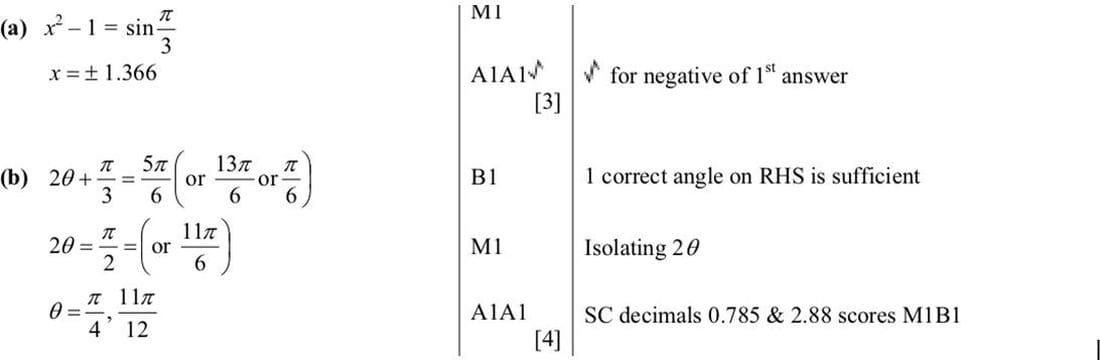
(a) Find the possible values of x for which \(\sin^{-1}(x^2 - 1) = \frac{1}{3}\pi\), giving your answers correct to 3 decimal places.
(b) Solve the equation \(\sin(2\theta + \frac{1}{3}\pi) = \frac{1}{2}\) for \(0 \leq \theta \leq \pi\), giving \(\theta\) in terms of \(\pi\) in your answers.
Nov 2013 p12 q1
583
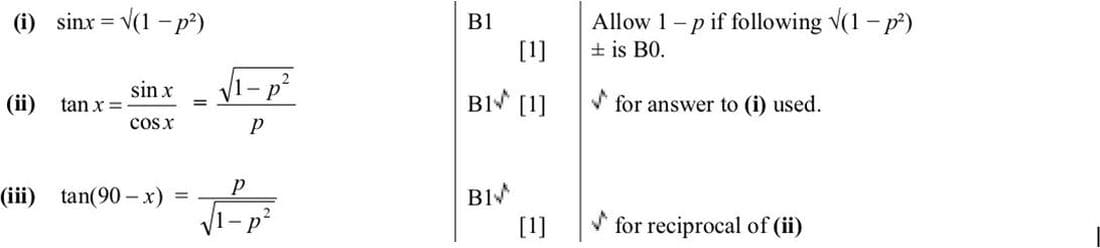
Given that \(\cos x = p\), where \(x\) is an acute angle in degrees, find, in terms of \(p\),
- \(\sin x\),
- \(\tan x\),
- \(\tan(90^\circ - x)\).
June 2013 p12 q5
584
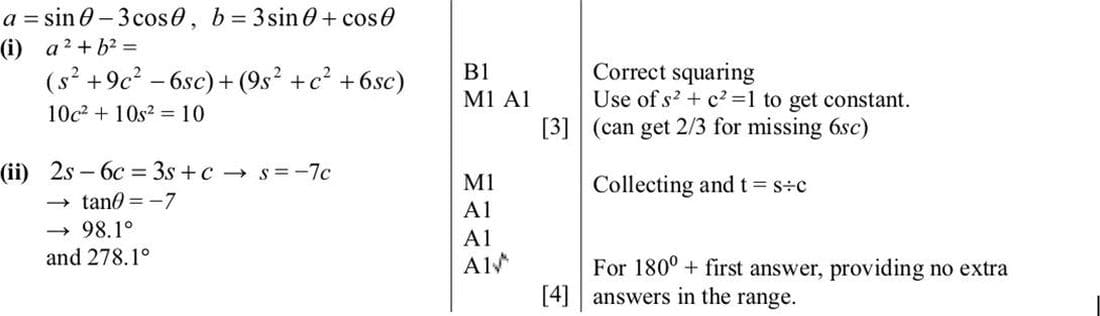
It is given that \(a = \\sin \theta - 3 \\cos \theta\) and \(b = 3 \\sin \theta + \\cos \theta\), where \(0^\circ \leq \theta \leq 360^\circ\).
(i) Show that \(a^2 + b^2\) has a constant value for all values of \(\theta\).
(ii) Find the values of \(\theta\) for which \(2a = b\).
Nov 2012 p13 q6
585
The functions f and g are defined for \(-\frac{1}{2}\pi \leq x \leq \frac{1}{2}\pi\) by
\(f(x) = \frac{1}{2}x + \frac{1}{6}\pi\),
\(g(x) = \cos x\).
Solve the following equations for \(-\frac{1}{2}\pi \leq x \leq \frac{1}{2}\pi\).
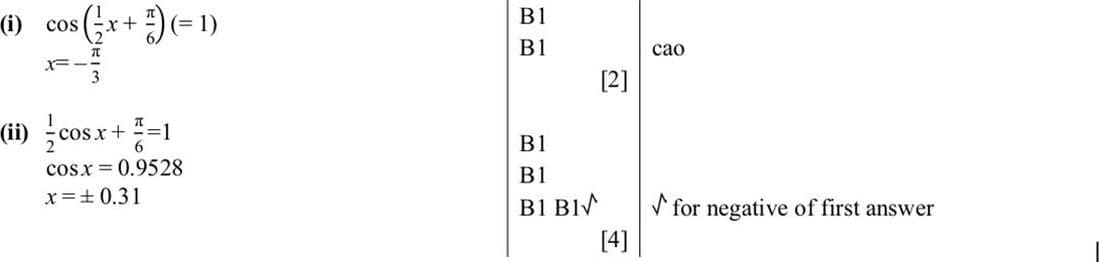
- \(gf(x) = 1\), giving your answer in terms of \(\pi\).
- \(fg(x) = 1\), giving your answers correct to 2 decimal places.