Exam-Style Problems
⬅ Back to SubchapterProblem 533
533
(i) Sketch, on the same diagram, the graphs of \(y = \sin x\) and \(y = \cos 2x\) for \(0^\circ \leq x \leq 180^\circ\).
(ii) Verify that \(x = 30^\circ\) is a root of the equation \(\sin x = \cos 2x\), and state the other root of this equation for which \(0^\circ \leq x \leq 180^\circ\).
(iii) Hence state the set of values of \(x\), for \(0^\circ \leq x \leq 180^\circ\), for which \(\sin x < \cos 2x\).

Problem 534
534
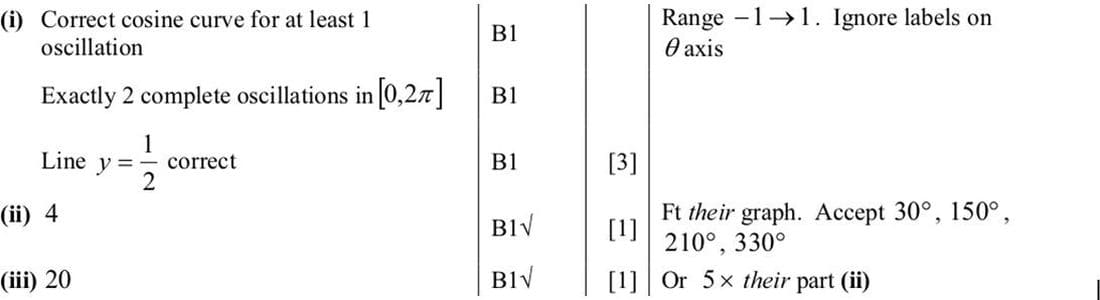
(i) Sketch, on a single diagram, the graphs of \(y = \cos 2\theta\) and \(y = \frac{1}{2}\) for \(0 \leq \theta \leq 2\pi\).
(ii) Write down the number of roots of the equation \(2\cos 2\theta - 1 = 0\) in the interval \(0 \leq \theta \leq 2\pi\).
(iii) Deduce the number of roots of the equation \(2\cos 2\theta - 1 = 0\) in the interval \(10\pi \leq \theta \leq 20\pi\).
Problem 535
535
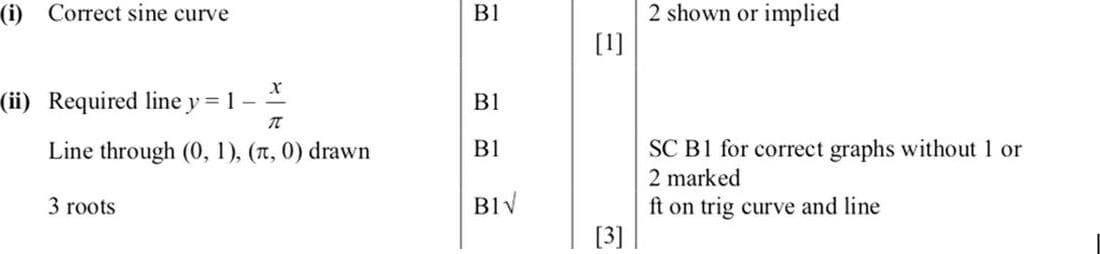
(i) Sketch the curve \(y = 2 \sin x\) for \(0 \leq x \leq 2\pi\).
(ii) By adding a suitable straight line to your sketch, determine the number of real roots of the equation \(2\pi \sin x = \pi - x\). State the equation of the straight line.
Problem 536
536
The equation of a curve is \(y = 3 \cos 2x\). The equation of a line is \(x + 2y = \pi\). On the same diagram, sketch the curve and the line for \(0 \leq x \leq \pi\).

Problem 537
537
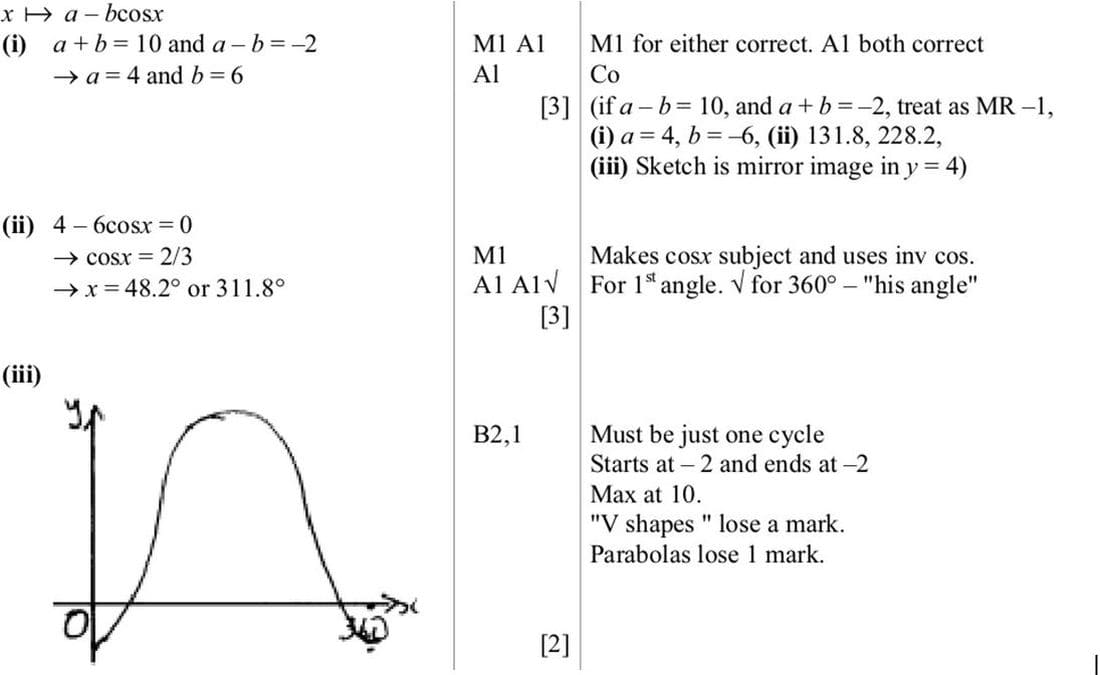
The function \(f\) is such that \(f(x) = a - b \cos x\) for \(0^\circ \leq x \leq 360^\circ\), where \(a\) and \(b\) are positive constants. The maximum value of \(f(x)\) is 10 and the minimum value is \(-2\).
- Find the values of \(a\) and \(b\).
- Solve the equation \(f(x) = 0\).
- Sketch the graph of \(y = f(x)\).