Exam-Style Problems
⬅ Back to SubchapterNov 2020 p12 q9
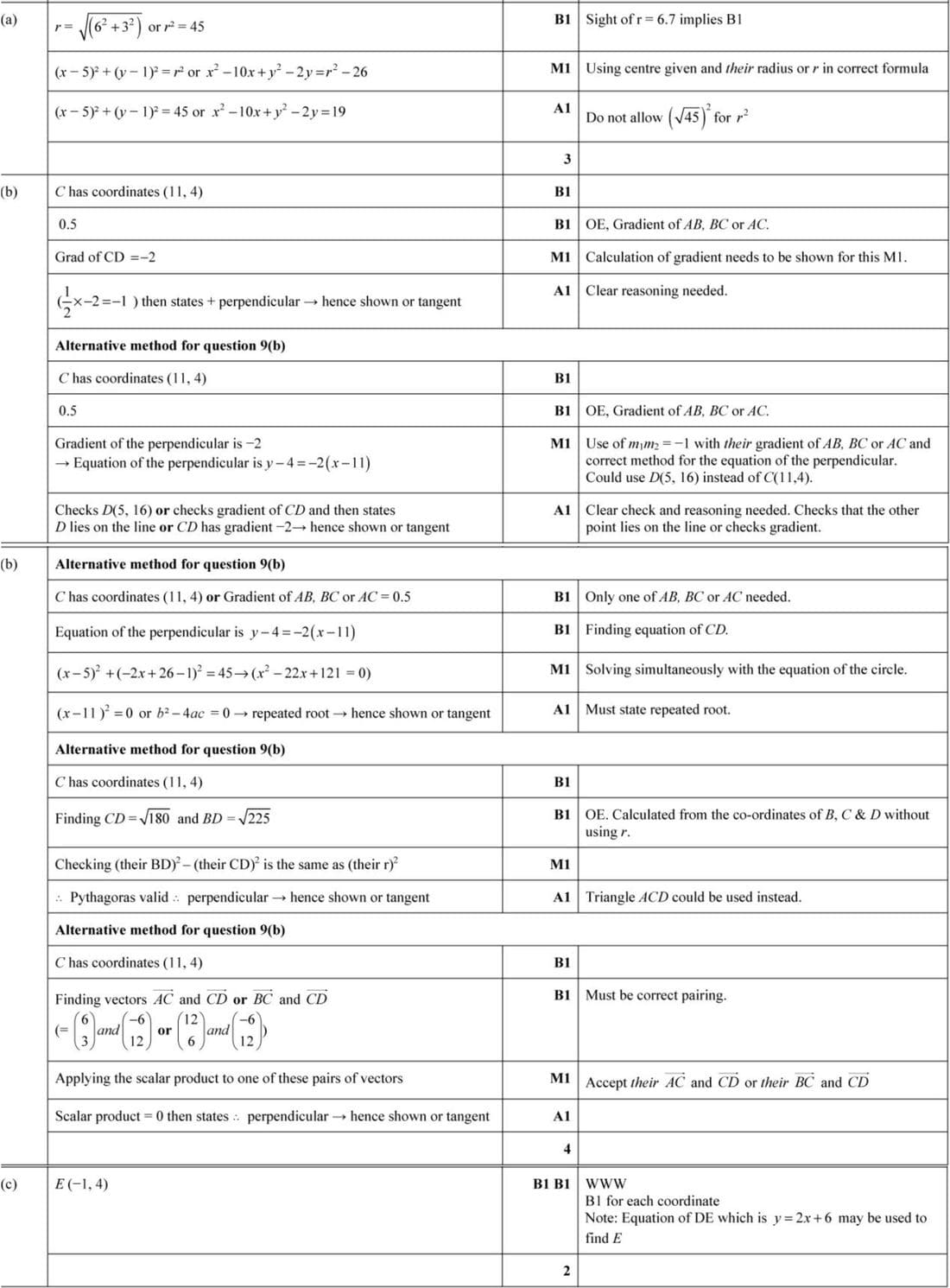
A circle has centre at the point \(B(5, 1)\). The point \(A(-1, -2)\) lies on the circle.
(a) Find the equation of the circle.
Point \(C\) is such that \(AC\) is a diameter of the circle. Point \(D\) has coordinates \((5, 16)\).
(b) Show that \(DC\) is a tangent to the circle.
The other tangent from \(D\) to the circle touches the circle at \(E\).
(c) Find the coordinates of \(E\).
Nov 2020 p11 q9
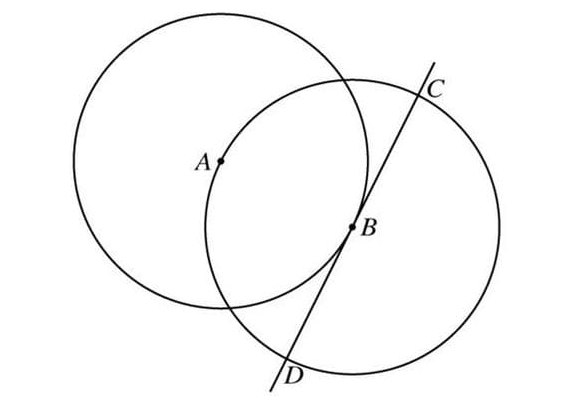
The diagram shows a circle with centre A passing through the point B. A second circle has centre B and passes through A. The tangent at B to the first circle intersects the second circle at C and D.
The coordinates of A are (-1, 4) and the coordinates of B are (3, 2).
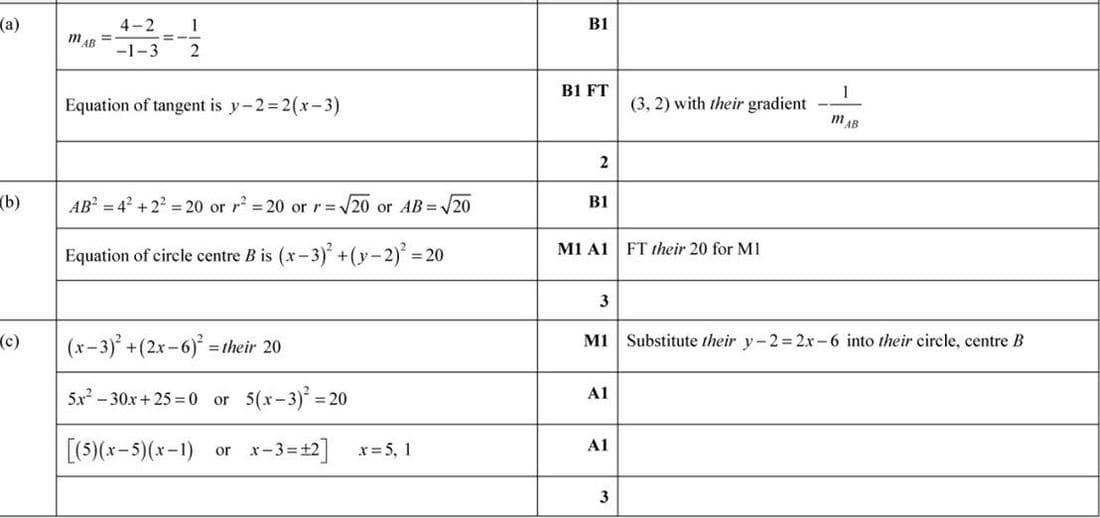
- Find the equation of the tangent CBD.
- Find an equation of the circle with centre B.
- Find, by calculation, the x-coordinates of C and D.
June 2020 p13 q10
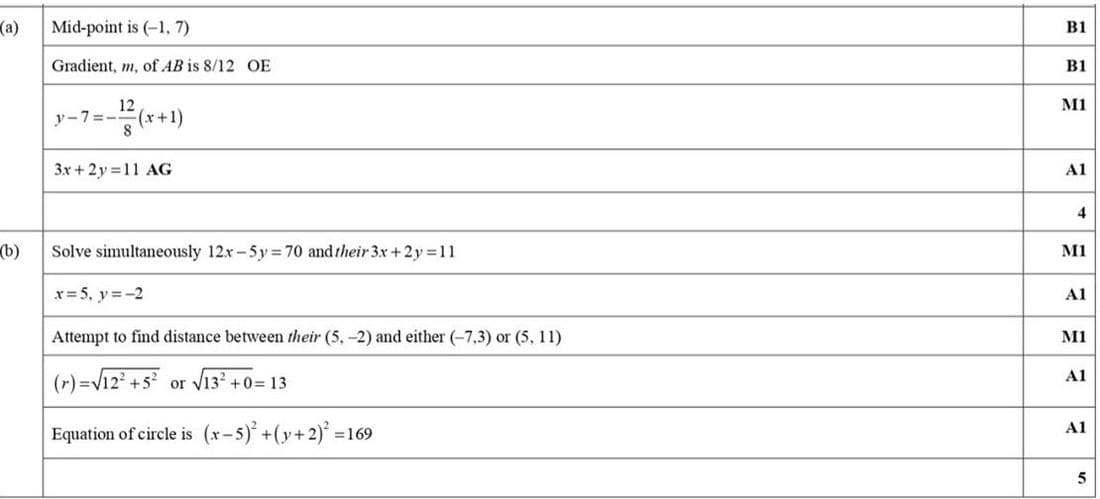
(a) The coordinates of two points A and B are \((-7, 3)\) and \((5, 11)\) respectively. Show that the equation of the perpendicular bisector of \(AB\) is \(3x + 2y = 11\).
(b) A circle passes through \(A\) and \(B\) and its centre lies on the line \(12x - 5y = 70\). Find an equation of the circle.
June 2020 p12 q11
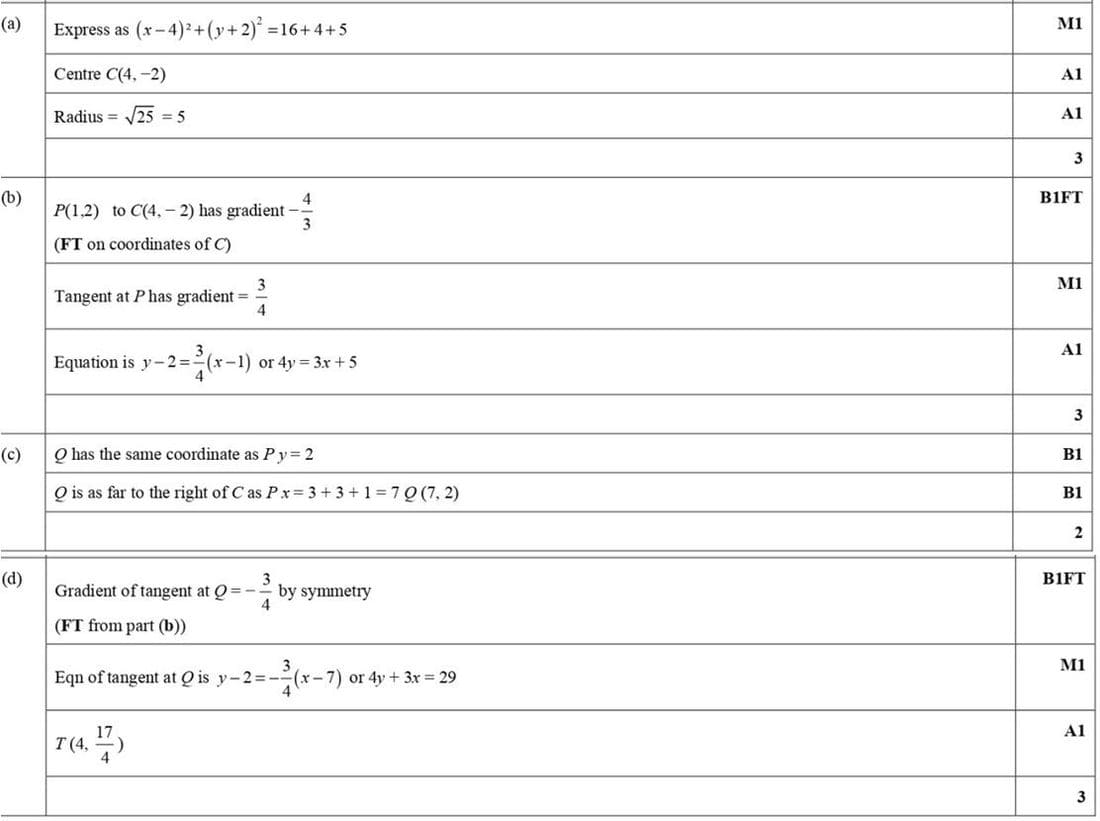
The equation of a circle with centre C is \(x^2 + y^2 - 8x + 4y - 5 = 0\).
(a) Find the radius of the circle and the coordinates of C.
The point P (1, 2) lies on the circle.
(b) Show that the equation of the tangent to the circle at P is \(4y = 3x + 5\).
The point Q also lies on the circle and PQ is parallel to the x-axis.
(c) Write down the coordinates of Q.
The tangents to the circle at P and Q meet at T.
(d) Find the coordinates of T.
June 2020 p11 q10
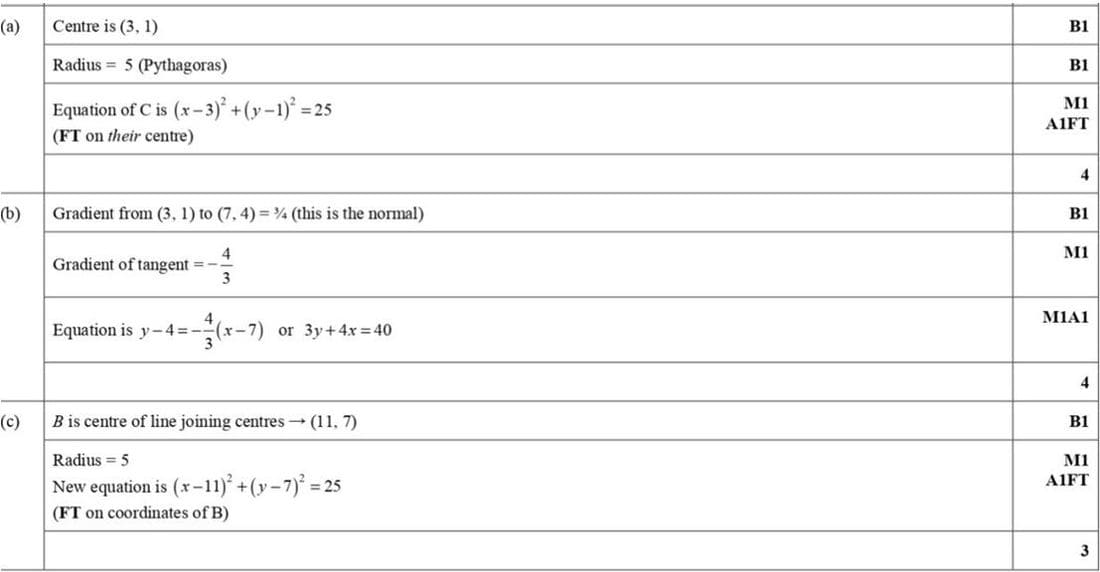
The coordinates of the points A and B are (-1, -2) and (7, 4) respectively.
(a) Find the equation of the circle, C, for which AB is a diameter.
(b) Find the equation of the tangent, T, to circle C at the point B.
(c) Find the equation of the circle which is the reflection of circle C in the line T.